36E (Eutelsat 36B)

POS TV (georgia)...11230 H 15000 3/5

Reception antenna WAVE FRONTIER 1 ... south west area (Oltenia/Romania) ...rain
 
sorry
 
Last edited:
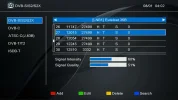
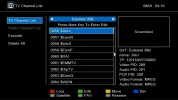
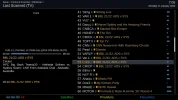
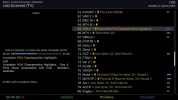
Some "fun" from DSTV Africa - subsaharan beam. Unfortunately fully encrypted but ... the lock is here!:cool:

12246.webp 12246d.webp 12246a.webp 12246b.webp
 
Check 12054V as well - it's just about lockable on my 1.8m here. All encrypted there as well though...
 
Thanks for the tip. However, no chance, I'm some 1700 km from you, whole different situation...
 
Couple of locks from the DSTV Sub Saharan beam today on the GTMedia v8 UHD receiver.

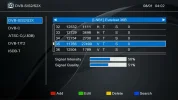
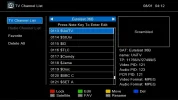
Pictured below are a few screen shots of the DSTV frequencies of 11766V and 12015H, both with SR of 27500.
Unfortunately, the GTMedia cannot pour any Poop from these due to the encryption.

Location: Surrey, UK

.
36.0E_20220116_11766V_SR27500_DSTV_SubSaharaBeam_p1.jpg 36.0E_20220116_11766V_SR27500_DSTV_SubSaharaBeam_p2.jpg 36.0E_20220116_12015H_SR27500_DSTV_SubSaharaBeam_p3.jpg 36.0E_20220116_12015H_SR27500_DSTV_SubSaharaBeam_p4.jpg
 
I have listed below a few more DSTV Sub Saharan beam frequencies to add to the list of those locked.
They were also locked in yesterdays scan but I did not include them with screen shots.

The new screen shot entries are for 11746 H, 12053 H and 12245 H ( pics attached)
The DSTV Sub Saharan frequencies locked so far are as follows:

11746 H, SR27500
11766 V, SR27500
12015 H, SR27500
12053 H, SR27500
12245 H, SR27500

Location: Surrey, UK

.
36.0E_20220117_11746H_SR27500_DSTV_SubSaharaBeam_p0.jpg 36.0E_20220117_12053H_SR27500_DSTV_SubSaharaBeam_p1.jpg 36.0E_20220117_12245H_SR27500_DSTV_SubSaharaBeam_p2.jpg
 
Last edited:
I have listed below a few more DSTV Sub Saharan beam frequencies to add to the list of those locked.
They were also locked in yesterdays scan but I did not include them with screen shots.

The new screen shot entries are for 11746 H, 12053 H and 12245 H ( pics attached)
The DSTV Sub Saharan frequencies locked so far are as follows:

11746 H, SR27500
11766 V, SR27500
12015 H, SR27500
12053 H, SR27500
12245 H, SR27500

Location: Surrey, UK

.
View attachment 140425 View attachment 140426 View attachment 140427

The difference between North and South again ..... M.B.

Out of the first 4 in your list only 11746 H, SR27500 shows around 2db of signal here, the others are barely a flicker,
12245 H, SR27500 does lock at 10.5 db ... different footprint ?
 
The difference between North and South again ..... M.B.

Out of the first 4 in your list only 11746 H, SR27500 shows around 2db of signal here, the others are barely a flicker,
12245 H, SR27500 does lock at 10.5 db ... different footprint ?


@nelson_b

Yes, I think it is the North/South divide again, those few hundred miles further North make quite a difference to the signal levels as the beam falls away.
I am not sure what is going on with 12245 H, SR27500 re the signal level. It is a lot stronger than any of the other DSTV signals from 36E.

The beams where I think the North might have the edge are for the Russian frequencies, especially the circular polarity ones from the two satellites co-located at 36E (35.9E and 36.1E)?
I might try out a dielectric plate in the feed or place an SMW Ku-Band polariser in line to see if I can get anywhere with the Russian frequencies.
 
@nelson_b

Yes, I think it is the North/South divide again, those few hundred miles further North make quite a difference to the signal levels as the beam falls away.
I am not sure what is going on with 12245 H, SR27500 re the signal level. It is a lot stronger than any of the other DSTV signals from 36E.

The beams where I think the North might have the edge are for the Russian frequencies, especially the circular polarity ones from the two satellites co-located at 36E (35.9E and 36.1E)?
I might try out a dielectric plate in the feed or place an SMW Ku-Band polariser in line to see if I can get anywhere with the Russian frequencies.

Satbeams lists a steerable beam ... that would make sense with that transponder at my location ...

As you probably remember i had a success some time ago with a couple of Russian circulars ... i have the sub reflector and feed on my setup currently - and it has a fixed / sealed cap so i cant quickly do a test on circular ... the last time i looked there - there was only one that locked for me ... others were (i think) affected / blocked by the Sub Saharan frequencies being the same.
 
Last edited:
I'm back :cool:

I inserted a Ku-Band polariser in line between the waveguide and the Invacom C120 LNB to have a look at the circular polarity signals from Eutelsat 36B.
The polariser was a Swedish Microwave XD12 unit.

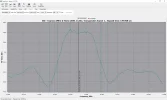
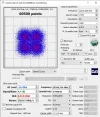
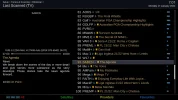
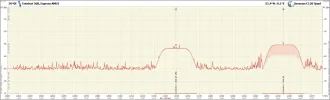
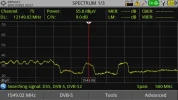
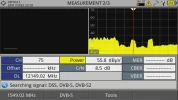
The experiment was with limited success as I only locked one circular polarity frequency at 12149 L, SR27500 using the IQMonitor tool.
In addition, the Promax meter was also able to detect the frequency at reasonable levels. It seems to be the Trikolor mux according to Flysat and Lyngsat?

I have attached a few screen shots below of the frequency as recorded in IQMonitor and the Promax meter.
Note: - IQMonitor records the signal as H polarity as it does not distinguish between H and L polarities. There seems to be no configuration option for circular polaritiy?

Location: Surrey, UK

.
36°0E_20220119_IQm_Spectrum_12000-12280 H.jpg 36°0E_2022019_IQm_Transponders.jpg 36.0E_20220120_PromaxSp_12149L_XD12.JPG 36.0E_20220120_PromaxMe_12149L_XD12.JPG
 
Last edited:
I'm back :cool:

I inserted a Ku-Band polariser in line between the waveguide and the Invacom C120 LNB to have a look at the circular polarity signals from Eutelsat 36B.
The polariser was a Swedish Microwave XD12 unit.

The experiment was with limited success as I only locked one circular polarity frequency at 12149 L, SR27500 using the IQMonitor tool.
In addition, the Promax meter was also able to detect the frequency at reasonable levels. It seems to be the Trikolor mux according to Flysat and Lyngsat?

I have attached a few screen shots below of the frequency as recorded in IQMonitor and the Promax meter.
Note: - IQMonitor records the signal as H polarity as it does not distinguish between H and L polarities. There seems to be no configuration option for circular polaritiy?

Location: Surrey, UK

.
View attachment 140481 View attachment 140482 View attachment 140483 View attachment 140484

Nice achievement @moonbase :)


That is the same solitary transponder that i was able to see when i last tried a couple of years back ... its remarkable to get anything at all from this beam. Can you see 56E with your current setup? there was 1 transponder on that sat that i once locked with 1.8 .. your 2.0 m may well receive more.
 
Can you remember which TP it was on 56e nelson, i'll have a poke around for it
 
Nice achievement @moonbase :)


That is the same solitary transponder that i was able to see when i last tried a couple of years back ... its remarkable to get anything at all from this beam. Can you see 56E with your current setup? there was 1 transponder on that sat that i once locked with 1.8 .. your 2.0 m may well receive more.


Yes, I can see 56.0 East, however, its probably close to my East limit on line of sight. I am not convinced I will have full illumination of the dish from 56.0 East
I will check it out when I get further round the arc. I might get bogged down on 38.0 East in C-Band before then.
It is only a couple of degree to the left of where I am now and it is beckoning...

Before then, I have a couple of circular polarity LNBF's that I am going to try out on 36.0 East.
They have different designs to the dielectric plate in them and both are different to the design of the plate in the Swedish Microwave XD12 polariser.
Perhaps the different plate design might give me a boost?

It is a balancing act with these fringe circular polarity signals.
You get some signal level increase by converting circular to linear polarity. However, you then lose signal level due to the impact of the plate in the feed partly blocking the signal.

If I could get my hands on a Ku-Band polo pipe that uses steps or ridges to convert circular to linear polarity instead of a dielectric plate I think I might have a little bit more success.
 
Yes, I can see 56.0 East, however, its probably close to my East limit on line of sight. I am not convinced I will have full illumination of the dish from 56.0 East
I will check it out when I get further round the arc. I might get bogged down on 38.0 East in C-Band before then.
It is only a couple of degree to the left of where I am now and it is beckoning...

Before then, I have a couple of circular polarity LNBF's that I am going to try out on 36.0 East.
They have different designs to the dielectric plate in them and both are different to the design of the plate in the Swedish Microwave XD12 polariser.
Perhaps the different plate design might give me a boost?

It is a balancing act with these fringe circular polarity signals.
You get some signal level increase by converting circular to linear polarity. However, you then lose signal level due to the impact of the plate in the feed partly blocking the signal.

If I could get my hands on a Ku-Band polo pipe that uses steps or ridges to convert circular to linear polarity instead of a dielectric plate I think I might have a little bit more success.
I've not seen a mechanical depolariser for Ku Band, but there is the IRTE 'fish fork' depolariser.
You could take one out of their PF scalar feed and install inside whatever you are using. Being perspex it had relatively low loss whilst retaining a high coefficient of permittivity.
 
Did somebody have reasonable success with the 'Frankenstein PCB' design at Ku band on here at some point ?
 
I've not seen a mechanical depolariser for Ku Band, but there is the IRTE 'fish fork' depolariser.
You could take one out of their PF scalar feed and install inside whatever you are using. Being perspex it had relatively low loss whilst retaining a high coefficient of permittivity.

Is or was there an official Channel Master polorising plate available for the 1.2 / 1.8 mtr CM feed to purchase ?
 
...but there is the IRTE 'fish fork' depolariser.
You could take one out of their PF scalar feed and install inside whatever you are using. Being perspex it had relatively low loss whilst retaining a high coefficient of permittivity.


Is "fish fork" the shape of the plate in the IRTE PF scalar feed?
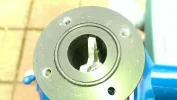
I have attached a picture below of the Swedish Microwave XD12 polariser, is the plate similar to the IRTE fish fork?

The part pictured below is currently inserted between the Precision C120 waveguide and the Invacom LNB

.
IMAG1581.webp
 
Back
Top