85.1W Sirius XM3

manugf

New Member
My Satellite Setup
110cm motorized, Toroidal T-90, 240cm C-Band
My Location
Spain
American SiriusXM satellite radio reception from the Northwest of Spain.
Receiver: Sirius Stratus 7
Antenna: SiriusXM NGVA3 magnetic antenna placed on a 1 meter offset dish.

Fairly stable reception of SiriusXM preview channel.


Attachments

  • 2022-06-29 15.12.28.webp
    2022-06-29 15.12.28.webp
    60.4 KB · Views: 44
  • 2022-06-29 15.11.49.webp
    2022-06-29 15.11.49.webp
    167.4 KB · Views: 42
Wow that is fantastic! According to Satbeams there is a spillover into Spain somehow. Is that what you were trying to verify?
I have a soft spot for SiriusXM, I subscribed while I lived in the US and have kept my account open, though streaming only this time!
 
Wow that is fantastic! According to Satbeams there is a spillover into Spain somehow. Is that what you were trying to verify?
I have a soft spot for SiriusXM, I subscribed while I lived in the US and have kept my account open, though streaming only this time!
Hi!
I've tried two different locations, both with successful results.

The first location on the seaside (Baiona, Galicia, Spain) and the second one in the countryside (Ponteareas, Galicia, Spain).

I also tried two different satellite offset dishes, 80cm and 100cm. According to satbeams page 65cm should be enough in my location, but not with my current equipment.
I would like to make an helical S-band antenna to improve reception as I believe the Sirius magnetic antenna is not giving the best performance fitted on a sat dish.
 
I wonder what the results would be with this indonesian DTH gear from MNC. You'd in fact need the LNB only and have it fitted properly to your antenna.
 
@manugf Very nice work, and the scenery. Here is a link to a helical calculator that I used: Antenas - Helicoidal simple - Calculadora Javascript

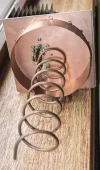
The pictures show the feed that I use on the Prodelin 3122 offset dish. Helices are fairly wide band antennas, this one was designed for 2250 centre but works reasonably well over a range of 1800-2500MHz (RHCP on dish). The helix was wound using 0.141" semi rigid cable. The foil near the feed point optimised the match. I use a Mini Circuits ZHL-1724HLN LNA as it has a very wide dynamic range and WiFi & cellular will easily overload lower power amplifiers. It's noise figure was measured in the region of 1.2dB. The output isolator reduces ripple.
 

Attachments

  • 2.2-2.3GHz_feed_DSC2317s.webp
    2.2-2.3GHz_feed_DSC2317s.webp
    173.2 KB · Views: 29
  • S-Band_feed+LNA_29-5-20xs.webp
    S-Band_feed+LNA_29-5-20xs.webp
    134.9 KB · Views: 29
Probably won't work well. SiriusXM uses 2320...2345 MHz, while SES-7 uses 2520...2670 MHz.

I'm a bit late in adding to this here, but another issue is that the Sirius XM satellite frequencies are being increasingly allocated for terrestrial mobile services across Europe, either Band 40 for 4G TDD LTE or Band n40 for 5G TDD NR (both a maximum 2300-2400 MHz spread). In the UK, O2 have spectrum rights between 2350-2390 MHz for most of GB (in use right now mainly for expanding capacity in urban areas), with the MoD retaining use of the rest of the band - in Northern Ireland & parts of the western islands of Scotland, the whole 100 MHz of the band remains in MoD use. Spectrum rights & use elsewhere will of course vary.

As it is, 85.1W is just a little below the horizon at my location (the western horizon limit is around 80-81W)
 
Back
Top