Amos reception

I need a beter LNB, this one is pretty good with only a 0.1dB noise rating. Maybe I need to tweak the skew a little bit more?
Eventually I'll get one of those nice LNBs with the feed horn and a long neck so i can play with the exact focal point of the dish (I might be a couple of cm too close at the minute).

thanks again
T

Edit:
Digging a bit deeper I see the transponders I have are on Amos 2 which has a footprint that covers my corner of the world, however, the other channels are on Amos 3 for which we're supposed to be completely out of the footprint. Therefore i conclude that I'm not going to get a signal on those with my current equipment and will wait until the financial controller gives me a little more hobby-money!
 
OK, Update....
I have installed the new actuator which is working a lot more acurately and quietly than the rusty old one. I used a magnetic spirit level and got the pole about an level as it can go. I slid the level around the circumference of the pole to ensure it was the same all the way around. However, whatever i do, i always seem to be aiming too high for Hotbird or too low for Amos.

To recap, I have to point the dish a bit higher to get Amos and point a bit lower to get hotbird. I did just find what appeared to be the centre then for some reason I just lost reception on everything! I wonder if several hours of tweaking just took its toll on some part of the system?

I'm wondering if it's something to do with the whole assembly or the installation of the actuator. is that possible?

One more question: how do I keep the wife enthusiatic about it all? :)

Tony
 
ok, what about satellites to the west. To isolate the problem you need to know what is happening on 3 satellites. Say, for example, 28ºE, 1ºW, & 30ºW.
 
TheToad said:
One more question: how do I keep the wife enthusiatic about it all? :)


Tricky ............ but how about buying her a new Ironing Board?
 
Ok, when the wife lets me have more play time I'll try and see what I can get.

In the meantime, some pics of the installation just in case there's something real obvious.

T
 

Attachments

  • 08072010083.webp
    08072010083.webp
    501 KB · Views: 44
  • 08072010084.webp
    08072010084.webp
    588.7 KB · Views: 39
Well that explains a lot then, your setup does not include a polar mount, it appears to be a fixed mount with the bolts loosened and is therefore not describing an arc in the sky. This explains why you are unable to track satellites on the arc. The dish is just moving left to right in a straight line. See my polar mount mechanism in picture
 

Attachments

  • DCP_0630.webp
    DCP_0630.webp
    130.7 KB · Views: 33
  • DCP_0631.webp
    DCP_0631.webp
    105.5 KB · Views: 34
Topper, I've seen a few mounts like that that work just fine, the problem I see with that one though is no declination adjustment.
 
There is nothing wrong with the mount, it needs a deep and level concrete base. :)

It is bound to be wobbling as it moves, and with the narrow beam width of the dish that is going to have an effect.

Tracking the arc with a narrow beam width dish is something of a compromise where the aim is for fine tuning on the most wanted weakest signal whilst still getting the other satellites that you want.
 
Declination is the jack screw/nut at the top of the mount from what I see. I think from Topper's profile it's fixed at this time, but in any case a good example of a well made mount.
 
satelliteman said:
Declination is the jack screw/nut at the top of the mount from what I see. I think from Topper's profile it's fixed at this time, but in any case a good example of a well made mount.
I think we are at cross purposes. I was talking about the mount in post #25. I can't see any declination adjustment there. Layout looks similar to a CM 1.2m polar mount, but without the declination adjuster on the top.
 
Declination adjustment is the bolt at the back, closest to the rear actuator bolt.
 
Huevos said:
I think we are at cross purposes. I was talking about the mount in post #25. I can't see any declination adjustment there. Layout looks similar to a CM 1.2m polar mount, but without the declination adjuster on the top.

Ah, apologies Huevos, must of incorrectly misread the post. See what you were referring to and would certainly echo re no declination adjustment on the mount. I can't see the bolt at the back mentioned above having any bearing on declination. In fact it looks like it locks the main polar axis angle in place. Of course it's difficult to see from only a photo.

The picture does seem to show some declination has been made by the design of the mount.
 

Attachments

  • 0807201008311.webp
    0807201008311.webp
    46.8 KB · Views: 39
satelliteman said:
See what you were referring to and would certainly echo re no declination adjustment on the mount. I can't see the bolt at the back mentioned above having any bearing on declination.
That's how I saw it too, and without adjustment there's only one chance of it being able to track the arc right. Since it is a high/low problem from one satellite to another, if the pole is plumb and the mount is facing south the only other problem that I can think of that would cause this is incorrect declination. To proove the point the OP needs to measure the angle of the polar axis (digital level needed).
 
That bolt on the back does indeed move the elevation of the dish (is that want you mean by declination?) I have to loosen the top of the 2 bolts on the mount for this rear bolt to move anything, then I tighten it up again to ensure it stays in place.

So what's the verdict? Do i need a whole new mount or just more accurate setting up in concrete?

Thanks
Tony
 
TheToad said:
That bolt on the back does indeed move the elevation of the dish (is that want you mean by declination?) I have to loosen the top of the 2 bolts on the mount for this rear bolt to move anything, then I tighten it up again to ensure it stays in place.

So what's the verdict? Do i need a whole new mount or just more accurate setting up in concrete?

Thanks
Tony

No, that sets the polar axis angle. There should be a declination adjustment at the front end to get her tracking spot on.
 
aha, sounds like I need a bit of a read-up on the terminology. I'll go searching :)
 
The declination offset adjustment tilts the dish forward or lowers the sight of the dish onto the arc. Should be around 7.5° for your location but will vary depending on latitude.
 
Yes I see now that it is a polar mount but indeed seems to have a fixed declination which unless you are on the exact location it was designed for could never track the arc correctly unless we are not being shown something relevant in the photographs,

@ satelliteman... indeed some now very rusty molegrips holding my dish on station, been too busy at work and doing DIY to get a new wiper motor :) I will be receiving a round tuit soon
 
Hi again,
I took a look at the assembly and did a little reading and I have a bit of a clearer idea of what you guys are talking about now. I got the dish from Leeds and I'm in Melton Mowbray which is almost precisely 1 degree difference in lattitude. From my understanding this relates to just a 0.12 degree difference in declination. Previously I had managed to get this dish to track properly by carefully adjusting the level of the base with wedges (ok pebbles) under each corner, maybe I was just very lucky.

I've tried to measure up and do some trig but I'm not exactly sure which measurements to take. Do I check from the rear of the dishmount to the centre of the bolts, or from the bolts to the rear of the 'upright' member'? Or somewhere else? If I can get the right measurements it's relatively simple to turn this into an angle and work out what I need to do.

many thanks

Tony
 
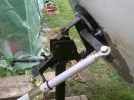
here's an image of the mount from the other side. You may also notice that the dish has warped a bit from the circular mount at the rear. I wonder how much of a difference this makes to the declination and if wedges in there would keep it more stable.
 

Attachments

  • 10072010085.webp
    10072010085.webp
    302 KB · Views: 28
Back
Top