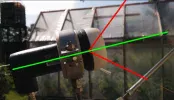
Antenna's focal point - "le point G"

RimaNTSS

Super Moderator
Staff member
My Satellite Setup
Some SAT-related hardware.
My Location
N-E from Riga
OK, here I would like to open discussion on finding focal point of offset antenna and proper direction of LNB placed ind that point. I see the need for this discussion cuz not every sat-user knows exact location of this mysterious point in sat system. Not everybody ever checked position of LNB , how it is located and where is pointing towards surface of antenna. I also think that not all antenna's producers made feedarms perfect to hold LNB in right point and direct them to the right direction. We all can check that on real dishes we have.
I do not think I can start from very beginning of theory, but would like to do job step-by-step.
So, first step would be to check weather dish is perfect shape. If it is warped than does not make sense to continue this dialog.
Check warpage is easy- just string (put threads) your dish vertically and horizontally. And only if vertical and horizontal threads are touching each other you can continue with finding focal point of antenna.
Be honest to yourself, even 1mm gap between strings is not good and make no sense to continue reading this thread. It is also advisable, if possible, to find out offset angle of your antenna provided by manufacturer, and also to get digital protractor (could also be analog) for future measurements.
Attaching picture of antenna I have with existing gap. This antenna will still work, but will newer bring you maximum result.

TBC
 

Attachments

  • P1310111 (Large).webp
    P1310111 (Large).webp
    40.4 KB · Views: 354
You can straighten warped dishes out. I straightened my 1.5m Gibby and the 90cm Fibo. They are likely not performing as they did new but not far off. No gaps between the strings any more. (you need to take the back Y bracket off the Fibo 90 to do it correctly)
 
I mean, dish should be straight, but if it is not straight lets not discuss how to make it perfect in shape, at least not in this thread. Here we will do some measurements on our existing dishes, and measurements will be correct only if dish is in perfect shape. Only then we will be able to calculate focal point. It does not make any sense to calculate focus of warped dish. Moreover, one of the measurements should be measured with very high precision and highly depend on antenna's perfect shape.
My picture in first post is just an example, and not perfect example. Threads I used are too thick. But even with thick threads it is obvious that there is gap between vertical and horizontal cottons.
 
I hope that at least somebody stringed his dish and found out whether it is good shape. My new Philips is not in ship-shape, so, there is gap between strings about 1mm. I will use this antenna just as an experimental in this topic. So, we stringed dish in such way that distances AC=CB=BD=DA. Where strings cross each other (hopefully they are slightly touching) we can mark point E
ScreenHunter_09 Sep. 14 10.26.webp
 
And it is needless to say that points ABCD should be marked not on the edge of the dish but were working surface starts.
If we draw line from E perpendicular to surface of antenna we can find point H. Some people think that LNB should be pointed to this point, but it is very wrong. H is not mysterious " le point G". H is not deepest antenna point as well, it is just geometrical center.
So, now we can start measuring. And we need to do only 3 measurements, all in mm. I will measure my antenna
- AB - 990
- CD- 910
- EH- 80 (ish, it is not easy to measure this distance).
EH should be measured as precisely as possible, with precision up to 0,1mm. To do it I got one instrument from PRC.
IMG_20140914_105921 (Medium).webp ScreenHunter_10 Sep. 14 11.01.webp
 
And it is needless to say that points ABCD should be marked not on the edge of the dish but were working surface starts.
If we draw line from E perpendicular to surface of antenna we can find point H. Some people think that LNB should be pointed to this point, but it is very wrong. H is not mysterious " le point G". H is not deepest antenna point as well, it is just geometrical center.
So, now we can start measuring. And we need to do only 3 measurements, all in mm. I will measure my antenna
- AB - 990
- CD- 910
- EH- 80 (ish, it is not easy to measure this distance).
EH should be measured as precisely as possible, with precision up to 0,1mm. To do it I got one instrument from PRC.
View attachment 68013 View attachment 68012
Is EH the distance (gap) from lines to dish face?
 
Those, interested in continuation, can post their measurements... only 3 numbers. And from those 3 numbers we will later calculate position of Focus, offset angle of antenna and also "le point G".
 
And now the hardest part starts: There is one sat-specialist on Russian-speaking part of the world, he made program Parabola4, but program on Cyrillic and not all characters appear correctly on PCs that do not have Cyrillic setup.
Program you can download HERE. Later I will explain how to use it, and, of course will inform owner of software if you like it.
 
Those, interested in continuation, can post their measurements... only 3 numbers. And from those 3 numbers we will later calculate position of Focus, offset angle of antenna and also "le point G".

Putting in 'le point G' into Google brings up a long list of interesting images
 
After downloading and opening Parabola4 you will see approximately something like attached. Insert your 3 measurements in windows circled green. Push button "1" and then look in purple circle for two numbers, first (biggest one) is distance from A to Focus, and second shows distance from B to Focus. Then push button "2" and look for GB number (I circled it blue). For my antenna GB=407 means distance from B til "le point G".
ScreenHunter_11 Sep. 14 13.51.webp ScreenHunter_12 Sep. 14 14.03.webp
So, now we know how to calculate Focus and aiming point.
Ha ha: I know what usual people (not SAT-fans) mean by "le point G" :-doh
 
If everybody is comfortable with it, someday we can discuss ways how to practically check and adjust LNB's position to get maximum of your antenna.
 
"Le Point G"?....."getting the maximum out of your antenna"?........is this "Carry On Satellite"?......:-rofl2
 
""" So, now we know how to calculate Focus and aiming point. ""

All well and good in theory, question is how do you get a blind lnb to target the g on the dish?

Ok you can modify a spare lnb with a laser pointer ( as I did ) to get closest to the g.

Have all offset lnbs the same wave guides?

After modifying the lnb holder still had to fine tune and tweak the actual lnb used for max qual. signal.

As stated before not technically proficient but good with logic.

Sorry if stupid question.

Regards
 
Thanks for the questions. They are really great!
how do you get a blind lnb to target the g on the dish?
For example using such a device AdapterLazer.webp instead of LNB. After holder is adjusted, just place LNB in it.
After modifying the lnb holder still had to fine tune and tweak the actual lnb used for max qual. signal.
After inserting LNB (make sure LNB's focus is in the exactly same place as antenna's focus) you only need to adjust skew, but maximum signal should be adjusted by antenna's elevation.
 
Another method to check whether LNB is pointing to G could probably be- making nice picture of your installation and then draw couple of lines directly on the picture: Angle between red lines will be equal to antenna's opening angle. Green line should be dividing that angle exactly in the middle. ScreenHunter_14 Sep. 14 21.43.webp
 
53787-2a9295f399822d9426a3472701ee6a2b.jpg


Was this custom made for the purpose of lining up lnbs to target point on dish?

Looks like a heath robinson device, laser pointer inserted in a collar with same dimensions as a lnb.

Many variables here laser pointers are notorious for not having a true exit beam and does it have a snug fit in the collar,, 1 mm at source can give false reading even at so short distance.

Excuse my silly questions.

Regards

""" IMPORTANT: prior to mounting the laser pointer, you should check if the laser beam doesn't have a lateral deviation. Put the laser pointer on a flat surface (e.g. table) and point the laser beam at a wall which is +/- 5 m away. Now slowly roll the pointer around it's axe (without moving it sidewards!). The red laser spot at the wall should not move. If it does move (or describes a small circle), then the laser beam is not correctly aligned with the body of the pen.

Link http://www.scavalon.be/avalonuk/technical/laserclino.htm
 
Last edited:
Yes, of course, that was made for one purpose- lining up LNBs ;)
Nothing and nobody is perfect! Laser pointers are made to be used during PPT presentations and does not require beam to be parallel to body. I did think that more expensive laser pointer from Velleman components will be different, but it was not perfect as well. I did tests at distance almost 2 meters, and turning pointer around laser beam made circle about 4cm in diameter. P1300736 (Large).webp
After some research, I decided to get from China Boresighter for rifles. It is on the way already. I think it will be much better than usual laser-pointer. ScreenHunter_15 Sep. 14 22.39.webp
 
Back
Top