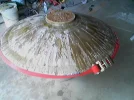
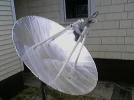
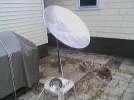
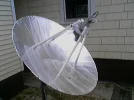
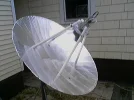
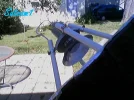
Anyone tried to make BIG dish at home?

Nice work Satcom! Very inventive. But is your cloth/resin method not easier?
Satcom1 said:
I would like to make a good performing 1.2M dish for very little money. One that uses common materials that are easy to get and tools that are simple and available most anywhere. :toke:

This dish is formed from a 1/8" X 4'X4' sheet of pressboard (Masonite) or 1/4" Acrylic or Galvinized sheet metal.

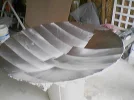
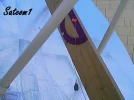
Five concentric circles divide the sheet and radial lines are marked off. See Pics. Then with a circular saw or table saw, the radials are cut. Placed over a garbage can the weight alone is enough to form the dish.

Fast drying tile mastic is rubbed into the radials and left to dry overnite. The interior dish surface is painted with 4 cans of Rust Oleum Galvinizing paint. The tape holds the dish to a parabolic shape until the mastic sets. :cool:
 
sycron said:
Nice work Satcom! Very inventive. But is your cloth/resin method not easier?

I have made two precision parabolic dishes using the cloth/resin method. They are excellent dishes. They do take alot more work and money. But far less then a consumer grade dish.

I like to take an idea to it's simplest form and yet get good results. To me simple is beautiful, the best form of creation.

For C-Band this dish should work pretty good, I expect I'll get some KU but the precision dishes are excellent with KU.

Actually, your dish inspired me for this project. :-worship
 
In an attempt to make this dish as simple as possible, I decided to go with aluminum foil rather then the expensive Rust Oleum Galvinizing paint.

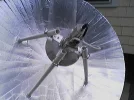
I also found that pulling the dish into shape with a web belt is better then tape. The dish is 45 1/2" Dia. by 7" deep and has a F/D of 18 1/2"

I am following Divibi's rule of 1mm for KU and 5mm for C Band dish surface variation. I'm within the KU spec on 90% of the 1.18M dish.

Todays Pics, enjoy:cool:
 

Attachments

  • 665A0470.webp
    665A0470.webp
    45.3 KB · Views: 193
  • 665A0472.webp
    665A0472.webp
    27.8 KB · Views: 192
Just don't melt the LNB
 
Satcom1 said:
In an attempt to make this dish as simple as possible, I decided to go with aluminum foil rather then the expensive Rust Oleum Galvinizing paint.

I also found that pulling the dish into shape with a web belt is better then tape. The dish is 45 1/2" Dia. by 7" deep and has a F/D of 18 1/2"

I am following Divibi's rule of 1mm for KU and 5mm for C Band dish surface variation. I'm within the KU spec on 90% of the 1.18M dish.

Todays Pics, enjoy:cool:

The dish looks great

Good work Satcom1, but how will you put the lnb on to this dish please share the snap of the LNB holder and where you install that.
 
Moradabad said:
The dish looks great

Good work Satcom1, but how will you put the lnb on to this dish please share the snap of the LNB holder and where you install that.

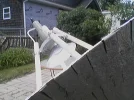
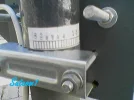
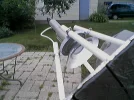
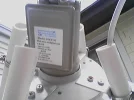
I just used PVC plumbing parts and some nuts and bolts.

From the Parabolic Dish Calculater I downloaded from the web, the F/D was calculated at 18 1/2" and I set the lnbf to that and made the PVC pipes 23" to allow for adjustment. Didn't need to adjust, just set the lnbf lens opening at F/D and got strong signal.:cool:
 

Attachments

  • 665A0480.webp
    665A0480.webp
    72.4 KB · Views: 192
  • 665A0479.webp
    665A0479.webp
    52.7 KB · Views: 184
  • 665A0478.webp
    665A0478.webp
    34.9 KB · Views: 217
  • 665A0477.webp
    665A0477.webp
    40.3 KB · Views: 180
Low Profile said:
Just don't melt the LNB

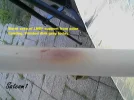
This time of the year sun is a little higher then the satellite arc so lnbf is safe. However, one of the PVC legs is getting hot enough to melt, i'll spray paint the foil.:)
 
Using the Walrus1957 Scalar Cones is highly recommended on a Prime Focus dish, the flat Scalar ring is pretty much useless on a small dish.

Even though this is a 1.18M dish it produces a stronger signal and captures many more channels then the Fresnel Dish.

The only useable channels were special test channels. Although I received many channels both C Band and KU with very strong SQ, none of them were useable.

To my mind the reason for this is that DVB signal must be exactly same time received at lnbf from all parts of dish. If not then data is corrupted. Also unusual Symbol Rates will fail much more often.:confused:

The "Divibi Rule" of 1mm precision for parabola applies to both C and KU Bands. This for any DVB channel. Analog or test channels not so much.
A flat plate developed into a parabola just won't work. A segmented dish won't work.:-Nooo

The dish produced with the casting table method works best if one were to attempt to make their own dish. Also constructing a frame of PVC pipes bowed to a parabola and then covered with aluminum mesh might make a useable dish, if great care is taken.
But that is for some other time.;)
 

Attachments

  • 665A0478.webp
    665A0478.webp
    34.9 KB · Views: 77
Satcom1 said:
Using the Walrus1957 Scalar Cones is highly recommended on a Prime Focus dish, the flat Scalar ring is pretty much useless on a small dish.

Even though this is a 1.18M dish it produces a stronger signal and captures many more channels then the Fresnel Dish.

The only useable channels were special test channels. Although I received many channels both C Band and KU with very strong SQ, none of them were useable.

To my mind the reason for this is that DVB signal must be exactly same time received at lnbf from all parts of dish. If not then data is corrupted. Also unusual Symbol Rates will fail much more often.:confused:

The "Divibi Rule" of 1mm precision for parabola applies to both C and KU Bands. This for any DVB channel. Analog or test channels not so much.
A flat plate developed into a parabola just won't work. A segmented dish won't work.:-Nooo

The dish produced with the casting table method works best if one were to attempt to make their own dish. Also constructing a frame of PVC pipes bowed to a parabola and then covered with aluminum mesh might make a useable dish, if great care is taken.
But that is for some other time.;)


Satcom1 thanks for wonderful snaps, so are you able to get each and every channel with clear picture or you are getting picture freezing .
 
Moradabad said:
Satcom1 thanks for wonderful snaps, so are you able to get each and every channel with clear picture or you are getting picture freezing .


On my Coolsat 6000 Premium receiver I have scanned and recovered several channels. On my Diamond 9000HD receiver I scan and receive fewer channels and that means to me the the Coolsat has a more sensative or is otherwise able to produce a better digital picture.

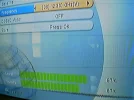
There are channels that are testing a new DVB signal and those all come in rock solid. Others have some pixelating and some have diagonal lines and no useable video but have audio. It seems to me that if the dish surface was perfectly smooth the DVB signals would be better. Many channels are 64% SQ show in the green but will not produce channel scan results. I get NHK Japanese channels on PAS 9 satellite at 59 - 61% and have rock solid video. That satellite (58W) is far to my east, my true south satellite is 89w degrees. All my other satellites are in a more congested area of the Clarke Belt.

On this dish, I have decided to use a screed blade and fill the surface about 10CM layer of some material like Plaster of Paris and then screed it to a better Parabola shape. :eek:

All suggestions about what material or method to use will be appreciated. Here is a picture of the dish. The variations in surface are no more than 3 mm.
 

Attachments

  • 665A0478.webp
    665A0478.webp
    34.9 KB · Views: 68
Well, If you want to receive some of the stronger channels and don't have much $ but have some carpentry skills, make one of these.

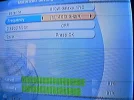
I have a Primestar 1.0m X 0.7m dish (see avitar) on a motor and receive this channel at SQ 63 to 66. This homade dish receives the same channel at a very solid SQ of 87.:-omg

Here are some Pics::-pointr
 

Attachments

  • 665A0535.webp
    665A0535.webp
    49.8 KB · Views: 137
  • 665A0529.webp
    665A0529.webp
    46.8 KB · Views: 143
  • 665A0527.webp
    665A0527.webp
    27.5 KB · Views: 134
  • 665A0526.webp
    665A0526.webp
    27.8 KB · Views: 135
This semi-parabolic dish may make a high gain fringe HDTV ATSC antenna. :)
Think of the WiFi you could haul in with this.:cool:
 
Decided to revisit KU on this dish and a different satellite. I've selected the WSI DMX741 C/KU LNBF with 22Khz switching. In testing the C Band is just as good as the BSC421 17K LNBF which is also as good as the Panorama 17K LNBF. They are all performing well on this dish for C Band.

The KU portion of this LNBF is kinda a compromise in performance. Having said that, the results are pretty good. This dish even with it's imperfections produces a strong KU signal. It produces the same signal as a 0.3dB N/F KU LNBF on a 76cm Winegard dish. :cool:

Here are todays Pics. :-pointr
 

Attachments

  • 665A0541.webp
    665A0541.webp
    45.2 KB · Views: 97
  • 665A0542.webp
    665A0542.webp
    51.7 KB · Views: 83
  • 665A0543.webp
    665A0543.webp
    25.4 KB · Views: 91
  • 665A0546.webp
    665A0546.webp
    46.2 KB · Views: 85
Both of the lower LNBF arms got so hot they softened and bent.)(-red
 

Attachments

  • BurntDishArm.webp
    BurntDishArm.webp
    43.1 KB · Views: 107
This is a very interesting thread.

I wonder if anyone has ever considered making a 'virtual' large dish from several dirt cheap 60cm ones ? They would have to be paralelled up and all mounted on a single frame that you then steer as required.

The tricky bit would be coupling them all to a feedline, retaining phase and impedence, but I bet there is a way to do it without too much maths :)

GB.
 
That's a really nice idea, but I don't think it would work in practice since the 60 cm dishes used would all be of the same part of the parabola (assuming they are all the same make/model). The dishes at the edge, furthest from the LNB, would need a smaller curvature to focus the signal properly.

(Imagine each of your 60 cm dishes still has its own LNB temporarily attached while you try to put the dishes together somehow. I am not sure how you would align the dishes in a large parabolic frame with all the LNBs coinciding at a common focus.)

Jez
 
Hi Jez,

Hmm, no I was thinking of mounting them all parallel and using them c/w their lnbs. A kind of co-phased array. Phasing them with minimal loss would be just one of the problems to be tackled. It certainly should be cheap though !

As to gain, by comparison, the area of a 60cm dish is about 0.28m2 compared with the approx 1.1m2 of a 1.2m dish. This implies that if you can couple them efficiently it would need 4 small dishes to make a 1.2m equivalent dish.

7 small dishes would 'stack' well together with min wasted space and could theoretically provide the equivalent of a nearly 1.6m dish !

Gb
 
Certainly not wishing to diminish your enthuiasm however it is a well known fact that the cost of the electronics involved to match the signals to produce a better quality signal (since strength is not the required result here) would outweigh the cost of a single larger dish. It it were possible people would have been doing this 20 years ago. I grant you that the cost of electronics and the speed of processing by the electronics may have increased over the years but I sincerely doubt the viability before you begin.

What is true is that the type of dish farm samcruise envisages actually already exists but in the production of electricity from solar energy


A big array with a collection tower in Spain

_http://www.metaefficient.com/images/15.jpg
_http://www.metaefficient.com/images/solucar_solar_tower.jpg

A single dish collector in USA

_http://www.sandia.gov/news-center/news-releases/2004/images/jpg/solar-talk.jpg
 
In fact, looking into this further, the real killer is that the LOs of all the LNBs won't be locked to each other, introducing unacceptable distortion unless a common LO is used and its signal distributed amongst the array... :-DOH2

There is a really good explanation of the issues here:...
h**p://www.vetrun.com/forums/showthread.php?t=6085&highlight=combining+dishes

Ok, I accept it's a no-brainer.

G
 
Back
Top