Anyone tried to make BIG dish at home?

Satcom1 said:
Everyone having said that, does it really need to be that accurate? A lot of the steel stamped dishes claim surfaces +- .020" but when you run strings across the face, the dish is often warped.

There are many BUD's here "Big Ugly Dish" that have hail stone damage but still do a good job.

The solid surface dish versus the mesh dish only produces mild improvements.

Hi:)
I don't know exactly but I read that commercial quality dishes are 1mm accurate and if you self build a ku-band dish over 1,80m you have to keep it to a millimeter, or else for example your 6m homebrew dish will only work as a 2m one and similar horror stories:eek:
 
Satcom1 said:
Everyone having said that, does it really need to be that accurate? A lot of the steel stamped dishes claim surfaces +- .020" but when you run strings across the face, the dish is often warped.

There are many BUD's here "Big Ugly Dish" that have hail stone damage but still do a good job.

The solid surface dish versus the mesh dish only produces mild improvements.

Today i was thinking the same...at 12.75Ghz the accuracy should be high...but 1mm accuracy? i think that 1mm accuracy should be for frequencies that wavelenght become smaller, like 10/15mm..

divibi said:
Hey guys,

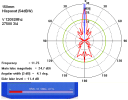
Is it possible to use a conical horn antenna in place of a feed+LNB in the focal point of a prime focus dish???

It wont do any good...you can add a conical horn of 26dBi and you use it on your dish..that the gain of the dish will be the same. I never did that..but in simulation the gain of the dish is still the same.


Today i´ve tested a antenna that i´m working...the efficiency of the antenna in theory is 85% (for 11.75Ghz), i build it...but it only gave me 21% of signal (the receiver only starts to show signal received at 12%). Using a Conical Horn with 24.5dBi i have >50%, which is enough to see channel´s...bad results:-Nooo
 

Attachments

  • 1gif.GIF
    1gif.GIF
    15.7 KB · Views: 179
Guys, let's clarify several things:

1. BUD's were made for C-Band, where's lower precision is needed. And they were made so big, because of poor signal. So fact that they perform well today, is related to fact, that power of satellites, and quality of LNB's increased, not just BUD is so excellent.

2. Cheap steel dishes are cheap, but they at least have parabolic shape, which may be hard to achieve at home.
 
BombedOne said:
Guys, let's clarify several things:
2. Cheap steel dishes are cheap, but they at least have parabolic shape, which may be hard to achieve at home.

Hi there!:)

Yes, the commercial dish antenna manufacturers must be doing something right. Them and... Klaus Schumacher in Brazil. Mr Schumacher used concrete to make a NEGATIVE! (less precise than positive???) mould. Next "the segments of the reflector were then placed inside, whilst keeping in mind the accuracy needed for ku-band reception" It sounds so simple, but the devil is in the detail. I don't know how he made it, don't know what panels those are, but he made it. He knows athing or two about precision.

Lastly, do know you how SPUN ALUMINIUM dishes are manufactured or need I not ask?;)
 
divibi said:
Hi there!:)

Yes, the commercial dish antenna manufacturers must be doing something right. Them and... Klaus Schumacher in Brazil. Mr Schumacher used concrete to make a NEGATIVE! (less precise than positive???) mould. Next "the segments of the reflector were then placed inside, whilst keeping in mind the accuracy needed for ku-band reception" It sounds so simple, but the devil is in the detail. I don't know how he made it, don't know what panels those are, but he made it. He knows athing or two about precision.

Lastly, do know you how SPUN ALUMINIUM dishes are manufactured or need I not ask?;)

I hope you have had the pleasure of viewing DVD "Christmas Vacation" which is now a classic movie in USA. When it was made there was a very popular craze here, like the "Hoola Hoop" It was a spun aluminum dish that was used as a downhill snow sled. If one could find one today it would likely make a pretty good 1 meter dish. :-rofl2

It is interesting that old Channel Master 1 meter dishes (offset round) have been proven to perform as well as many 1.2 meter steel dishes and some 1.8 meter dishes. This dish is only available here to commercial accounts for POS terminals, what a shame. These Channel Master dishes are molded fiberglass and little is known as to why they perform so well. Mike Kohl has a website that has data on these dishes.:cool:
 
This idea has been running through my head for several days now. I put the right words into the search engine and came up with this simple to make dish. It is more Fresnel lens then Parabolic dish and does not require a precision parabola.

Made from one 4' X4' sheet of masonite and a roll of metalized Mylar.

I will use this as a prime focus C-Band experiment. The center hole in the lens is shadowed by the LNBF and Scalar Ring. It also provides some wind relief. :cool:
 
Satcom1 said:
This idea has been running through my head for several days now. I put the right words into the search engine and came up with this simple to make dish. It is more Fresnel lens then Parabolic dish and does not require a precision parabola.

Made from one 4' X4' sheet of masonite and a roll of metalized Mylar.

I will use this as a prime focus C-Band experiment. The center hole in the lens is shadowed by the LNBF and Scalar Ring. It also provides some wind relief. :cool:


Can you explain the measures of the antenna, i will try to simulate one and see how the antenna perform..
 
Construction:

mark the masonite sheet as shown. Starting with the outermost radius cut out the three rings and the gap in each ring. Also make the short radial cuts in the outermost ring. (These act to equalise the curvature when the ring is bent to form a conic section.) Also cut out the three 'joiners' as shown. A hacksaw blade is good for cutting masonite. Finally, smooth all edges with a file.

By bringing together the edges of the gap in each ring, a conic section is formed. The 'joiners' are used to hold the edges together. Glue each joiner to one side of the gap (rough surfaces together). When dry, glue the other side of the gap and joiner, bend the ring to match up the two gap edges and clamp between two blocks of wood until dry as shown. As elsewhere, this construction is easier to do with two people. Glue all three rings this way
 
Satcom1 said:
I hope you have had the pleasure of viewing DVD "Christmas Vacation" which is now a classic movie in USA. When it was made there was a very popular craze here, like the "Hoola Hoop" It was a spun aluminum dish that was used as a downhill snow sled. If one could find one today it would likely make a pretty good 1 meter dish. :-rofl2

It is interesting that old Channel Master 1 meter dishes (offset round) have been proven to perform as well as many 1.2 meter steel dishes and some 1.8 meter dishes. This dish is only available here to commercial accounts for POS terminals, what a shame. These Channel Master dishes are molded fiberglass and little is known as to why they perform so well. Mike Kohl has a website that has data on these dishes.:cool:

Hi:)

I love that movie and I like Chevy Chase comedies:-rofl2
1m Channel Master offset dish is really some very fine ku-band suitable mesh dish encapsulated in fiberglass or plastic of some kind. It has a very good shape and doesn't lose it! Does it have a secondary reflector ( is it dual-optics?) because if so, then it's 15 to 20% better than 1m normal offset and it would perform like 1,2m, anyway.
 
Satcom1 said:
came up with this simple to make dish. It is more Fresnel lens then Parabolic dish and does not require a precision parabola.

:-worship I WANT TO BELIEVE:-worship:) And I'm keeping your word for that:) Does it really NOT REQUIRE fantastic precision in ku-band?
 
divibi said:
:-worship I WANT TO BELIEVE:-worship:) And I'm keeping your word for that:) Does it really NOT REQUIRE fantastic precision in ku-band?

divibi- Don't really know as of yet how it will perform, That is the interesting part of this hobby for me. :)

Today work started on my Fresnel Dish. :D

Cut a 4' X 8' sheet of 1/4" pressed board in half and did the layout as described in diagram above. I went to the hardware store and got a 4' X 4' piece of aluminum "bug screen" mesh.

The f/d for the dish is about 71.2 cm and at that f/d the beam is concentrated from just over one square meter to 17 cm. Just about right for a C-BAND LNBF, with Scalar ring.

The 1 meter Channel Masters are being used by some here as C/KU dishes with the BSC621 LNBF. Very good KU reception and fair C-band with maybe 40 channel of C-band.
 
@Satcom1 , can you give the radius and depth for each ring?
 
casser said:
@Satcom1 , can you give the radius and depth for each ring?


Had the dish rings built and set it on the patio to assemble the rings into one dish. Sun melted the hot glue and everything came apart. :-DOH2

Contact cement and a second person is the best way to assemble the rings. Because I used 1/4" material versus "Masonite" which is almost 3/16" the rings are very hard to bring together. However, the assembled dish will be much stronger. :cool:

Casser-

The rings shoud be ready to assemble in two days and then I will be able to give you the dimensions.

The next one I build will use metal joinery straps bent to match conix and SS screws.
 
Satcom1 said:
Casser-

The rings shoud be ready to assemble in two days and then I will be able to give you the dimensions.

The dimensions was to simulate the antenna, but 1.20m is too big..the simulation would take +-5hour´s. I will try with smaller dimensions.

For me the most annoying part of homemade antennas is the LNB in the correct focal point..we build the support for a certain distance, but if is not the correct place, some hour´s are lost just to find the FC and then rebuild the support! that´s why i dont like homemade parabolic dish:p


When the antenna is finnished, post some pictures and result´s:)
 
These pictures are after I got the hot glue cleaned off and applied the aluminum mesh to the rings. I then glued and clamped them back into cones. They will have to dry overnight and then I will assemble them into the dish. You may be able to see in the picture of the smallest ring, I just continued the mesh over the opening. By rubbing it with a cloth it formed a parabola shape.

I had the idea of placing three small mirrors on the outer ring of the dish and then aiming the dish at the sun. Possible to hold paper over the dish to find focal point.
 
Satcom1 said:
I had the idea of placing three small mirrors on the outer ring of the dish and then aiming the dish at the sun. Possible to hold paper over the dish to find focal point.

Looking good the construction:)

You might try it with mirror´s...but be carreful that you might burn something!!


In the antennas that i simulate/test the FC it´s not 1mm critical. example: The FC is at 350mm, but if you have the LNB at 315mm the antenna will still radiate...but with less gain. So you should aim first the antenna to the strongest satellite that you can find.

-Or try to aim the antenna to a building, using SatFinder look for the strongest LNB position...but it´s a bad alternative.

-To see if the antenna is really working/radiating..i aim the antenna to a brick wall...with SatFinder i can see if there is a large diference between aiming to the sky or to a brick wall...

-Use 2.4Ghz wireless...a 1.20meter antenna will have -3dB angle very small at 11.75Ghz it´s hard to see if the antenna is radiating or to find the FC, but at 2.4Ghz the antenna the -3dB angle will be larger...so it´s easier.

These are the homemade tricks that i learned over the year´s:-rofl2
 
Casser-

That is very valuable information. I copied it to my "Book of Knowledge". :)

Here are some pictures of the assembled dish. The diameter is 48" and the depth is 4". That suggests a f/d of 36", we shall see.

I have to give it 24 hours to dry the glue. In the mean time I will make a polar mount of sorts for it.
 
@SatCom

In this link you can find a tutorial to make an Inclinometer..that should help you.


It looks very easy to make it..
 
Hello Everyone-

Rainy day today so I moved the work indoors. U-zzz

Here are pictures of my progress today. :-pointr
 
Today, the 3/4" PVC LNBF legs were secured to the dish using, 3/4" pvc pipe caps and 1" by 1/4"-20 hex head bolts and nuts. :)

A monting plate and 1-1/4" dia. dowel spacers were fabricated and mounting holes for a Primestar adjustable dish bracket were added.

Instead of aluminum mesh I found a spray on metalic paint that will be used for the next dish. (If any) :D

I came to realize that the dish diameter can be increased just by making a larger cone in three or four sections and glueing it on. So maybe what is lost in the Fresnel design ( if any ) can be gained back by adding additional rings. This will increase the diameter and depth shortining the f/d. :-righton

If the dish does what I want it to, I will coat all the surfaces with Marine Grade Epoxy to stabilize it. :cool:

Here are todays Pictures. :-pointr
 
Back
Top