Anyone tried to make BIG dish at home?

The Flat plate parabolic dish did not work good. Maybe, 80 percent of what you might expect. It was also very hard to make.

The cone method with a 90 degree bend did not work any less then the straight cone, but was not any better then the parabolic flat plate method.

The balloon method with either fiberglass or craft paper strips soaked in polyurethane varnish and then laid up on the balloon made the best and cheapest dish. Both very strong in structure. Results of a one meter dish versus a one meter P* factory made dish were the same*.

The balloon is reusable if you are careful in removing the balloon from the dish. I rubbed Paraffin on the balloon and also tried pva hair spray, both worked well as parting agents.

I hope this information is helpful and that others will try the balloon method, I am very satisfied with the results.

*- This is based on signal quality on a Coolsat Premium 6000 receiver.
 
Satcom1 said:
Topper-

Sorry, I tried what you suggested while I tried to post .jpg files several times and it did not work.

The files appear to upload when viewing the "progress bar" but when I have gone back to the manage attachments section they do not appear.

Perhaps you are ignoring the size limitations on the files, the scroll down lists the maximum sizes of all files. Often these days because technology has gone forward in leaps and bounds recently it is necessary to reduce the size of the file using pixresizer or similar as an old fashioned 5 Mpixel camera produces a 2MB file which exceeds the available limits. Most new cameras exceed 10 Mpixel
 
Satcom1 said:
The balloon method with either fiberglass or craft paper strips soaked in polyurethane varnish and then laid up on the balloon made the best and cheapest dish. Both very strong in structure. Results of a one meter dish versus a one meter P* factory made dish were the same*.

The balloon is reusable if you are careful in removing the balloon from the dish. I rubbed Paraffin on the balloon and also tried pva hair spray, both worked well as parting agents.

I hope this information is helpful and that others will try the balloon method, I am very satisfied with the results.

*- This is based on signal quality on a Coolsat Premium 6000 receiver.

As it would, though you would need to have quite a special feedhorn design if you are going for the 'half moon' reflector. Efficiency at Ku band microwave frequencies tends to fall off rapidly after a quarter of the balloon diameter is used for the reflector.

You can however make rather good MMDS (and PC wireless detection equipment ) using a normal size balloon up to half diameter.
 
@Satcom1

If you cannot upload the images, compress the images to zip/rar/7zip..and upload it here, i´m very curious to see that antennas:)
 
Channel Hopper said:
As it would, though you would need to have quite a special feedhorn design if you are going for the 'half moon' reflector. Efficiency at Ku band microwave frequencies tends to fall off rapidly after a quarter of the balloon diameter is used for the reflector. " Satcom 1 says- I don't believe a sphere will focus properly with any feedhorn."

You can however make rather good MMDS (and PC wireless detection equipment ) using a normal size balloon up to half diameter.


This would be true if one uses a spherical shaped balloon. However, I have found that some balloons have a parabolic shape to the dome. My six foot diameter yields a very good 1 meter dish and by laying on the fiberglass to a slanted portion of the dome an offset dish of sorts can be made. :cool:

I have made a parabolic template from an online calculator and it confirms the shape, as best I can determine.

I encourage others to try this method. :-worship

No special feedhorn is required, just a LNBF with Scalar Ring or a KU conical feedhorn that is part of most standard KU LNBF's sold here.

Try it, what can you lose? :)
 
Russian forums are full with designs of self-made dish, using inflatable beach balls. In center Russia such ball-dish (ca 50cm) provides efficient reception to receive 36E.
 
I mentioned the "Craft Paper" and varnish method earlier. Years ago I discovered that a simple strong electronics board could be fabricated by using thin cardboard. Punching holes through the cardboard for component leads and bending the leads into a "Pig Tail" and using these points for "point to point" wireing. If the cardboard is soaked with varnish a very strong and waterproof board is formed.

If one does not have fiberglas to make a parabolic dish then thin cardboard stock can be molded on to a parabolic surface and soaked with varnish. Three layers of this forms a very strong and waterproof surface. Stiffners in the form of ribs can be made using the same method.

I used a flat plate parabolic template found on another site for solar collectors and laid it over the inflated balloon. I used a parabolic template and adjusted the inflation of the balloon to match.

When the thin carboard stock is wetted out it conforms to the balloon parabolic shape perfectly. The balloon made of Latex seperates easily when dry.

Strips of thin cardboard may be used after soaking them in varnish and applying them to the balloon. To prevent a large build up of material at the apex, circular pieces are applied at the apex and strips stop short of the apex.
 
As my chinese, cheap 2.4m mesh dish become airborn and only polar mount remains so far, I decided to go back to selfmade mesh dish idea. Since it's construction is quite simple, and I think, easilly repeatable at home, if one has basic knowledge of metalworks.

All I need is now a formula, to calculate such parabola, to receive dish with F/D ratio matching stock LNB's, so I'll not have to make new feedhorn.
 
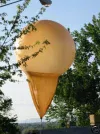
If I had the space I would buy one of these huge $20 weather balloons from eBay and copy satcom1's method to make a 3m dish..
 

Attachments

  • weatherballoon.webp
    weatherballoon.webp
    41.6 KB · Views: 112
I've made some calculations for materials and tools needed for making a big dish (ca. 3.8m), like one on the picture. Just one at picture is made from thin walled tubing, while ours will be made from 2mm wall thick 20x20mm tubes.

Metalworks are not hard itself, but for proper bending of tubes, you'll need welding torch or hot chamber, to make tubes "remember" their shape, and cooling down system, to make them more tempered.

So unless you have access to some forge, making own dish like this is not a great idea.
 
Sometimes i forgot how good Conical Horn´s are..

1º image..32cm Homemade "dish" for a 54dBW satellite, +-30dBi...9.03
2º image..31cm Homemade Conial Horn for the same satellite/frequency, 27.5dBi??...12.88

But conical horn´s >27dBi are soooo long..it´s frustrating:mad:
 

Attachments

  • bscap0000.webp
    bscap0000.webp
    25.3 KB · Views: 86
  • snapshot20090207151139.webp
    snapshot20090207151139.webp
    28.2 KB · Views: 72
Satcom1 said:
Yes, I found a link on spincasting a while back. A pan was placed on A phonograph turntable and liquid parafine was poured in. They claim a perfect parabola.:)
I thought of using a ceiling fan motor and a variable speed controller. :cool:

I have a gearbox from an old garden roto-tiller,it is heavy duty cast iron and would be hefty enough to make a heavy duty turntable for spinning cement.It has the shafts for the tiller tines and a keyed shaft to mount a pulley to get the precise ratio to achieve the needed rpm.
Then it dawned on me that cement mixers turn at a slow rpm and the drums flip to mix and then to pour.If they were the proper rpm or could be modified for the proper rpm you could make a big turntable to mount on the end of the barrel.Make a juicy mix of cement,pour the cement out into a mortar box then flip the mixer barrel vertical.Mount the turntable on the vertical barrel then pour the cement on the turntable.When the cement sets you should then have a mold to make a big parabola dish.
 
But you should notice one thing - to make cement really crackless, you need a quite large amount of sand involved in it. But when there's sand and mixture dries while moving, the larger granules will form, which will make dish surface very rough.
 
casser said:
Sometimes i forgot how good Conical Horn´s are..

1º image..32cm Homemade "dish" for a 54dBW satellite, +-30dBi...9.03
2º image..31cm Homemade Conial Horn for the same satellite/frequency, 27.5dBi??...12.88

But conical horn´s >27dBi are soooo long..it´s frustrating:mad:


Hi Casser,,

What angle is the cone for KU ... and is 1m dish v cone going to result in a cone with a 1m mouth?


cheers..
 
pedro2000uk said:
Hi Casser,,

What angle is the cone for KU ... and is 1m dish v cone going to result in a cone with a 1m mouth?

cheers..

The results that i posted before are a bit wrong..i did a couple of test´s for Astra 2 south beams and both antennas had pretty same results, this happens because the conical horn didint have enough lenght to a "perfect" 30cm diameter version and the 30cm "homemade dish" have bigger efficiency.

The conical dimensions for that test are.. Diameter:300mm Lenght:750mm ; the perfect dimensions for 30cm (50% efficiency) are..300mm Lenght 1091mm, giving a flare angle of 7.42º.

A 1meter diameter conical horn will perform about 3dB better than a dish..so in simple math, will perform like a 1.5meter dish. Off course, if you put a >100% efficiency 1meter dish against a 50% efficiency conical horn, the results will be pretty the same...the 3dB gain that i always mention was comparing with a offset (60/70% efficiency).

A 1meter conical horn would have lenght of 12863mm (12.8meter)..the calculations are correct!:p

Like Low Profile user said "The 'extra' 3db comes from the inherent lower noise figure associated with a conical horn.", also i confirm it in some paper´s about conical horns. I did find a "conical horn" antenna which the lenght are +-2x the diameter and it´s keeping the extra 3dB, but it´s much more complex to build it and to find the correct dimensions (my math is not so good)..i will work on it for the next weeks.
 
Hi Casser

12.8m is a bit big.

I don't quite understand that the dimensions for the 300mm x 1091mm aren't scaled up to give a 1000mm x 3636mm.

Can the cones be bent/ coiled, not as easy to make* I know but it should work without excessive loss I would have thought.

How long are the final waveguides at c. 18-19mm you use with the cones?

Do oblong cones have similar efficiency?


*hmmm old E flat base anyone ...
 
pedro2000uk said:
Hi Casser

12.8m is a bit big.

I don't quite understand that the dimensions for the 300mm x 1091mm aren't scaled up to give a 1000mm x 3636mm.

Can the cones be bent/ coiled, not as easy to make* I know but it should work without excessive loss I would have thought.

How long are the final waveguides at c. 18-19mm you use with the cones?

Do oblong cones have similar efficiency?


*hmmm old E flat base anyone ...

Conical Horn dimensions are not proportional, just because you double the diameter, you cant double the lenght...the lenght of the conical horn is based in formulas and bigger the frequency is, bigger is the lenght of the cone...it´s not like reflector antennas, the cone lenght is determined by diameter+Wavelenght. A 2.4ghz 30cm conical horn, will not work in 11.75ghz.

In big cones, i didint find any difference using only the LNB waveguide (+-18mm) or the universal LNB (+-50mm)...in a 2m lenght cone, cutting or adding 10cm in lenght will make few difference on the gain (maybe a variaton of 0.5dBi).

I didint understand the oblong cone:confused:

Just a curiosity, many of the Universal LNB´s that i tried have gain of +-14dBi.
 
Hey Casser, how big would a conical horn have to be to match a 8m dish?

You should build one for Klaus Schumacher, I'm sure he would be into it :D
 
kamaleon said:
Hey Casser, how big would a conical horn have to be to match a 8m dish?

You should build one for Klaus Schumacher, I'm sure he would be into it :D

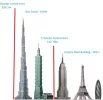
I made the calculations for 8meter diameter conical horn and for 5.5meter for 11750Mhz, the 5.5m should have the performance of a 8meter dish...the length results are in the attached image:-rofl2

Can you imagine the 8meter conical Horn aimed to a 40º satellite? Empire State building should support it, unless you bury the antenna in the ground:p
 

Attachments

  • conicajpg.webp
    conicajpg.webp
    22.8 KB · Views: 84
I'm not following you... 5.5m is the diameter of the opening of the horn or the lenght of it?
 
Back
Top