Anyone tried to make BIG dish at home?

Hi,

I am quite impressed of the tema. We built up dishes about 1,8m big from composite in 80's to receive ECS1 in Czechoslovakia.
Results was not so good but worked.

Another idea from this time - wooden construction on plain roof as parabolic sector. I should have some photo somewhere.

There is much more influences on dish construction, for example type of paint and color of the paint or thicknes of dielectric before aluminium from signal side. Etc.

JH
 
Pawel Pietrolay said:
People from forum use aluminium foil to make wave reflective surface, what's other way to gain the same result and similar efficency.Meaby any paint, zinc paint with graphite, or paint mixed with aluminium powder. I have no idea to find somethinq instead of aluminium foil. There is surely alternative for Aluminium foil, but nowbody knows what paint flexible material could be proper solution.Using foil we get not ideal surface like in parabolic mirrors. So i am waiting for solution. I am not sufficent inteligent to say which materials are wave reflective and which not.

Almost all metal is opaque to microwaves, but for a good reflector, you need a thick layer to fully concentrate the waves. A thin layer of metallic powder, or foil allows much of the wanted signal to pass through.
 
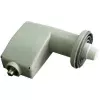
Example of Ku Prime Focus LNBF.
 

Attachments

  • 8932.webp
    8932.webp
    3.8 KB · Views: 38
Next question is which LNB is proper for parabolic dish.

Hi @Pawel Pietrolay take a look here _http://astra2d.proboards.com/index.cgi?board=Eastern i use this lnb inverto+feedhorn C120 for astra2d reception _http://i56.photobucket.com/albums/g171/bonou12/DSCF5248.jpg
 
now you should see this, it's about how to make a mesh grid dish.
sorry it's in my language (Persian) and i couldn't translate it to english .

enjoy of it .
 

Attachments

Hi All,

I read the whole thread. It was THAT interesting. I admire the inventiveness of the members here.
I have experience with Ku in combination with big dishes.
Yes, the look angle becomes very narrow and yes accuracy of the dish shape is of utmost importance. I firmly agree with the 1mm tolerance for Ku. Therefore homemade petals which are somewhat flat in one direction introduces serious signal loss.

I have not built my own dishes as they are too big but I did make a Ku band scalar ring out of brass on a lathe/milling machine for a center focus 3m dish. (ChannelMaster - 4piece fiber) It works well with a standard LNB where I removed the throat with conical scalar rings.

Currently I use
1 ChannelMaster 3m center focus
1 Prodelin 2.4m center focus
1 Prodelin 2.4m offset
1 ChannelMaster 1.8 offset
1 Prodelin 1.8m offset
and am in the process of setting up a second 2.4m Prodelin offset dish.

Concerning some of the ideas posted here:
1. don't forget that expanding foam will push non solid molds out of shape. Polyester resin might crack when applied very thick, epoxy is much less prone to do that but expensive.
2. antenna array's will never work, especially with Ku because there is no way to synchronize output and as another poster discovered, the LO must also be synchronous.
3. I am absolutely flabergasted about the idea with 3 pieces of mirror around the edge of the dish to determine focal point. Why didn't I think of that?
4. When deciding on the size and dimensions of a dish to be made, make sure that the f/D ratio fits exactly to the LNBF you are planning to use.
5. I believe for accurate homemade big Ku dishes, the only way to go is with a spinning mold around a center axis and then painstakingly prepare your dish surface with body filler etc. and sanding until after months of work you have the perfect shape. Then you should have optimal performance from your dish.
6. Consider background noise. (and the absence of it with horns) The scalar rings and feed must exactly match the f/D ratio of the dish.

I hope this thread will continue. I enjoyed reading it tremendously.

Cheers,
Diverguy
 
It should be noted that antenna arays DO work in Ku band - check square/flat ku band antennas. They use huge amount of small phased vibrators.
 
Antenna arays must work on any frequency. But it should be before down conversion at LNB. It means piepes from separate dishes to LNB input and old feshion LNB without feed. Joke is that phase of signals must be same from all dishes in one point.
I saw some Ku small antena build with strips connected together on plain squere dish and LNB inside. (some year ago)
 
T1154,
Re DIY dish construction
It seems to me that without accurate moulds or templates the construction of a dish is unlikely to produce satisfactory results . Has anyone tried building a dish array using 1 or 2 metre dishes ?
 
OK I've not yet done this, but I think it will work...

1. Create a card profile of a parabola for the desired size. This can be done by creating a small one first (by spinning a pool of coloured water and 'dipping' a card into the water - turning it at the same speed as the water etc...). The small 2D card parabola having been cut out along the coloured tide line can be used with a projector to magnify the parabola onto a much larger card or stiff sheet of material. Anyway you will end up wih a fairly (not too important at this stage) accurate 2D parabol of the desired size.

2. Make a pile of sand into a mound and, using the concave part of the card, shape the sand into a fairly smooth positive parabolic shape.

3. Compact the sand (better if slightly damp) and use the card to make the parabola as tight and accurate as possible. Now cover with cloth and finally plastic sheets (don't worry too much about the creases).

4. Using expanded clay pellets (called Arlita here in Spain) mixed with a 'slip' of cement and water. form a layer about 10cm thick all over the mound. You are producing a rigid, lightweight and stable - if a little rustic, parabolic shape.

5. When cured and firm, set the other way up on a hub (from a vehicle) so it spins. Clearly you will need to attach some drive mechanism so that you can rotate it about 6 rpm.

6. Mix and pour in some self-levelling cement. THis should spread and climb the sides of the lightweight concrete form to produce a fairly smooth (depending on the quality of the self-leveling cement and the thoroughness of the mixing) internal surface. Et voila!

If anyone's got (a lot) more time than me this method might be worth a try. If the cement is not mm perfect one could then add a layer of resin using the same technique. THis way the resin (the expensive bit) is very thin and therefore not a bank breaker.

Oh well... just a thought
 
In past I participate on 1,8 m dish making and it is not so easy a results are no good enough. Other problem is probably metal construction for fastening and composit will not be self-supporting. Then you will need heavy metal construction with exact directing.

I am thinking about for example 3 pcs of 1m ordinary ofset dishes near each other. Outer dishes will have reflector in focal point directed to midle dish with LNB. I am not shure if it is realistic but looks possible for me. I will try with two dishes but later. Now snow is still here.

What do you thing abou:pt that idea :-)
 
Will all the signals be in perfect phase at the LNBF?
 
Satcom1 said:
Will all the signals be in perfect phase at the LNBF?

Yes, it looks as a problem. Should be possible to adjust phase by dishes distance. Good to know to have possibility to adjust it. Thanks.
Other unknown item is if signal beam directed to midle dish could be narrow or should be expanded to whole dish surface by spheric deflector. I think it is not only about signal but about impedances too.
For first I plan to check idea with two dishes and sun light to see result. Of course I will need some ground test stand build up and borow antennas from roof.
 
Rabbit fence dish
Another idea is to build huge cylindric parabola from concrete, wood or ....
On the picture is working UHF 5m wide parabolic antenne on a plain roof.
In our case there should be subreflector to focus long vertical focus point to feedhorn (LNB).

Great idea for people who have parabolic land with wire fence.
Bad news is that teleration for the dish is about 2 mm.
 

Attachments

diverguy said:
Hi All,

I read the whole thread. It was THAT interesting. I admire the inventiveness of the members here.
I have experience with Ku in combination with big dishes.
Yes, the look angle becomes very narrow and yes accuracy of the dish shape is of utmost importance. I firmly agree with the 1mm tolerance for Ku. Therefore homemade petals which are somewhat flat in one direction introduces serious signal loss.

I have not built my own dishes as they are too big but I did make a Ku band scalar ring out of brass on a lathe/milling machine for a center focus 3m dish. (ChannelMaster - 4piece fiber) It works well with a standard LNB where I removed the throat with conical scalar rings.

Currently I use
1 ChannelMaster 3m center focus
1 Prodelin 2.4m center focus
1 Prodelin 2.4m offset
1 ChannelMaster 1.8 offset
1 Prodelin 1.8m offset
and am in the process of setting up a second 2.4m Prodelin offset dish.

Concerning some of the ideas posted here:
1. don't forget that expanding foam will push non solid molds out of shape. Polyester resin might crack when applied very thick, epoxy is much less prone to do that but expensive.
2. antenna array's will never work, especially with Ku because there is no way to synchronize output and as another poster discovered, the LO must also be synchronous.
3. I am absolutely flabergasted about the idea with 3 pieces of mirror around the edge of the dish to determine focal point. Why didn't I think of that?
4. When deciding on the size and dimensions of a dish to be made, make sure that the f/D ratio fits exactly to the LNBF you are planning to use.
5. I believe for accurate homemade big Ku dishes, the only way to go is with a spinning mold around a center axis and then painstakingly prepare your dish surface with body filler etc. and sanding until after months of work you have the perfect shape. Then you should have optimal performance from your dish.
6. Consider background noise. (and the absence of it with horns) The scalar rings and feed must exactly match the f/D ratio of the dish.

I hope this thread will continue. I enjoyed reading it tremendously.

Cheers,
Diverguy

can you give me details of prodelin 1.8m fiber offset dish focal lenght of lnb holder. and also the lenght of the arm.
thanks in advance for your help.

boyet
 
boyet05 said:
can you give me details of prodelin 1.8m fiber offset dish focal lenght of lnb holder. and also the lenght of the arm.
thanks in advance for your help.

boyet

Prodelin have two different designs (possibly more) of their 1.8m dishes , one with an f/d ratio of 0.6 the other 0.8. Which one is yours ?
 
Channel Hopper said:
Prodelin have two different designs (possibly more) of their 1.8m dishes , one with an f/d ratio of 0.6 the other 0.8. Which one is yours ?


mine is 0.8 ratio. thanks for the help.
 
Actually, offset dish is segment, cut out from plain primefocus dish. So, at least theoretically, it's possible to consolidate offset dishes, like flower petals, equip system with primefocus lnb, and check for results...
 
Back
Top