Biggest Dish You’ve Tried for Weak Signals?

SEOShamsher

Member
My Satellite Setup
Past setup:
• 8-ft dish covering 68.5°E, 75.0°E (Ku), 78.5°E, 83.5°E, 90.0°E, 93.5°E (Ku), 100°E, 105.5°E, 115.0°E
• 6-ft dish at 49.0°E
• Receivers: COSHIP CDVB2000B, Dish TV Zinga

Current status:
Sold all equipment — want to start again from scratch.
My Location
Ludhiana, Punjab, India
Hey everyone,

I was browsing around and saw that earth station dishes can go up to like 21 meters… and honestly started imagining what kind of crazy performance those monsters must have kind of became a fantasy to try one for a few weeks.

So I thought I’d ask people here who’ve actually used bigger dishes — maybe 4m to 8m or even larger.

Curious to hear from folks who’ve really pushed the limits on weak east fringe / low elevation satellites.

What’s the biggest dish you’ve personally tested?

  • Dish size?
  • Band (Ku / C)?
  • How much real performance gain did you see as you went bigger?
Also wondering:

  • Is there a sweet spot where going bigger stops giving noticeable improvement?
  • At what size do returns start to diminish?
Would love to hear real-world experiences, especially with big dishes (4m to 8m and beyond), and any old stories about these “monster” setups:

  • How much difference did they actually make?
  • Any known record attempts or well-known satellite hunters who pushed huge dishes for weak signals?
Thanks!
 
Have a read about Klaus Schumacher - probably one of the most extreme examples of fringe reception.


Also DX Bozoth
 
Klaus came to mind when I saw this thread title.

Back in the 90s when my parents were working in Johannesburg, South Africa I wanted to try and emulate that setup to get Sky UK but while they had a large enough garden to do it, my dad wasn't that keen to spend that kind of money in a property that we were only going to live in for a few years. :-rofl2 It was a lot easier and cheaper to just watch the European channels rebroadcast via Multichoice DSTV on an 80cm dish. But where is the fun in that? I doubt it would have been possible to get a signal that far south, so probably just as well I didn't try...
 
I seem to remember a video on Dr Dish TV about an Australian chap who lived on a Pacific island, he had a 20m dish that he used to receive religious programming which he then rebroadcast to the island. The island might have been American Samoa but not sure.

Due to fuzzy memory all the details in the above sentences may be, or definitely are, wrong.
 
1994, near Samara in Russia.
A 7.5m prime focus dish set up for S and C band.
 
As a junior engineer one of my jobs was installation of CATV head end's, one part of that job was installing the down link dishes for the channels that were needed for their system.

These dishes went from 5 meters to 30 meters all depending on the location and weather conditions over the year, the further North the bigger the dish, back then the main downlink channels were on satellites ranging from 121 West to 148 West all on "C" band. (for the USA)

Also the further North you go then you started running into the snow belt, so you had to go with a bigger dish, this so you didn't loose signal when the dish filled up with snow, until the low guy on the totem pole had to go out and clear the dish.

So in my experience the biggest dish I messed with looking for signal was a 30 meter satcom dish, but now days there is not much needed in that size range due to fiber optics taking over.

So as a retired individual now my 11 foot "C / Ku " band dish is all I need for hunting down signals, I have received signals from Eutelsat at 172E to Intelsat 14 at 45W, all on a good day.

Sorry too long, to much coffee
 
Also DX Bozoth
Still alive and active, there's a topic here about him I believe.

Found one, perhaps there's more.
 
Last edited:
As a junior engineer one of my jobs was installation of CATV head end's, one part of that job was installing the down link dishes for the channels that were needed for their system.

These dishes went from 5 meters to 30 meters all depending on the location and weather conditions over the year, the further North the bigger the dish, back then the main downlink channels were on satellites ranging from 121 West to 148 West all on "C" band. (for the USA)

Also the further North you go then you started running into the snow belt, so you had to go with a bigger dish, this so you didn't loose signal when the dish filled up with snow, until the low guy on the totem pole had to go out and clear the dish.

So in my experience the biggest dish I messed with looking for signal was a 30 meter satcom dish, but now days there is not much needed in that size range due to fiber optics taking over.

So as a retired individual now my 11 foot "C / Ku " band dish is all I need for hunting down signals, I have received signals from Eutelsat at 172E to Intelsat 14 at 45W, all on a good day.

Sorry too long, to much coffee
I think you are the right person to asnwer this correctly. What would be sweet spot for ku band prime focus dish? I mean after what size signal improvements get very minor.

As I've done some research and after 30 ft improvements get almost none as there is atmostphre noise and more other noises too. is it true?
 
Well with the advent of 5G signals "C" band is almost useless in some areas, and yes if the dish is pointing low to the ground the ground clutter gets worst the bigger the dish goes, if you have a big dish pointing through a town or city you get a lot of junk you have to pick through.

And if my memory is still working right, the overall gain gets about 3 dB better for every foot increase of dish diameter, in some cases where signal problem arise we would have to bolt on some skirts to up the gain, also on low to the horizon cases we would have to put a ground shield on the dish to block ground clutter.

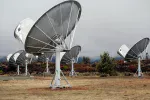
This was done to the Allen Telescope array in California, as the dishes there use the off set LNB's, California is a very noisy RF environment.

I would like to have one of these puppys.
Allen-Telescope-Array.webp
 
I think you are the right person to asnwer this correctly. What would be sweet spot for ku band prime focus dish? I mean after what size signal improvements get very minor.

As I've done some research and after 30 ft improvements get almost none as there is atmostphre noise and more other noises too. is it true?
A parabolic reflector works on a formula, gain vs size is an absolute, determined by frequency and the losses (aberration and feed mismatch)

What could improve matters without increasing the diameter is a secondary reflector, turning the system into a cassegrain / gregorian design, though there is a specific set of equations to construct and align them.


Thanks for explaining that! Good to know we can squeeze more gain without going bigger through Cassegrain/Gregorian design.


But for my use case multi LNB setup is a must so that route is pretty much a dead end for me. Plus the math and precision alignment involved sounds like a rabbit hole I don't want to go down honestly.


For serious single satellite DX hunting though that's definitely an interesting option to keep in the back of the mind. Good knowledge to have even if not practical for most of us!
 
Back
Top