C-Band with a Fortec 2.4m dish.

foxcube

Member
My Satellite Setup
1m offset motorised, 1,2m CM offset manual.
My Location
Merseyside
The local amateur radio club has acquired a Fortec 2.4m dish which will eventually be used to transmit 2.4GHz up to the amateur TV transponder on Es'Hail-2 at 25.5E, when it eventually goes up.

I've read the threads about the dish and the good and bad things about it.

C-band reception should give the opportunity to get the dish geometry correct and verify that its performance is reasonable. I've done a fair bit of satellite receiving on Ku band over the years, but C-band is new to me.

I couldn't resist having a quick try of the dish with a C1W-PLL before tweaking it and managed to receive a couple of transponders on 10E. Lyngsat suggests that a 1.25m dish should receive the 40dBW strength in NW UK, so obviously there's plenty of improvement to be made. The LNB clearly wasn't pointing at the middle of the dish. Should I be able to get everything at 10E with 2.4m eventually?

I have a clear view of anything east of 10E. Is there a better satellite that I could use as a yardstick, where I should get some transponders but not others? I'm using an amateur radio designed MiniTiouner receiver, which is optimised for the low (< 1000) symbol rates that amateurs can go down to. This gives an accurate readout of received strength in dBm, amongst other things. MiniTioune - BATC Wiki

TIA
 
The Fortec dishes have very poor reputation. Whilst they can be made to work reasonably well for C-band there normal performance at Ku frequencies is equivalent one or two dish sizes smaller. And require constant tweaking to stop them distorting too badly

At 2.4GHz the I predict the performance is going to be horrible.
 
aka the Origami Dish ....... :wacko:
 
Thanks for the replies.

If it works reasonably well at 3.7GHz, why would it be horrible at a slightly lower frequency?
 
2.4 GHz is S band, you should be fine.
 
@foxcube Take a look here The C-band Tin-Dish challenge I haven't tried it on 10E but others may chip in. If they are put together carefully, they work quite well. However, I wouldn't leave one out in an exposed position in a storm, you might end up with a mangled mess (mine lives in a garage when not in use).

My one works well on X band (7.25-7.75GHz) and seems quite close to the expected performance of a 2.4m i.e. ~6dB up on a 1.2m. The C-band Tin-Dish challenge (X Band)

2.4 GHz is S band, you should be fine.
Agreed, it is. The beam pattern won't be up to Intelsat/Eutelsat standard but that's not mandated for Es'Hail-2 AFAIK.

I found the MiniTioune quite difficult to use on normal broadcast as all parameters need to be entered first. At times it took ages to acquire a signal but that may have ben operator error. I compared it to a TBS6983 and the performance was similar down to 125ks/s (Radio Immaculate Conception) which is the lowest I could find. At that data rate Crazyscan has a better chance when not set to blind scan.

16E_21564H_radio-immac.webp

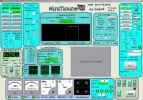
Here's a screen shot of Minitioune and a TBS on a Ka band 1100 ks/s signal.

16E_21535H.webp
 
Dont install this dish anywhere exposed (eg roof of a building)

The structural integrity of these dishes is ahem limited........
 
To provide some clarity over the dish quality and 'fit for purpose', a few images of the final resting place and face/side on shots would help if posted here.

Uplinking does have its own issues not least the near field radiation that has a tendency to cook things, plus the possibility of side, or offbeam signal, but from memory there are no s band satellites anywhere near the position you are broadcasting to.
 
Thanks for the replies.

I don't think I'll be using it on Ka band. :-) I've never used Crazyscan.

I see there are some signal strengths mentioned in the Tin Dish thread, including 10E, so that will give me something to go on.

The dish is going to be put on a pallet with castors for testing. It's going in the corner of a low roof, walled on 3 sides, so it should be reasonably well shielded and isolated. The dish face can be fixed to the wall eventually if required.

I'll do some photos when it's ready.
 
Uplinking does have its own issues not least the near field radiation that has a tendency to cook things, plus the possibility of side, or offbeam signal, but from memory there are no s band satellites anywhere near the position you are broadcasting to.

Quite a few round there. Including milbird Skynet 5B at 25.1E :D
 
Last edited:
I very much doubt they will care, but a drone strike on a 2.4m target would be interesting to watch.
 
I very much doubt they will care, but a drone strike on a 2.4m target would be interesting to watch.

One of those Fortecs would just fold up around it like one of those planned derelict satellite netting captures :-rofl2
 
As a ham myself and in to DATV this is of much interest to me, replying here to subscribe to this thread.
Currently messing around with 5-10GHz stuff but satellite would be incredible, will be a lot of interest at my local club :)
 
I assume you're familiar with the BATC web site: British Amateur Television Club

Here are some other links:

http://www.amsat-dl.org/images/stories/satellites/Eshail-2/P4A_Leaflet.pdf
https://wiki.batc.org.uk/images/8/89/CAT17_EsHail2.pdf

The downlink on 10.5GHz should be receivable with an 80-100cm dish. The estimated uplink requirements for DVB-S2 on 2.4GHz are 100W to a 2.4m dish at 8MHz bandwidth. That should be scalable, so 25W to a 1.2m dish at 500kHz bandwidth. Even that will probably need an amplifier with a P1 compression point of around 150W.

With all of Europe et al trying to use it, it will need careful management and cooperation to make it successful, but it's a nice problem to have.
 
Back
Top