Cooling the LNB

I know :) When I was at army, our radars used such cooling system. But all hardware initially was designed for such cooling.

Regarding LNB - I simply don't know, since all LNB I had access to, show difference no more than 5% in Q. Just some models (Surprisingly NOT Invacom), recover faster in rain fade.
 
Today I went to chemistry shop. They said that they will ever grant me 100-200 grams of liquid nitrogen, for such experiments, but unluckily, they don't have small transportation enclosures, just 20 liter ones. I'll try to lend such enclosure somewhere at chemistry lab.
 
pedro2000uk said:
The cooling of the lnb to -30c / -40c has been proven to give gains just using freeze spray like you use to freeze a water pipe or even just cooling with water on a hot day can show gains.
It works... to a degree (sic). We are far too busy or we would have a system running... it is more doing it to a budget, especially running costs.

:cool:

Exactly.
What is interesting though , is plotting the signal reception of a weak signal when the LNB is heated to variying temperatures, as this can be used to provide a curve on a graph that determines what is the likely advantage of cooling to extremes.

It is not just the noise figure that is altered, circuit stability and the power supply components all undergo degradation away from their standard specifications.

What is the point then, if the advanteges are so small.
As others have stated, it may not be to everyones taste, but if you are already out of other solutions, and you have a fridge, and the wife does not object to it being taken apart and some plumbing added, you can get a few channels that might not normally be received.
 
Take the fridge apart?.. no way.. we were just going to bung the fridge outside on a stack of pallets so the LNB was in the ice box... bit of army camouflage paint... you'd hardly notice it:-rofl2.

(must do a picture)
 
Yo wussup all the mad scientists in da house, did anyone conduct some mo' mad experimenting on them lnb?
 
we are .. busy with ... er .. werk.. but the weather is conducting the experiments at the moment for us reaffirming that it all works.. it's all about doing it for a price and practical engineering issues for the dth market...
 
Receiver noise is proportional to root 4KTBR (if memory serves me correctly - it is 20 odd years since I was at college).
 
If someone will donate me a small vacuum flask for liquid nitrogen (conventional one, used for beverages will NOT work), I can do this experiment any time. I queried all local chem labs and stores, they said that no such small flasks available, smallest is 5 liter one, which ise quite heavy and hard to transport around.
 
Low Profile said:
Receiver noise is proportional to root 4KTBR (if memory serves me correctly - it is 20 odd years since I was at college).
Hi,:)
On what college course can I learn such things?

Why some satellite receivers have more sensitive tuners than others? What single factor determines the sensitivity most; materials, temperature, receiver software...?
 
In what regards tuner sensitiveness, better design and better components used in the tuners?
 
kamaleon said:
In what regards tuner sensitiveness, better design and better components used in the tuners?

Everything in the domestic TVRO market these days is designed to perform at a price, usually the lowest a manufacturer/brand distributor can get away with.
It is unlikely the enthusiast is going to come up with something vastly superior without spending some time stabilising the incoming power supply first, and then cooling the important components in the receivers tuner. Even then the same improvement might be achieved by using high quality cable to the dish, or adding 30% to the dish area.

The cheapest option has always been, stick up a bigger dish.
 
I can't say for ALL profesional tuners, but I had a look inside some scopus and tandberg units. Yes, they are made with better quality components, but this does not means better sensitivity at all. Generally, they have worse sensitivity, than generic home receiver. The quality of components and overal design (software & hardware) is more aimed for stability along time, to allow trouble-free 24/7 operation.
 
BombedOne said:
I can't say for ALL profesional tuners, but I had a look inside some scopus and tandberg units. Yes, they are made with better quality components, but this does not means better sensitivity at all. Generally, they have worse sensitivity, than generic home receiver. The quality of components and overal design (software & hardware) is more aimed for stability along time, to allow trouble-free 24/7 operation.

The saying, 'a candle that burns twice as bright' springs to mind
 
divibi said:
Hi,:)
On what college course can I learn such things?

Why some satellite receivers have more sensitive tuners than others? What single factor determines the sensitivity most; materials, temperature, receiver software...?

I went to a military engineering college.
As has been said, design is the main factor.
You could probably improve the sensitivity of most receivers by removing or modifying the AGC and overload circuitry, though this may be detrimental to the receiver under some conditions. I guess it depends on the design. Ideally you want to amplify the signal as much as possible, while at the same time attenuating noise (STFO). You could also possibly mess around with filters and amplifiers at the front end to get better results. To be honest, I've been out of the field for a little while, so I'm not up to date with current development, though I do have a few ideas of my own.
 
Low Profile said:
I went to a military engineering college.
As has been said, design is the main factor.
You could probably improve the sensitivity of most receivers by removing or modifying the AGC and overload circuitry, though this may be detrimental to the receiver under some conditions. I guess it depends on the design. Ideally you want to amplify the signal as much as possible, while at the same time attenuating noise (STFO). You could also possibly mess around with filters and amplifiers at the front end to get better results. To be honest, I've been out of the field for a little while, so I'm not up to date with current development, though I do have a few ideas of my own.

Thank you, Low Profile:):-worship
 
Yes, the narrower is input range, the better is S/N and sensitivity. Ideally, you can squeeze out great signal from single transponder only. But this requires very very good knowledge of volume rezonators and flat filters, and also access to quite complicated equipment.
 
BombedOne said:
Yes, the narrower is input range, the better is S/N and sensitivity. Ideally, you can squeeze out great signal from single transponder only. But this requires very very good knowledge of volume rezonators and flat filters, and also access to quite complicated equipment.

Thank you BombedOne, as well :):-worship
 
Hello from Transilvania and Sorry for my English,
I foud this forum two month ago and i read all the post about Fringe Reception,Wow !
I work like a refrigeration engineer and i cool LNC to -34C years ago to a modified and a �butchered� R12 frezer to watch the results.
I found 2 problems and i need Yours experience to be solved.
1-condensation inside wave guide feedhorn
2-when the refrigeration units its turn ON the LNC temperature go down dramaticaly to 20C to -34C and thermic shock cant damage the electronics component inside the LNC.
I want to make home made one feedhorn for a offset 0,9m 300mm 400mm long ,replace all the air inside feedhorn with a inert gas and glue transparent plastic on top of the feedhorn.I need one feedhorn to long becose i must prevent condensation on top of the plastic feedhorn.
The problem its,300mm feedhorn its to long and signal its lost inside the waveguide.
What cant be done?
I dont have experience with Ghz frecvency and i need calculation for a 300mm 400mm waveguide,diameter and all info i need to solv this problem.
Thank You for Your time,
Respectfully,
mouse.
 
Hehe :)

Let me share my achievement in this area:

Liquid nitrogen: Does not worked
Reason: I applied it too rapidly, LNB cracked in middle and cable went into dust-like condition in about 4 seconds. Then I ran out of liquid nitrogen.

Regarding alternate cooling methods, I've built and bench-tested 3 stage peltier cooled design, which is free from problems you've mentioned above, and also works with default C120 feedhorn. The reason that project is stopped - lack of free money to buy effective peltier modules (need about $150 for them). Initial experiments were conducted with weak, cheap peltiers.

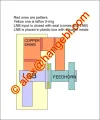
Drawings of my construction are on paper only, no digital version yet. Structure is as follows - 3 peltier modules are interconnected to each other via 10mm thick copper shims. The cold end touches inverto white tech flange LNB (as the smallest one available), which is sealed airtight in plastic box, filled with silicagel. The feedhorn is attached through teflon 0-ring. the hot end of peltier module assembly touches the feedhorn, warming it up, and avoiding condensation on it. I easilly achieved 30C delta of temperatures by using 3 cheap (~$15 ea) peltiers. With expensive ones (and better power supply), I think 50C is achievable, which looks much more interesting.

On the attached picture you can see very schematic representation of my design.
 

Attachments

  • 3stage.webp
    3stage.webp
    21.6 KB · Views: 50
Hi,Mr.BombedOne,
I have more respect for You after i read the Fringe Reception on this forum,its a pleasure to talk with You.I have one question for You regardind the phased antenna array,i open that foto and i see 16 VHF antenna on top of the military truck.How they are conected all 16 antenna to a first stage low noise amplifier with a minimum signal lost ?
This antenna look to be Swann,but its different from Swann antenna i know,maybee its more version,where i found the dimension to make at home this tipe of military antenna?
In the past i make more antenna ,but only Swann give me a good impresion,work wery well.
Regarding liquid nitrogene its beyond my capability,but i work each day with freon refrigerants R134a,R404a.
I cant compare the price of a Peltier elements with classic refrigeration sistem.Price its low in my case and easy to be built.I work now on refrigeration units with freon R404a inside to achive -50C.
I found complete documentation on a cascade sistem work combined with R404a and R508b to achive -100C,in a small volume to cool the LNC and the receiver tuner togheder.
 
Back
Top