Discret 11 and 12 scrambling

Many would be interested!As you saw in previous posts, I created a D11/D12 encoder from a D12 decoder.
I've entered the circuit diagram.If you'd like to trust me, I think I can repair your encoder.
I'm French, so it will need to be sent by mail, or if you have a friend coming to France for vacation (they could bring it with them).
 
I used to work for a cable company called Cablelink in Dublin in the 1990s.
Cablelink tested the Discret system in the late 1980s, which had been intended for use to launch the Premiere Movie Channel on the cable network. However, the deal did not proceed, and a couple of years later Cablelink changed to the Cryptovision system to launch premium channels from Sky.

Before I left Cablelink, I salvaged some equipment that was being scrapped. I have a Discret headend encoder and a few decoder units that were used for parts. The encoder still powers up, but there is a fault somewhere in the video circuit.
I would love to get the encoder working, but I don't have enough technical knowledge to repair it, so I am offering either:
1. To pay someone with the technical knowledge to get the encoder working again.
2. To trade the encoder and decoders for a unit that someone can build for me that simulates the Discret composite video and audio encryption.

I can provide pictures of the equipment on request.
Very interesting. Cryptovision is something I've never seen - I think it's very similar to Videocrypt in terms of it being a cut and rotate system, but beyond that, it's an unknown.

Do you have any decoders or technical information on it? How data is transmitted etc.

For Discret, which version was tried? 11, 12 or 14?
 
(continuing conversation with user name changed)

I believe Cablelink used version 12 of Discret. The decoders had the cable company name printed on the front facia. These also had a modulator built in so that the decoded output could be readily viewed on a UHF channel and easily tuned into a VCR.

Even though I have limited technical knowledge, I was fascinated by the extensive testing of Discret on Cablelink. Much of it carried the Premiere movie channel with the intention to officially launch it to Irish viewers, but that deal fell through. I remember one Easter weekend there was some sort of fault with the satellite feed of Premiere at the headend. Hum bars were moving up and down the screen. Every time a bar hit the VBI section, it would upset the encoded channel and would become clear for a few seconds before reverting to encrypted. Eventually the encoder just gave up trying to encrypt and Premiere was viewable in the clear. Because it was Easter weekend, there was nobody at the headend to reset the encoder, so we got an entire weekend of Premiere for free!

Discret decoders had actually begun to be installed in customer homes, but when Premiere was removed from testing after the collapse of the deal, Cablelink replaced it with 24 hour carriage of MTV, for some reason. Only customers who had paid for a decoder with the intention of viewing Premiere could view MTV 24 hours. Eventually, Discret was abandoned as encryption technology was moving on.

Cryptovision was a new departure at the time. Its only other notable use was an Intelsat channel for overseas military forces - I think it was called BFBS. The encoded output was similar to VideoCrypt cut and rotate, except the colour was retained in the shuffling, whereas the VideoCrypt effect was almost monochrome. Cryptovision decoders were cardless, individually addressable and made by Omnitron in Ireland. A second generation decoder was built by Pace UK. Encoders came from Tandberg, Norway.
 
Last edited:
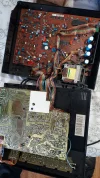
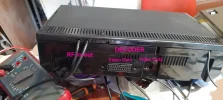
Here is the Cablelink Discret Decoder used for domestic installations. It powers up, but may have been used to cannibalise parts. The flyleads are for the RF feed in, of which all channels were carried on VHF. The output looped the VHF channels through, plus the decoder output on a UHF channel, selectable with a screwdriver from about channel 29 to 42.
 

Attachments

  • Discret Cablelink Decoder 01.webp
    Discret Cablelink Decoder 01.webp
    190.2 KB · Views: 60
  • Discret Cablelink Decoder 07.webp
    Discret Cablelink Decoder 07.webp
    1.1 MB · Views: 43
  • Discret Cablelink Decoder 06.webp
    Discret Cablelink Decoder 06.webp
    1.4 MB · Views: 31
  • Discret Cablelink Decoder 05.webp
    Discret Cablelink Decoder 05.webp
    81.4 KB · Views: 28
  • Discret Cablelink Decoder 04.webp
    Discret Cablelink Decoder 04.webp
    190.2 KB · Views: 28
  • Discret Cablelink Decoder 03.webp
    Discret Cablelink Decoder 03.webp
    172.9 KB · Views: 33
  • Discret Cablelink Decoder 02.webp
    Discret Cablelink Decoder 02.webp
    169.1 KB · Views: 41
Last edited:
Here is a Discret decoder which I believe was only used for testing purposes at the Cablelink headend. This a baseband unit without the UHF modulator used on the domestic version. This does not power up, but all of the electronics appear to be intact.
 

Attachments

  • Cablelink Discret Headend Decoder 01.webp
    Cablelink Discret Headend Decoder 01.webp
    183.1 KB · Views: 37
  • Cablelink Discret Headend Decoder 02.webp
    Cablelink Discret Headend Decoder 02.webp
    158.8 KB · Views: 30
  • Cablelink Discret Headend Decoder 03.webp
    Cablelink Discret Headend Decoder 03.webp
    105.1 KB · Views: 33
  • Cablelink Discret Headend Decoder 04.webp
    Cablelink Discret Headend Decoder 04.webp
    270.1 KB · Views: 38
Here is the Discret encoder from Cablelink's headend. It powers up and all components appear to be intact. However, when I try to connect a video feed, all I see is a very faint outline of a picture with very little luminance, which fades in and out to black.
 

Attachments

  • Discret Cablelink Encoder 05.webp
    Discret Cablelink Encoder 05.webp
    1.2 MB · Views: 39
  • Discret Cablelink Encoder 04.webp
    Discret Cablelink Encoder 04.webp
    1.1 MB · Views: 32
  • Discret Cablelink Encoder 03.webp
    Discret Cablelink Encoder 03.webp
    110.6 KB · Views: 34
  • Discret Cablelink Encoder 02.webp
    Discret Cablelink Encoder 02.webp
    142.6 KB · Views: 33
  • Discret Cablelink Encoder 01.webp
    Discret Cablelink Encoder 01.webp
    129.5 KB · Views: 35
it will be a big challenge to fix this encoder !!!
many schematics to draw .
i am ok to try .
i hope to test also some decoder to compare to my D12 .
 
it will be a big challenge to fix this encoder !!!
many schematics to draw .
i am ok to try .
i hope to test also some decoder to compare to my D12 .
Yes, I would like to send the encoder to you through the post. I don't have the facility to contact you privately through this forum. Can you contact me with your mailing details?
 
Do you have any information or the decoders for Cryptovision? I'd love to implement that in hacktv. Yes, the cuts were at a higher sampling rate, 4xPAL line frequency ~17MHz, so the colour was retained unlike Videocrypt at 14MHz.
 
Cryptovision was a new departure at the time. Its only other notable use was an Intelsat channel for overseas military forces - I think it was called BFBS. The encoded output was similar to VideoCrypt cut and rotate, except the colour was retained in the shuffling, whereas the VideoCrypt effect was almost monochrome. Cryptovision decoders were cardless, individually addressable and made by Omnitron in Ireland. A second generation decoder was built by Pace UK. Encoders came from Tandberg, Norway.
As someone who listened to BFBS radio regularly back in the early 90s I got very used to seeing the Cryptovision encryption on screen. Back then it was SSVC that used to broadcast the TV service with BFBS being the radio side. I always thought the encrypted output looked so much nicer than Videocrypt due to the extra colour in those chopped up lines!
 
As someone who listened to BFBS radio regularly back in the early 90s I got very used to seeing the Cryptovision encryption on screen. Back then it was SSVC that used to broadcast the TV service with BFBS being the radio side. I always thought the encrypted output looked so much nicer than Videocrypt due to the extra colour in those chopped up lines!
Don't suppose you took or retained any VHS recordings? You can see some of the data at the top of the video (ruined by compression)

 
Don't suppose you took or retained any VHS recordings? You can see some of the data at the top of the video (ruined by compression)

No, sorry. I mean, I did have many hours of VHS recordings of BFBS but all would have been in LP and most were also with teletext overlayed over the video so I had a date and time reference, but I converted them to MP3 years ago and threw away the tapes which were taking up too much space...
 
Do you have any information or the decoders for Cryptovision? I'd love to implement that in hacktv. Yes, the cuts were at a higher sampling rate, 4xPAL line frequency ~17MHz, so the colour was retained unlike Videocrypt at 14MHz.
Would some pictures of the decoders and the internal circuitry help you?
 
Absolutely - anything at all that you have will be more than what I have now (which is nothing)!
 
I managed to bring a TUDI12 decoder back to life.It's a D12 decoder with an I (UK) standard tuner, but it's certainly configurable for stereo (BG or A5).
The video decoded by the main circuit is remodulated to the I standard (i.e., FM mono).
Using the internal tuner was of little interest, and even less so today since there are no more analog transmissions.
The major difference between this TUDI12 and the D11 and D12 decoders is that it also has a second audio channel (were there any coded stereo broadcasts?).
In the decoded image, the video is modulated to the I standard, demodulated by the TUDI, remodulated by the TUDI, and demodulated by the TV.
tudi01.webptudi04.webp
 
as Barry ask to me , i have made a coder with one of the two decoders , we keep the second one as ordinary decoder .
in picture on the bottom the new coder , on the top my personal D12 decoder .

codeur-barry1.webp
 
The encoder/decoder set is ready!
Set2.webp
The basic decoder has been converted into a D12 encoder with level selection from 0 to 7 (unencrypted mode).
The switch next to the encoder dial selects D11 mode (Canal+) or D12 mode (Cablelink).

decod2.webp
In this setup, the decoder receives the video signal via its RF tuner (which requires a few minutes to warm up before becoming operational).
After a few minutes, everything is very stable.
codeur2.webp
On the encoder, the code is a 12-bit number (0 to 4095).
On the original decoder, the code is 10 bits, in this case 1460624462.

encle.webp
 
Success by Dreambox1959!

The converted encoder and decoder are working fine. This is the first time that Discret content is being transmitted on the very same cable frequency in Dublin since 1988!

It's a wish come true. Thank you!

20260603_163850.webp

20260603_163903.webp
 
Back
Top