Hacktv: analogue tv transmitter

I've used a BladeRF (via soapy). It works but can be a bit sensitive, breaks up easily when there is any activity on the PC side. Moving a window or scrolling in a browser can be enough to break up the image. Soapy's <opts> are passed straight to the driver, so it's going to be difference for each device. I'd just provide a text box where users could enter anything.

hacktv can't modulate video with the FL2K at the moment, but it is something that could be done. The frequency range would be quite limited (0 to sample rate / 2).
 
I've used a BladeRF (via soapy). It works but can be a bit sensitive, breaks up easily when there is any activity on the PC side. Moving a window or scrolling in a browser can be enough to break up the image. Soapy's <opts> are passed straight to the driver, so it's going to be difference for each device. I'd just provide a text box where users could enter anything.
Ditto for LimeSDR - using Soapy driver. Though we found that even bypassing Soapy altogether produces the same 'sensitive' results.
 
Hi everyone,

I have what is probably a ver dumb question.

I have ubuntu 20.04 installed

I am able to install hacktv in ubuntu with 'sudo apt install hacktv'

After some research I have found how to open the hacktv-gui.jar

When I go to GUI settings I can see the detected build is fsphil.

My question is how can I install the captainjack64 version?

'sudo apt install hacktv/captainjack64' does not work.

I have tried:

make
sudo make install

But then a lot of packages were not found in the pkg-config and it ends with:

font.h:22:10: fatal error: ft2.build.h: no such file or directory 22 | #include <ft2build.h>
Compilation terminated.
make: ***[Makefile:32: hacktv.o] Error 1

I am not sure what this would have done if it had worked but I was hoping it would have created a hacktv.c file which I could then move to usr/bin, replacing the other version.

I am totally new at this. If anyone could give me some tips I would appreciate it.

Thanks!
 
Last edited:
You'll need to compile that from source as follows:

Code:
sudo apt update
sudo apt install libc-dev g++ build-essential git libfreetype6-dev
git clone https://github.com/captainjack64/hacktv.git
cd hacktv
make
sudo make install

If all goes well, it should install /usr/local/hacktv
 
Hi,

Thanks! It worked untill make.

Then I get:

No package 'libavfilter' found
gcc -g -Wall -Wno-unused-result -pthread -03 -c hacktv.c -o hacktv.o
In file included from video.h:44,
from hacktv.h:21,
from hacktv.c:24,
font.h:22:10: fatal error: ft2.build.h: no such file or directory 22 | #include <ft2build.h>
Compilation terminated.
make: ***[Makefile:32: hacktv.o] Error 1

Any idea what I could be doing wrong?


Thanks!
 
Oops, my bad. You might need some of these too:

sudo apt install hackrf libhackrf-dev libavutil-dev libavdevice-dev libswresample-dev libswscale-dev libavformat-dev libavcodec-dev
 
To connect the coaxial cable to the hack rf I need to buy an sma to f connecter right?

Would this do the trick?


I already bought this:


And a cable like this to connect the receiver to the hackrf:

 
Hello everyone, first up apologies for bumping this thread, but I needed some help with HackTV :)

I've recently acquired a 405 Line TV, the first in a few years and my old Aurora 405 line converter is long gone. Googling around it became obvious that converters are now thin on the ground and £££, but I came across this cool project called HackTV and some Youtube evidence of it being successfully used as a 405 line converter - and I just happen to have a HackRF One in a drawer. I also have a couple of Raspberry Pi4s to hand as well.

But, I don't have a Linux PC to hand and so I installed Raspian and the HackTV packages. The HackRF is connected via USB with an ANT500 aerial. The good news is that this setup worked on first try with the test card on 625 lines Pal. The bad news is that there's the most horrendous interference that's causing the test card to not lock and it sounds like a pneumatic drill is going on in the background that rocks the picture and the test tone. I've tried different USB cables, isolated all sources of RF in my shack and the problem persists on two different TVs. I've come to the conclusion that the Pis are the culprit, unless there's a fault on the SDR. I'd like to try it on my Windows 10 machine but I'm utterly stumped at how to compile it. Couple of questions - Has anyone any thoughts on the likely sources of the interference? And, can anyone share an up to date set of Windows binaries to try?

Many thanks for any help!
 
Hello everyone, first up apologies for bumping this thread, but I needed some help with HackTV :)

I've recently acquired a 405 Line TV, the first in a few years and my old Aurora 405 line converter is long gone. Googling around it became obvious that converters are now thin on the ground and £££, but I came across this cool project called HackTV and some Youtube evidence of it being successfully used as a 405 line converter - and I just happen to have a HackRF One in a drawer. I also have a couple of Raspberry Pi4s to hand as well.

But, I don't have a Linux PC to hand and so I installed Raspian and the HackTV packages. The HackRF is connected via USB with an ANT500 aerial. The good news is that this setup worked on first try with the test card on 625 lines Pal. The bad news is that there's the most horrendous interference that's causing the test card to not lock and it sounds like a pneumatic drill is going on in the background that rocks the picture and the test tone. I've tried different USB cables, isolated all sources of RF in my shack and the problem persists on two different TVs. I've come to the conclusion that the Pis are the culprit, unless there's a fault on the SDR. I'd like to try it on my Windows 10 machine but I'm utterly stumped at how to compile it. Couple of questions - Has anyone any thoughts on the likely sources of the interference? And, can anyone share an up to date set of Windows binaries to try?

Many thanks for any help!
The Pi will struggle with hacktv but using --nonicam to disable the NICAM carrier usually helps a lot. You could also try dropping the sample rate to lighten the load on it.

There's a compiled Windows binary of my fork here - https://filmnet.plus/hacktv/hacktv.zip. I don't use Windows but others say it works.
Works a treat for me, never had an issue with it myself.
 
This is great thank you, I'll give the Windows version a try. I did have my doubts about whether the Pi could cope. If I can try it on my more powerful Windows machine it can help identify if the problem is with the HackRF. I'll report back!
 
Hi everyone, just a quick update on this. I've tried HackTV in Windows on my justified but slightly ancient i7 alienware laptop and the problem is gone. The test card is fine, just the odd glitch which is the laptop chugging at a sample rate of 16Mhz. The glitching goes if I drop the rate a little. I have a better PC I can use instead. It's the clear the pi4 can't cope out of the box without quite a bit of tweaking.
 
I bought an old mini Dell Optiplex somethingorother to specifically use it for hacktv as the Pi is just too feeble. It has Ubuntu installed on it and copes with most demands just fine. The processor is i5 4570.
 
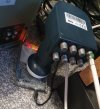
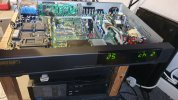
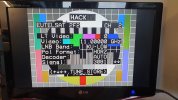
Now this is interesting. A while back @fsphil discovered that HackRF leaked some RF from within itself at double the frequency and deviation. What this means is that transmitting at 5.5GHz @ 8MHz deviation via HackTV, HackRF will leak the same transmission at 11GHz @ 16MHz deviation. Which means that we need to use an LNB and literally point it at HackRF (or a dish depending on how far they are from each other).

Here's reception on the Echostar LT8700 with a Sky LNB... The picture quality is excellent. Goes to show how good analogue can be and not a block in sight.

Here's one that @fsphil did


Attachments

  • 20230106_110442.jpg
    20230106_110442.jpg
    511.9 KB · Views: 35
  • 20230106_110449.jpg
    20230106_110449.jpg
    762.2 KB · Views: 36
  • 20230106_110504.jpg
    20230106_110504.jpg
    917.3 KB · Views: 39
Last edited:
I managed about 5 metres with a small camping satellite dish. It might work even further, but I ran out of space.
 
can this be do this with a bsb squarial

​

 
Possibly. Squarial takes frequencies between 11700 and.. 12500? Hackrf's max frequency is 6GHz, so transmitting at 6GHz should in theory yield a leak at 12GHz.

One way to find out.....
 
sadly i do not have a bsb squarial
 
Back
Top