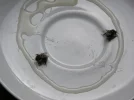
Insects (Bees) without six legs ?

Channel Hopper

Suffering fools, so you don't have to.
Staff member
My Satellite Setup
A little less analogue, and a lot more crap.
My Location
UK
I know, but today I found one small bee in the car, shortly after completing work nearby, I gave it some brown sugar solution via a kitchen towel as it was rather unresponsive to being moved off the dashboard when I wanted to travel home.

Is it a freak of nature, lost a couple by an accident, or has it actually got only four legs by whatever design it was created?

It has two pegs either side of the body by the way.
 
It probably lost a couple from just innocently sitting on a car, then all of a sudden the car took off and the poor bee lost grip on four legs and the other two got ripped off, he needs to claim some compensation there, he's got a good injuries in the workplace claim there... :-rofl2

Oh, and the best thing to revive an unwell bee is some honey, of course... :D
 
"He"?

Worker bees are all female.
 
Should've been Erica of course.

Which reminds me. Anyone remember Erica Roe? (think that's how it's spelled).
 
Obviously we are now completely off the topic of bees and on to puppies (again)

The Twickenham Streaker
ericaroe.webp
 
Ah,knew I could rely on you Topper.
 
Yes, she is an insect of course - with or without six legs

That bee was, perhaps? a bug ??
 
Definitely a bee, and now I have a bag of them (this time with six legs apiece) courtesy of a customer whose barn/outhouse is being redeveloped. They are nesting in a sports-bag that had to be removed, and after the builders threw it into the field - where it was raining heavily - I thought it might be better to move it under a wheelbarrow nearby. The builders however didn't think this a good idea, so I zipped up the bag and brought it home. They are currently enjoying a fly around in the living room and one of them has started looking at a saucer with some acacia honey I put down.

I doubt there are enough workers to keep the nest going since the helper bees number in the high thirties. I cannot see the queen as yet.

So, any ideas ?
 

Attachments

  • Bees1.webp
    Bees1.webp
    159.5 KB · Views: 33
Last edited:
Fish chips and mushy bees?????:-rofl2
 
Oh, and the best thing to revive an unwell bee is some honey, of course... :D

Seems you are right. I'm still not abolutely sure what these are, a bit small for bumble bees, a bit large for honey bees. Friendly though (famous last words).
 

Attachments

  • Bees 3.webp
    Bees 3.webp
    400.3 KB · Views: 35
  • Bees 4.webp
    Bees 4.webp
    19.5 KB · Views: 27
  • Bees 5.webp
    Bees 5.webp
    17.9 KB · Views: 32
Those are definitely bumble bees. The nest is a classic type. There is a fairly wide variation in size depending on the species.

Yours are bumble bees but if you're not sure then check here first http://www.bbka.org.uk/help/do_you_have_a_swarm.php

According to the Bumble Bee Trust there are "24 species of bumblebees, around 225 species of solitary bee and just a single honeybee species". To try to find out which bumble bee it is start here http://bumblebeeconservation.org/about-bees/identification

And good luck!
 
Hungry blighters, they'd scoffed the lot down overnight, so I refilled and put out a second saucer near the window first thing.

Many of the smaller ones are now on their way out the bag, so this week may have been close to hatching/flying moment for them. there are probably upwards of sixty still in there.
 

Attachments

  • Bees6.webp
    Bees6.webp
    47.3 KB · Views: 22
The average honey bee produces about a teaspoon of honey in it's lifetime, so that plate of honey to those little bumbles is probably like the bee equivalent of winning the lottery... :D
 
And I think the queen has emerged (unless it's a really fat male).

Not easy at all to identify from that site Paul, they move a bit too fast to get a good shot. Definitely a white tail, and yellow on much of the remainder of the body. I'll try to get closer once they've had a bit more to eat/drink.
 

Attachments

  • Bees7.webp
    Bees7.webp
    49.9 KB · Views: 28
  • Bees8.webp
    Bees8.webp
    32.3 KB · Views: 34
About the clearest and closest images I can get. And now if they are not flying around the room or looking at the decking they're all at the honey.

Once again the images show they only have four legs visible. Do bumble bees normally keep one pair tucked away ?
 

Attachments

  • Bees9.webp
    Bees9.webp
    241.3 KB · Views: 34
  • Bees10.webp
    Bees10.webp
    213.8 KB · Views: 28
  • Bees11.webp
    Bees11.webp
    204.1 KB · Views: 26
They do have six legs as standard! The rear pair are modified for collecting pollen but they're still regular sized. It's probably the front pair you can't see as they're smaller.
 
In picture three (previous post) the bee appears to be doing doughnuts or is this an optical illusion?

If there is a queen then you should be able to re-establish a colony

plenty of equipment on beebay
 
Last edited:
That's not the queen, but one of the larger (I assume) male members of the colony.

And they are onto their third teaspoon of honey, they'll eat me out of house and home at this rate, unless more of them go outside. I have a jasmin tree in bloom as well as some potted strawberry plants but they've so far ignore them.

I've narrowed the type down to either a Heath, or Barbuts, but it really isn't easy.
 
Congrats on getting that far down the ID route. Bees will always go for the easiest food source which is bound to be the stuff you're putting out. They will need pollen as well so some will be going out foraging elsewhere for that, you just haven't noticed.

What makes you think the bees are males? Certainly in honey bees the males (drones) do absolutely no work at all and just eat what the workers bring back to the colony. In fact after they've done their job fertilising the new virgin queens they're driven out of the colony by the workers to die. They'll even get their wings nipped off in the expulsion. I can't think that bumble bees would be that different.

So, those are probably workers you've seen. The queen will be in the nest somewhere laying eggs that will be new workers and, later on, the future queens.
 
Back
Top