ISS (LEO) HamTV 2395MHz

s-band

Member
My Satellite Setup
1.5m IRTE PF, Invacom SNF-031, TBS6983,
Various L, S, C, X & Ka bits. 1.2m S/X/Ku/Ka Prodelin on Az-El (being refurbished), 1.8m Precision PF with Bullseye Ku LNB or various C & X bits
My Location
Essex
Only 25 years or so since I last saw TV on S band. It's only a blank screen but it's a start.

Ham TV on ISS
A new TX was installed a couple of days ago and is transmitting a black screen. A colour bar generator and maybe a camera interface should be installed soon. Peak SNR was about 15dB at around 1555UTC today on 2395MHz RHCP. RX is a helical feed on a 1.2m dish with a MiniCircuits ZHL-1724HLN LNA, down-converted to 421.4MHz into a TBS6903.

ISS_2395MHz_RH_1-8-25_1555.webp
 
Only 25 years or so since I last saw TV on S band. It's only a blank screen but it's a start.
Ham TV on ISS
A new TX was installed a couple of days ago and is transmitting a black screen. A colour bar generator and maybe a camera interface should be installed soon. Peak SNR was about 15dB at around 1555UTC today on 2395MHz RHCP. RX is a helical feed on a 1.2m dish with a MiniCircuits ZHL-1724HLN LNA, down-converted to 421.4MHz into a TBS6903.
View attachment 164162

Capturing it with a dish of 90cm or more is going to be a challenge even if it is handheld.

I may bring out some kit I acquired in the 90s for this.
 
Quick question, are any broadcasts likely to be analogue (PAL/NTSC) ?

Two good passes later this afternoon in the Heathrow area, between two and three per day.

 
Last edited:
Quick question, are any broadcasts likely to be analogue (PAL/NTSC) ?
I don't think so. If you follow the link from my post, there's more info. Note that the TX antenna doesn't give good coverage due to its location and other things hanging off ISS. On a pass with 20 deg max elevation, the signal was visible but below threshold (2-3dB SNR for the parameters being used yesterday).

Although I down convert, most TBS 6983/6903 cards will tune 2395MHz directly so you just need an LNA at the antenna.
LEOs are difficult here. My sky view is quite limited and the tracker is not set up for fast tracking and is limited to 90deg elevation. If it needs to go over 90 deg el it turns 180 deg az which takes more than 30 seconds.
 
I don't think so. If you follow the link from my post, there's more info. Note that the TX antenna doesn't give good coverage due to its location and other things hanging off ISS. On a pass with 20 deg max elevation, the signal was visible but below threshold (2-3dB SNR for the parameters being used yesterday).

Although I down convert, most TBS 6983/6903 cards will tune 2395MHz directly so you just need an LNA at the antenna.
LEOs are difficult here. My sky view is quite limited and the tracker is not set up for fast tracking and is limited to 90deg elevation. If it needs to go over 90 deg el it turns 180 deg az which takes more than 30 seconds.
I did check the link (of the link) and there was no info on the black screen / colour bars that might appear later once they dock and a camera is imported into the Columbia bay


Everything on S band 25+ years ago was analogue, though the recent scans show DVB-S receiving equipment,
 
The kit here which is relatively easy to move about by hand. The L.O of 1838 MHz gives signal from the ISS at 557 MHz, so all that is required is the power via a isolated splitter. The Emitor analyser would be ideal as it can be taken up on the roof for a quick look while the ISS is near the horizon.

Tuning in on the TV downstairs may be beyond one pair of hands in the five minutes of the pass
 

Attachments

  • S band 1.webp
    S band 1.webp
    174.6 KB · Views: 44
  • S band 2.webp
    S band 2.webp
    257.3 KB · Views: 47
Last edited:
And yes, first pass at 2.30 (around five minutes) would give me no time to align, run downstairs and start tuning.

So, all equipment may need to be on the roof.

There is a pass tomorrow that is almost at zenith (15:18 86 degrees) so I may leave the antenna facing skywards beforehand and sit by the TV.
 
Does anyone know if the Octagon/GTMedia combos keep the satellite tuner voltage on when scanning terrestrial signals ?

With a two way splitter and cables it may be possible to set one up on the roof with a PC monitor.
 
Ah, forgot I had one of these.


Able to scan outside the usual 950-2150MHz , perhaps 550MHz is available on the app for satellite just to ensure the stuff upstairs is receiving S-band from ISS.
 
No time today, but Tuesday has a two high passes , one at 90 degrees


I did swing the CV device around earlier , a lot of terrestrial stuff on the Emitor ( 2.7-3.5 GHz), not surprisingly North East of here but for another thread.
 
Still black screen. Peaked at 12dB SNR at 53deg elevation a few minutes ago.
Good luck, CH.
 
Still black screen. Peaked at 12dB SNR at 53deg elevation a few minutes ago.
Good luck, CH.
Thanks, tomorrow is the six minute visibility, peaking at 90 degrees, around 13.40.

I will park the antenna on the middle of the roof and sit near the TV/receiver with the scan facility. I will look for the 525 combo later tonight, the app is already installed on the mobile.
 
Peaked at 14.3dB SNR during the 1415UTC pass which was 73deg max elevation. The gap in the waterfall was caused by the tracker not keeping up with the craft. The 1st half of the pass isn't recorded as trees were in the way.

ISS_1415_050825.webp
 
Thanks, tomorrow is the six minute visibility, peaking at 90 degrees, around 13.40.

I will park the antenna on the middle of the roof and sit near the TV/receiver with the scan facility. I will look for the 525 combo later tonight, the app is already installed on the mobile.
And the traffic yesterday meant I didn't get back in time. Next high pass is today at 14:28 but I may be driving again.
 
This week is turning out to be a nightmare for mid-day testing.

Saturday will be the next opportunityl but Sunday has two high passes inside two hours of each other.

Kit is on the roof pointing straight up and I have located yet another receiver that might be the one (SF4008)

A pass of little over five minutes without any tracking is going to be a nightmare.
 
Everything set for todays passes. For the first I will be using the SF4008 to power the antenna, with the IF loopthrough running to a RF Explorer set to a 100MHz range around 550MHz.

If the loopthrough of the Octagon isn't filtering out signals below satellite frequencies than I should get somethimg above the background in about 30m.
 
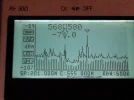
And.... just the faintest whisper

Next time I will use an isolating splitter.
 

Attachments

  • 1246.webp
    1246.webp
    262.4 KB · Views: 25
  • 1247.webp
    1247.webp
    310.9 KB · Views: 21
  • 1248.webp
    1248.webp
    265.5 KB · Views: 23
What bandwidth was the analyser set to?
With the parameters used it will keep lock down to about 3dB SNR but can be a bit picky locking initially. The best I have seen is around 15dB SNR but my 1.2m dish is blocked above about 75 degrees el. so I guess I might get a few more dB on an overhead pass. The level seems to be higher when the craft is to the east due to the antenna position on ISS.
You might just be able to get it assuming:
1.2m dish gain 27dB
Yagi about 20dB (optimisitic)
-3dB polarisation loss
So about 10dB down on my levels if the LNA in that MMDS ODU has a 1dB NF. Many dish feed type MMDS down converters do have a low NF.
 
Last edited:
What bandwidth was the analyser set to?
With the parameters used it will keep lock down to about 3dB SNR but can be a bit picky locking initially. The best I have seen is around 15dB SNR but my 1.2m dish is blocked above about 75 degrees el. so I guess I might get a few more dB on an overhead pass. The level seems to be higher when the craft is to the east due to the antenna position on ISS.
You might just be able to get it assuming:
1.2m dish gain 27dB
Yagi about 20dB (optimisitic)
-3dB polarisation loss
So about 10dB down on my levels.
Screen was set at 100 MHz across, and as you can see I - stupidly - missed the peak at 12:50 (forgot to look at the pass time closer) but I doubt it would have got much larger with feed on the tuner loopthrough.

The antenna states a gain of 30dB minimum so 27 on a circular downlink when facing the ISS directly.

I could strap the electronics onto the front of a dish but then I'm currently looking at dual axis tracking for perhaps 5 minutes of a blank video, no more than twice a day.

I will try sometime next week with an isolating full band splitter during the week though next Sunday morning also has two high passes (perhaps with video.....)
 
Back
Top