KA reception is a no go so far for me

..Thanks again for the info supplied ..
Not desperately trying to get Saorsat to view as a tv installation ..
As is well known on here ..I'm more interested in DXing ..
Capture...log and move on ..as it were.
;)
..so if it should be that I manage reception now ..and it vanishes one day in the future ...so be it.

I'm currently trying to set up a temporary offset 9E installation using a the only dish I have spare ..
A 65cm Faval offset dish..
It should be relatively straightforward using a ku lnb first ..and my new meter..
If only the rain would stop for a while .
They complain of drought in the south and east ..but like Ireland ...we have water in abundance ..
atm its 24/7
such is life..
I will of course report signal levels ..if any on ka ...once its up and running.
rgds
VS


Just got the Faval pointed at 9East ..currently scanned in the Arquiva mux 11727V ...but have to go to work now ..
will tweak for max signal later ..assuming the rain stops.
rgds
 
It would be interesting to see spectrum shot from someone in North East Scotland to confirm what frequencies are being used on the Scottish Purple beam. I think it unlikely you'd find anything being output on 20185MHz.

If you click around on the Ka-sat finder, the Irish purple footprint is recommended half ways across the Irish sea in one line between Dublin and Manchester. Whereas the Scottish Purple footprint is only recommended as far south as Dundee. That would suggest that the Irish footprint should be considerably stronger in Manchester than the Scottish footprint.
 
Based on Satbeams I reckon the Scottish beams might be stronger.

Questions:
Are satbeams actually showing the correct beams?

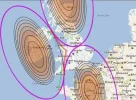
Then I added purple rings, which are roughly right, then the green is the safe for reliable operation range.

I think tooway's finder shows recommended spot, but not necessarily strongest spot at that location. They might be attempting to have an even number of people on each spot, thus encouracing some people towards a slightly weaker spot, that should have less users.

But hey even tooway/KA sat may not know what the overspill is. Also the rings are not realy round, and each ring is slightly different shape due to the curvature of the earth and the size of the spot they wanted to create.

The black lines are satbeams. The purple is my rough guess, green is my safe guess for reliable operation
 

Attachments

  • SaorSatCoverageComplete.webp
    SaorSatCoverageComplete.webp
    60.6 KB · Views: 86
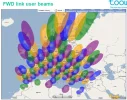
The Satbeams footprints don't quite match the Eutelsat published footprints. For example, the Satbeams Irish Purple spot is somewhat further south than the Eutelsat corresponding footprint.
 

Attachments

  • kasat_foot.webp
    kasat_foot.webp
    71.7 KB · Views: 64
..Looking at the satbeams official spot map ..Manchester appears to sit at a confluence of Yellow Purple and Blue spots ..so none are really dominant if its accurate ..(though if anything the Blue Irish spot holds and edge)
It would go a long way to explaining the High signal level ..and inability to actually lock anything ..
We need more information from actual geographical locations in order to form a better picture ..
..Till then ..we are fishing in the dark as it were..
rgds
VS
 
Tsiklon said:
The Satbeams footprints don't quite match the Eutelsat published footprints. For example, the Satbeams Irish Purple spot is somewhat further south than the Eutelsat corresponding footprint.

I wonder what Iceland and Latvia did to upset Eutelsat.
 
...Ok ..finished work for the day
..and yes ..its still raining so no fine tweaking for me.
I did however just swap out the ku for the ka lnb to get an idea of sig strength..
A steady 5.5 db showing on the F15 ..setup not maximised..but still appears to be a blank carrier..
..no change there..
but the 5.5db is being seen in rain soaked conditions on a 65cm dish ...lnb at the focus.
I have a suggestion to any of our Irish members who have access to either an F15 or an openbox S9HD ..
Perhaps you could scan the channels in and forward the channels database ..so I can upload it into the box by usb stick.
Then I can try again ..with the channel settings already installed.
Worth a try ...?
I'm thinking that ..since I can't pull the info from the stream ..perhaps already having them might give me the edge..

..this would also prove both boxes compatibility to resolve the signal ...at your end of course.
rgds
VS
 
This thread is absolutely fascinating.

Still holding out for some decent weather here so I can play with C-band :D
 
Interesting that there should be such a wide variation in this 'signals' level over a 12 hour period..
As previously said I swapped out the ku for for the ka in the rain about 5:30 last night ..
Not fine tuned but the F15 showed a 5.5db signal was present and lockable if the was anything to lock to.

The rain finally stopped about 2 hours later ...but the signal hit the lowest level at 3db ..a 2db shift as it dried up ..so we can ignore rain fade.
By 10pm the level had risen steadily to around 6.5 dm ...and by midnight it briefly hit 8db..
I looked again at 1:30 just before I went to bed ..signal level at 7db..
Checked again this morning around 9:am signal at 6.5 db ...and it hasn't rained since wednesday evening ..
This signal ...whatever it is ..(and I suspect a confluence of at least 2 spots) rises and falls by as much as 5 db over 12 hours..
interesting ..and yet impractical .. but then it may only happen at overlap points.
rgds
VS
 
After reading through all this, it goes to prove that satellite broadcast engineers know their stuff.
They are able, with Ka spots to almost precisely target a specific area and limit overspill.
This allows RTE to pay far less for, particularly, American tv series, as they can give a fairly accurate, and relatively small, audience size.
Case in point is the new series "Homeland", just started on Channel 4, we have been watching it on RTE 2 HD for over a month now. In the past "Lost" was another which was always a couple of weeks ahead here, due to almost no overspill.
They have, in their case, done a very good job.
If Ku was capable of being so tightly focussed, then that would be bad news for all of us that love this hobby.
As it stands there is little chance of us all having to swap over to Ka, thank goodness for that.
 
excollier said:
After reading through all this, it goes to prove that satellite broadcast engineers know their stuff.
They are able, with Ka spots to almost precisely target a specific area and limit overspill.
This allows RTE to pay far less for, particularly, American tv series, as they can give a fairly accurate, and relatively small, audience size.
Case in point is the new series "Homeland", just started on Channel 4, we have been watching it on RTE 2 HD for over a month now. In the past "Lost" was another which was always a couple of weeks ahead here, due to almost no overspill.
They have, in their case, done a very good job.
If Ku was capable of being so tightly focussed, then that would be bad news for all of us that love this hobby.
As it stands there is little chance of us all having to swap over to Ka, thank goodness for that.
Agreed EC..
They have every right to use these tightly focussed beams to protect their interests...but there's no denying ..that from a hobbyists perspective it is most frustrating that you nearest land mass neighbour is receiving a broadcast that you have less chance of dxing ....than say South America..
The signal variations I've seen on trying to dx this ka footprint is more difficult and more variable than picking up Somalian TV in C band ..
..and I'm not a Somalian Pirate....
;)
rgds
VS
 
Vipersan said:
..and I'm not a Somalian Pirate....
;)
rgds
VS


Bah.

Another illusion shattered.
 
It's all about money.
The money (or lack of it, in the case of RTE) always wins in the end!
 
Tsiklon said:
The Satbeams footprints don't quite match the Eutelsat published footprints. For example, the Satbeams Irish Purple spot is somewhat further south than the Eutelsat corresponding footprint.


If u click this link it will bring you to a google map.

Earth Point Excel To KML - Google Maps

This is EXACTLY based on tooways "which colour should I use info" rather than satbeams information. At the moment I have only added the data for the Irish purple spot.

Note: This does NOT show the spot coverage, it shows where the recommended spot is purple, not coverage. However in South West Ireland it shows the edge of the coverage ring.

On the welch coast it shows not the end of the spot, but the point where the green spot starts to be recommended instead of the purple spot.

In northern Ireland/scotland edge it shows where the blue beam starts to be recommended.

Hopefully next week I'll have a better map, with all the UK spots

But from this info, it seems as if coverage in Manchester may be better than I thought. If you "clone" the left hand side of the map, then flip it to the right. It should give a better spot coverage, if you get me ....
 
Vipersan said:
Interesting that there should be such a wide variation in this 'signals' level over a 12 hour period..
As previously said I swapped out the ku for for the ka in the rain about 5:30 last night ..
Not fine tuned but the F15 showed a 5.5db signal was present and lockable if the was anything to lock to.

The rain finally stopped about 2 hours later ...but the signal hit the lowest level at 3db ..a 2db shift as it dried up ..so we can ignore rain fade.
By 10pm the level had risen steadily to around 6.5 dm ...and by midnight it briefly hit 8db..
I looked again at 1:30 just before I went to bed ..signal level at 7db..
Checked again this morning around 9:am signal at 6.5 db ...and it hasn't rained since wednesday evening ..
This signal ...whatever it is ..(and I suspect a confluence of at least 2 spots) rises and falls by as much as 5 db over 12 hours..
interesting ..and yet impractical .. but then it may only happen at overlap points.
rgds
VS

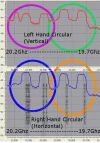
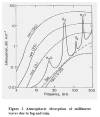
Unfortunately, rain fade is an issue, especially at Ka-band frequencies. This is backed up both by the physics and personal experience having monitored the Saorsat transmssions since the middle of last year.

Are the signal strength levels from the F15 reliable? The size of the signal fluctuations seem suspiciously large to me.
 

Attachments

  • signal.webp
    signal.webp
    23.1 KB · Views: 63
Thanks again for the info ZG...
If you know anyone who can provide a channel database already scanned for eithe the Openbox S9HD or for DRHD F15..
I'll load the channels pre scanned into the box(s) and give it another go ..otherwise I'm going to have to admit defeat ..for now that is.
rgds
VS
 
Tsiklon said:
Unfortunately, rain fade is an issue, especially at Ka-band frequencies. This is backed up both by the physics and personal experience having monitored the Saorsat transmssions since the middle of last year.

Are the signal strength levels from the F15 reliable? The size of the signal fluctuations seem suspiciously large to me.
Absolutely reliable Tsiklon..
The most reliable box I've ever owned ..
And you'll also note that I had 5.5 db in the rain ..which dropped to its lowest at 3db 2 hours later in dry conditions ..
The exact reverse of what you'd expect ..

next time I try ..I'll take photos of the on screen displayed levels..as shown on the TV ..
Its the db level ..which equates more to Q rather than overall signal level.. I suspect
you can't strictly speaking use the on screen meters of the F15 in the same way you would a meter as such

I'll also try the same experiment on the S9 ....and my sat meter when I get a chance.
rgds
VS
 
Vipersan said:
Thanks again for the info ZG...
If you know anyone who can provide a channel database already scanned for eithe the Openbox S9HD or for DRHD F15..
I'll load the channels pre scanned into the box(s) and give it another go ..otherwise I'm going to have to admit defeat ..for now that is.
rgds
VS

I have already PM'd an irish guy with an F15. No response yet.
 
Vipersan said:
Absolutely reliable Tsiklon..
The most reliable box I've ever owned ..
And you'll also note that I had 5.5 db in the rain ..which dropped to its lowest at 3db 2 hours later in dry conditions ..
The exact reverse of what you'd expect ..

The drop in signal once conditions had improved could be down to the Ka-band losses at the dish surface (or more likely humidity on, or inside the feed), and there is always the chance of scintillation fade at these frequencies, which would show up as a varying drop in signal.

_http://www.scientiairanica.com/PDF/Articles/00000257/SI100415.pdf
 
Back
Top