Make Gregorian dish

That 82 degree angle means that the lnb is looking far over all sides of the dish .
That shows that there is still a enough signal even wenn the lnb is not pointed to the exact focal point of the dish
 
That shows that there is still a enough signal even wenn the lnb is not pointed to the exact focal point of the dish
You are right. But at the same time LNB can pick up more noise if it is not looking at the right spot- "Le point G"
 
Would be very interesting to see some drawings from members interested and participating.
 
And, in parallel of drawing your nice pictures of IBU, start ti find answer to my previously posted question: How to draw an ellipse if you know locations of its focuses and you also given 2 dots on surface of ellipse? Is that possible at all?
Not totally with you Rima :confused

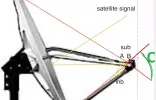
Where exactly would the sub be located. At point A in my diagram, where the edges of the open angle hits the edges of the sub or point B where the focal point is in the centre of the sub? Or elsewhere. Obviously you would need a small parabolic dish for the sub and have to calculate it's focal point to work out the position of the lnb, which would in turn need to be sited so that it's phase centre is in line with the focal point of the sub. Am I getting this right?Untitled 2.webp
 
Not A and not B, somehow like C. But you probably go too fast. ScreenHunter_60 Oct. 20 21.27.webp
 
Obviously you would need a small parabolic dish for the sub and have to calculate it's focal point to work out the position of the lnb, which would in turn need to be sited so that it's phase centre is in line with the focal point of the sub. Am I getting this right?
Totally wrong about parabolic! We gonna design Gregorian type system, that means subreflector should have ellipsoidal shape.
 
Returning to the question about ellipse, this is simple picture which can help to draw. ScreenHunter_62 Oct. 20 21.40.webp
 
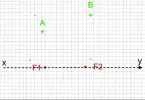
So: How to draw an ellipse if you know locations of its focuses and you also given 2 dots on surface of ellipse? Is that possible at all?
Can you draw ellipse on attached picture with focuses F1 and F2 and points A and B would rest on line of ellipse? ScreenHunter_63 Oct. 20 21.45.webp
 
Not on that flat plane, no. It might be possible by going into other dimensions but that's a bit beyond me.
 
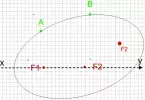
Yes, we are speaking about flat plane. You are right PauIR. in those conditions it is impossible to build ellipse. But, if we properly change position of one of the focuses than it will be possible to get points A and B on curve of ellipse. We will use this for continuation of our work - will change position of F2 till it is possible to draw ellipse connecting points A and B.
 
Not totally with you Rima :confused
Obviously you would need a small parabolic dish for the sub
No, you don't want a parabolic sub-reflector. A Parabolic reflector would convert your incoming cone of wavefronts into a circular (tubular) wavefront again, much as the one picked up by your first reflector coming from the satellite.

Instead, you want the end of an ellipsoid (of which the sphere is a special case with both focal points (pins holding the string) co-inciding). This will reflect the incoming cone properly into a single point (if positioned as RimanTSS has drawn above as 'C').

Don't worry, this is by no Means straightforward - calculating and creating a proper reflector system is not easy, especially if you do not have access to precision milling and metal workíng equipment. But you may get remarkable results if you try hard enough! (That's what's so fun about this - figuring out the shortcuts and can-do stuff.).
 
Nothing happens?! No drawings? No interest? Should we continue? :D
 
Nothing happens?! No drawings? No interest? Should we continue? :D
Well I'm still interested. But I do have a life away from this forum, as I'm sure you all do!

I'm a bit lost as per your request of a drawing of an ellipse. Yes, I can draw one, there are several different ways to do this. But what measurements are we to use? Is your diagram in post#50 to scale of some sort (1 square = 10cm?). Are we to use this as a template?

Re post#47 so the sub will sit beyond the point of focus? Does the signal converge at the point of focus and then spread out again after that point? Just asking so that I understand how this works. (I might not be using the correct terminology so please feel free to correct me!)
 
Well I'm still interested. But I do have a life away from this forum, as I'm sure you all do!
Oh, yes...
Re post#47 so the sub will sit beyond the point of focus?
Yes
Does the signal converge at the point of focus and then spread out again after that point?
Yes
Just asking so that I understand how this works. (I might not be using the correct terminology so please feel free to correct me!)
Perfectly clear.
 
Totally wrong about parabolic! We gonna design Gregorian type system, that means subreflector should have ellipsoidal shape.
Ok, I'm with you now, I think.
Ellipse = 2 dimensional shape in a flat plane
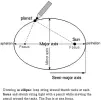
Ellipsoidal = 3 dimensional shape (a concave ellipse, yes?) As per picture.

Untitled.webp
 
if we properly change position of one of the focuses than it will be possible to get points A and B on curve of ellipse. We will use this for continuation of our work - will change position of F2 till it is possible to draw ellipse connecting points A and B.
So you want us to determine the actual final position of F2 so that when drawn using F1 & F2 as the two fixed pins for the formation of the ellipse, the edges of the ellipse will pass through points A & B, is that correct?

So to determine where the final position of F2 is we will have to adjust it's position along the axis x-y, as per the diagram, is that correct?


Untitled.webp

:)
 
Ok, I'm with you now, I think.
Ellipse = 2 dimensional shape in a flat plane
Ellipsoidal = 3 dimensional shape (a concave ellipse, yes?) As per picture.
Right! SUB of Gregory type antenna has shape of the cut of rotatory ellipsoid (shape similar to melon). Of course, our "melon" should be at right size, dimensions and with properly made cut.
So you want us to determine the actual final position of F2 so that when drawn using F1 & F2 as the two fixed pins for the formation of the ellipse, the edges of the ellipse will pass through points A & B, is that correct?
Yes that what we will be doing.
So to determine where the final position of F2 is we will have to adjust it's position along the axis x-y, as per the diagram, is that correct?
Will not limit position of F2 by moving it only along the X-Y axe, it's position could be anywhere.
But more important for everybody, at this moment, is to find the way how to draw ellipse. It could be easily done on paper or electronically, you chose your own way. For example like this ScreenHunter_69 Oct. 23 18.01.webp
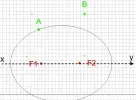
For example, here I drew ellipse from focuses F1 and F2 and outside line of ellipse goes via point A ScreenHunter_67 Oct. 23 17.39.webp
But, if I move F2 to another place, I can draw ellipse from focuses F1 and F2 and A and B are also connected by line ScreenHunter_68 Oct. 23 17.58.webp
 
Back
Top