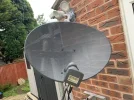
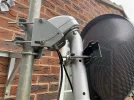
Multi LNB Set up on a Sky Dish

FWIW, when I find Thor at 0.8W with a steerable dish, I fix a cane/ stick /piece of wooden batten a short distance in front of it ,and inline with that sat, so that I can easily repoint the dish towards Thor again if I later "lose the plot" - the one in front of the Gibby is on the end of the greenhouse, and the one in front of the TD110 is on the top side edge of the garage - and that certainly "worked" and saved me a lot of time and "angst" over the years! :D
 
The width of the dish (of just the reflecting area) is 103cm, and the height is 113cm. That gives an offset angle of 24.3 degrees.

The topstring is 118cm and the bottomstring is 64cm - I'm not too sure on how to do that calculation.

That would give about 28.5 degrees offset for the present position of the LNB feedhorn (for focal point about 1.5 cm from the LNB front).

Calculation: see of course Satellite TV - Scientific Analysis - 2 Dish & Rotor Settings
(But this is certainly not a preferred method to calculate the offset angle of a dish, but just the method to calculate the present offset position of the LNB; other than Charles Macfarlane wrote there.)

I agree that there are questions to ask about the proper LNBposition for this dish. If you want to go further with it, I would do mm-precise measurements on it (height and width), and 1/2 mm-precise measurement on depth at the center; all of course on (the edges of) the working paraboloid surface of the dish... and tested that the dish is actually exactly flatfaced...

greetz,
A33
 
I have set the zone 1 dish up again today. I put the motor to zero, put the dish on the centre of the motor, and then drove it to Thor and aligned it.

When the dish is at Thor, I can get some TPs and channels. But when I’m driving it any other say, it seems to ‘overshoot’ it, and moves a bit too far. If I use the east/west button to adjust it manually, I am able to adjust to get a signal.

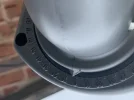
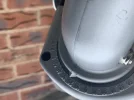
The first picture of the motor, near 5 is where it points to when I drive it to Thor using USALS.

The second, near 35, is where USALS drives it to for 28e. The third pic, where it points near 25, is where I need to adjust it to, to receive a picture for 28e.
 

Attachments

  • CCB40413-5049-4419-8EE6-5022531AAC6E.webp
    CCB40413-5049-4419-8EE6-5022531AAC6E.webp
    53.9 KB · Views: 15
  • F48F5EF6-94F7-4596-9CC4-5E32EB89C6E1.webp
    F48F5EF6-94F7-4596-9CC4-5E32EB89C6E1.webp
    31.1 KB · Views: 15
  • 450711AD-0D3D-42B4-8F57-6F0C78BB5519.webp
    450711AD-0D3D-42B4-8F57-6F0C78BB5519.webp
    81.9 KB · Views: 20
  • 0520DE13-E5A3-45E5-84FE-6E76DC342CC1.webp
    0520DE13-E5A3-45E5-84FE-6E76DC342CC1.webp
    77.1 KB · Views: 20
  • CECFA2E5-271A-41EB-ADD5-E60CE31A93C5.webp
    CECFA2E5-271A-41EB-ADD5-E60CE31A93C5.webp
    18.3 KB · Views: 19
  • 1C33887D-8089-4B7A-BD78-08F1EFF3B09F.webp
    1C33887D-8089-4B7A-BD78-08F1EFF3B09F.webp
    22.2 KB · Views: 15
  • 11A19394-ED5C-4DCF-8A2F-EFBCD2140B68.webp
    11A19394-ED5C-4DCF-8A2F-EFBCD2140B68.webp
    22.2 KB · Views: 16
Have you set your longitude and latitude correctly on the receiver?
 
If it overshoots under USALS control then the elevation setting is probably a little too high - and the reason you get some transponders on other sats using the E&W buttons on the motor is because you have more precise control on exactly how far E or W the dish is moved before it stops.

Thus, from the above, slightly reduce the elevation setting " a very little at a time".
 
Don't forget negative Longitude readings = West, positive = East.
 
I’ve set the lat long as 52.7N, 2.1W. Rounding to the nearest 1 decimal place.

With the motor, when it is at Thor, should it be pointing nearer to 0 rather than 5 (as on my motor)?

If it overshoots under USALS control then the elevation setting is probably a little too high - and the reason you get some transponders on other sats using the E&W buttons on the motor is because you have more precise control on exactly how far E or W the dish is moved before it stops.

Thus, from the above, slightly reduce the elevation setting " a very little at a time".
Is that the elevation on the dish or the motor?
 
You should turn your motor to most far east/west position you want to receive and improve your dish alignment. The best way to do it is IMO to push the dish with tightened screws in different directions, to check, where you are getting the best signal. 28.2°E and 30°W will do the job.

PS: I had a rotating dish as well here at 13° E. Quite funny to see a rotating dish receiving its home sat so far in the "exotic" east. 28.2°E at your place is like 42°E here.
 
Your true south is your Longitude position, so when your dish is pointing to 1W your motor should be pointing to 2.1 West, if that is your correct longitude.
 
I re did it. Earlier I was aligning the dish to my markings for Thor. Now I aligned the motor instead to the markings, and it is tracking the arc.

It was overcast today so I couldn’t get a good lock on Thor to fine tune the dish. I am missing a fair few transponders, but it was a good exercise for me.

I’ll grab a new dish in the next few weeks and switch it over, hopefully with better luck.
 
The Sky LNB is optimised for the dish shape and skew at 28.2E. Along with the small dish size reception of any satellite other than the very strong ones is a bonus - 1W in particular as it has some H & V transponders using same frequency, so anything but perfect skew will result in interference from the opposite polarisation.

If you think you are tracking the arc reasonably well you could try your other dish again.
 
The Sky LNB is optimised for the dish shape and skew at 28.2E. Along with the small dish size reception of any satellite other than the very strong ones is a bonus - 1W in particular as it has some H & V transponders using same frequency, so anything but perfect skew will result in interference from the opposite polarisation.

If you think you are tracking the arc reasonably well you could try your other dish again.
I’m going to try and get hold of some wing nuts to make it easier, and then I’ll probably that again.

In theory, if you have one larger and one smaller “round” dish of the same make/model etc, would one be easier to align than the other?
 
I’m going to try and get hold of some wing nuts to make it easier, and then I’ll probably that again.

In theory, if you have one larger and one smaller “round” dish of the same make/model etc, would one be easier to align than the other?
It's usually "swings & roundabouts" ::rolleyes:
- the larger dish should pull in more of the weaker sat transponders and give higher signal levels - but only when "correctly" aligned, and that can be more difficult because the beamwidth is narrower than a smaller dish, and it may well be heavier and more difficult to align;
- the smaller dish will basically be the opposite of the larger dish (as above)!
 
I have spoken too soon about the dish tracking the arc perfectly. I did a blind scan on 16e and realised that I am getting hotbird channels, and some 19.2e channels appeared when the motor was at '21.2e'. :eek:

So now I have an undershoot rather than an overshoot as earlier. I'll try and resolve this when I upgrade the dish. The arc tracking is better than before, as I wasn’t getting any trasnsponders on 28e, but there is work for me to do. :(

I tried the larger dish again today, using the smaller dish as a marker for thor, still nothing. Unfortunately I think I need to admit defeat with that max digital dish for the time being. On a side note, I did find an old Technomate 1m dish on eBay this morning that had the same dish-to-pole bracket as the maxx digital dish; given they've got a few bad reviews, I'm not too surprised with the outcome with this one.

I might go ahead and set up the other dish I was planning into in the next few weeks or so, I've been on the look out for some cheap paint, would the below work?

 
Small dishes have a wide beam width i.e. signals are received from a wider angle, its the reason they are initially simpler to set up as it's easier to find a signal. For example if you point a 60cm dish at 26E, it will also receive signals from 28.2E. Receiving 19.2E when pointed at 21E is not unexpected on a tiny dish.
 
Ref that red oxide primer - it would be MUCH quicker & easier to use spray paint and the "finish" will be more even & smoother.
 
I have set the zone 1 dish up again today. I put the motor to zero, put the dish on the centre of the motor, and then drove it to Thor and aligned it.

When the dish is at Thor, I can get some TPs and channels. But when I’m driving it any other say, it seems to ‘overshoot’ it, and moves a bit too far. If I use the east/west button to adjust it manually, I am able to adjust to get a signal.

The first picture of the motor, near 5 is where it points to when I drive it to Thor using USALS.

The second, near 35, is where USALS drives it to for 28e. The third pic, where it points near 25, is where I need to adjust it to, to receive a picture for 28e.
hey mate - why you bothering with a motorised sky dish - get a proper offset 60cm or 80cm or something, im sure alignment would be be easier.
 
hey mate - why you bothering with a motorised sky dish - get a proper offset 60cm or 80cm or something, im sure alignment would be be easier.
I’ve got a 1.1m dish, a freebie that I was given to me. But I couldn’t get any signal on Thor on that, even when using it as a fixed. As I had the motor and the poles already set up, I just put on a spare zone 1 that I had lying around. It’s on temporary, I’ll probably upgrade to a bigger dish in a few weeks.
 
couldnt get a signal on 1w with a 1,1m - you werent doing something right :) do you have a cheap satellite finder, did you use dishpointer with your co-ords?
 
I’ve got one of those GT media sat finder that connects to your phone, I was also using my receiver at the same time. I managed to get 1w on the zone 1 and then even used that as a marker for the larger dish, but still nothing.

I'm not certain if it is down to issues with the dish or my inexperience; I think its probably a combination of the two.
 
Back
Top