deeptho
Specialist Contributor
- My Satellite Setup
- Wavefrontier T90, Laminas 120cm, 2 other dishes; tbs 5927, tbs6904, tbs6909x, tbs6903x, tbs5990, tbs6981,tbs5927
- My Location
- Europe
No split of the frequency range in most of the LNBs we use (Invertos, SMW, XMW, Norsat etc). Just the one LO to cover the whole range. An exception would be the Inverto Saorsat or some Hughes LNBs, which use Ka B 19.7 to 20.2 GHz (higher 500 MHz). Or a more exotic LNB like my Gilat AN8024 ( four LOF's).What would be good defaults for the local oscillator frequencies of Ka bands A,B,C,D,E?
Currently I assume that each of the Ka span 1 GHz of bandwidth, which is split in
a low and a high part of each 500 Mhz, which each have a different local oscillator frequency.
I also assume that these are the bands:
Ka A : 18.2 - 19.2 GHz
Ka B : 19.2 - 20.2 GHz
Ka C : 20.2 - 21.2 GHz
Ka D : 21.2 - 22.2 GHz
Ka E : 17.2 - 18.2 GHz
No split of the frequency range in most of the LNBs we use (Invertos, SMW, XMW, Norsat etc). Just the one LO to cover the whole range. An exception would be the Inverto Saorsat or some Hughes LNBs, which use Ka B 19.7 to 20.2 GHz (higher 500 MHz). Or a more exotic LNB like my Gilat AN8024 ( four LOF's).
So for the four KA bands, you would need to have the default four local oscillators thus -
Ka A : 17.25 GHz
Ka B : 18.25 GHz
Ka C : 19.25 GHz
Ka C : 20.25 GHz
Any LNBs that use LO's outside of those ranges would I suppose have to carry on using the LNB C option in the LNB list.
I think 18.25 LO is just a misprint on the page, as the LNB's label gives the correct LO of 17.25.I guess these things are not as standardised as other LNBs.
By the way, I found a chinese Ka-band lnb here:
_https://www.aliexpress.com/i/1005002629719890.html?gatewayAdapt=glo2fra
L.O frequency:18.25GHz
Satellite:19.2ºE,42ºE
19.2E has muxes in the range 18.5-18.8 Ghz which should be band A, but the LO according to your list
would be fore band B. 42.E has muxes between 18.7 and 18.8.
With an LO of 18.25Ggz the RF output for 18.5-18.8 should be in the range 250Mhz - 750Ghz, which
does not make sense. So something seems wrong. Maybe the oscillator is 17.5 GHz?
And indeed: the picture (after magnification and rotation) says
input: 18.2-19.2Ghz
Output: 950 - 1950 Ghz
Gain: 50 dB noise. 0.7dB
Would it be useful in Europe to invest in such band A LNB, given that it is still quite expensive?
I have just uploaded the code for neumoDVB version 1.0.
This version has many changes.
Important:
The full list of changes can be found here:
- You will need to use the latest blindscan drivers in order to make use of all features without problems.
- It is possible to use neumoDVB with the standard TBS drivers, but features such as spectrum scan, blind scan, parallel scan and constellation display will not work.
- Due to an incompatible change in the database format, you will need to re-enter your LNB and USALS information. Other data, such as services, muxes, ... is preserved.
- You will need to read the documentation to understand how LNBs should be configured, because this has changed in the new version.
![]()
neumodvb/docs/changes.md at master · deeptho/neumodvb
neumoDVB DVB-S2/DVB-T/DVB-C settop box and DX program for Linux - deeptho/neumodvbgithub.com
Some highlights include:
- New database format: data related to local setup is now stored in anew database, called devdb.mdb Also, the definition of LNBs and frontends has changed to better support new features. As a result of the move, old LNB definitions will be lost and need to be reentered. The remaining database now contain data that is independent of the local hardware setup and can therefore be shared with other users.
- neumoDVB now makes better use of cards with and RF mux. These cards, such as TBS6909x and TBS6903x have multiple tuners (e.g., 4) and even more demodulators (e.g. 8). The RF mux allow connecting any demodulator to any tuner. This means that all demodulators can reach all connected satellite cables. Also, multiple muxes can share the same tuner and thus tune to multiple muxes in the same band and with the same polarisation simultaneously.
- neumoDVB can longer needs concepts like "slave tuners" because all tuners can use al RF inputs. So the concept of slave tuner has been removed.
- Parallel blind scan on supported cards, neumoDVB now uses all available demodulators to scan muxes. This makes blind scanning (almost) 8 times faster on supported cards
- Parallel SI scanning was already possible in neumoDVB, but now it can exploit more parallelism by setting the RF mux than before.
- Faster scanning: neumoDVB processes transponders with many (more than 200) multi-streams much faster by detecting streams which are not transport streams.
- Improved spectrum analysis: very wide band muxes are no longer detected as dozens of very small peaks, but as a single or a small number of peaks. This speeds up blind scanning as well. The estimated symbol rate of peaks used to be very inaccurate and is not more accurate.
- Change voltage from 0 to 18V in two steps to avoid current overloads when many diseqc switches switch simultaneously.


Edit - Posted after your last post.Hello Llew,
your configuration looks ok.
The SNR on 10714H seems quite low. Perhaps the signal is border line and neumoDVB tries too hard to get SI data
When you say that it finished on 12691H, did a message box po up that mentioned that it was finished?
If so, then can you provide /tmp/neumo.log
That was fast for a full spectrumLLew,
I just double checked using tbs6909x (so not the same card), and 28.2E scans without problem: 57 muxes locked in 3 min and 30seconds.
I also have got 867 services which seems the right order of magnitude.
two muxes were listed with TEMPFAIL. I think this can only happen on tbs6909x when it tries to scan too many high symbolrate muxes at once.
In that case, it should retry later but that is not implemented yet
I just noticed that there seems to be some error in the status message in the screenshot (DVB: 1)
Could you check your cables? Your SNR on 10714H seems much too low. I get 15dB on a 1m dish.
View attachment 146054
Could you check your cables? Your SNR on 10714H seems much too low. I get 15dB on a 1m dish.
LLew,
I just double checked using tbs6909x (so not the same card), and 28.2E scans without problem: 57 muxes locked in 3 min and 30seconds.
I also have got 867 services which seems the right order of magnitude.
two muxes were listed with TEMPFAIL. I think this can only happen on tbs6909x when it tries to scan too many high symbolrate muxes at once.
In that case, it should retry later but that is not implemented yet
I just noticed that there seems to be some error in the status message in the screenshot (DVB: 1)
Could you check your cables? Your SNR on 10714H seems much too low. I get 15dB on a 1m dish.
View attachment 146054
I'll try that myself. Meanwhile, I'll do another spectrum scan - I'm using my old Sky dish, which yesterday underperformed because the rainy conditions prevailing.I have the same issue, it disappeared completely when card was attached directly to LNB...

I did not mean scanning issue, but distortions with cable
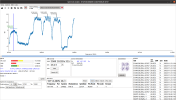
View attachment 146061View attachment 146062


According to the pictures, it looks like a badly set SKEW or insufficient separation of polarizations in the LNBNew build, same problem on 10714 polarities.
It's a V polarity presence that doesn't exist in reality. Cross-polarisation due to a wrongly adjusted LNB (or a high power signal interfering with an opposite polarity).Also, cant tell what you mean by ghost at 10914.