Project: Creating a TV channel

I have no desire to start a pirate radio. As a registered radio amateur, my shack was already inspected once (all ok), but I do not want any trouble. It is awkward to have strange people come inside your home and check your gear. They were quite amazed with what they saw, but all within the law.

Me broadcasting over the air is in theory not legal, but since the output power is so low that it barely reaches 50cm, I am confident that it would be easier to find an interference caused by my daughters hairdryer than my "broadcast".

The same with the content: I am consuming it myself and not giving access to it to anyone else. All screenshots are low resolution and I doubt that MTV would send me a cease and desist letter for posting about my lab grade "Beavies and Butthead TV" test channel.
 
Not really. One radio station mentioned on this forum broadcast for several months or perhaps even years, before it was finally confiscated, after which it returned on DAB and shortwave. Last time I checked, many pirate stations were available on or near the medium wave (many Dutch ones and one or two from Italy). On shortwave there was also Charleston International with 100 year old music.

But indeed, the Dutch were better at piracy than the English:-->
My post was referring to the UK, other countries may not use the same tactics and knowhow when responding to out of frequency 'noise'.
 
As a radio amateur I have have some insight on how it works in Portugal.

There are no vans driving around the neighborhood scanning the RF spectrum.

Instead, they follow up complaints. If suddenly your mobile internet on the phone does not work when the neighbour arrives, you or your operator will file a gripe.

This will then investigated and the source of the interference will be determined by triangulation. The offending device is determined and the owner must repair or dispose it. Failure to do that might result in fines.

Another story is the illegal broadcast on frequencies for which you have no legal authorisation. This might get you in much more trouble. Operating an unlicensed radio or TV station might result in (suspended) jail time.
 
As a radio amateur I have have some insight on how it works in Portugal.

There are no vans driving around the neighborhood scanning the RF spectrum.

Instead, they follow up complaints. If suddenly your mobile internet on the phone does not work when the neighbour arrives, you or your operator will file a gripe.

This will then investigated and the source of the interference will be determined by triangulation. The offending device is determined and the owner must repair or dispose it. Failure to do that might result in fines.

Another story is the illegal broadcast on frequencies for which you have no legal authorisation. This might get you in much more trouble. Operating an unlicensed radio or TV station might result in (suspended) jail time.
Confiscation of equipment (at the very least) and a fine is more likely. In some countries, pirate stations just had a stack of FM transmitters in storage. Once confiscated, they were back on air within hours from the same location. Compared to the income from advertisement, that was a small cost. The pirate hunters were happy as well, because they did knew where to go every few weeks or months to meet their quota. The listeners were happy. The advertisers were happy. Also, as a result there was more choice of music and even innovation.

I remember the times when "popular music" was restricted to a few hours per week on state run media because the government decided you should only listen to classical music. Once pirate radio took off, the FM band was so crowded that with special antennas it was possible to receive dozens of channels. They made no secret of their address (people sent in requests to play certain songs) Some of them used relay stations and/or transmitters of up to 40KWatt. Others set up live broadcasts from public spaces, attracting large crowds. After a while, national broadcasters had to give up the ambition to remain boring.

I am pretty sure some of those pirate operators were also radio amateurs and indeed they risked loosing their license if caught. A few radio stations caused interference, but most actually did not, which meant the operators probably had some idea of what they were doing. And of course there was the thrill factor.

From a technical point of view it is more interesting to experiment with antennas and transmit circuits. There is no need to use large powers then. 100 mWatt is plenty. Still illegal of course.
 
Update:

1780167047614.webp

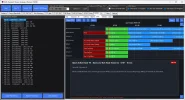
I can now create a TS with 4 channels, all with automatic EPG and teletext. Possibility to include LIVE feeds.

Further applications include:

VMA Normalizer: prepares uploaded videos to be compatible for TS insertions
VMA Failover Switcher: allows to run two copies of VMA MUX (same PC or different PC's) - if VMA MUX Master fails, synchronized VMA MUX Slave is activated (maximum delay 1 second). An alarm is issues and after restoration of the Master, the TS can be switched back from Slave to Master.
VMA EPG Content Generator: Requires a valid (commercial or non-commercial) API Key at TMDB to automatically generate teh EPG information for each video file
VMA Teletext Generator: Allows automatic and static generation of teletext pages, includes an editor and a bitmap to teletext mosaic converter
VMA Playout Controler: Allows to start all apps in a preconfigured way

All apps can be remote controlled via a web browser.

The VMA Playout Package requires some further development and finishing, but I am happy to say it works in a stable way, even when modulated to DVB-S/T/C on real receivers and TV's.
 
The goal is to provide a simple and highly automated playout solution for:
  • Hotels and resorts
  • Hospitals
  • Cruise ships
  • Corporate TV channels
  • Universities and schools
  • Museums and exhibitions
  • Local/community broadcasters
  • IPTV operators
  • Cable headends
  • Test labs and training facilities
The focus is on ease of use and automation. Content can be uploaded, scheduled and managed remotely, while EPG, teletext and channel operation are handled automatically.

The idea is that a single person should be able to operate one or multiple TV channels without requiring a dedicated broadcast engineering team.
 
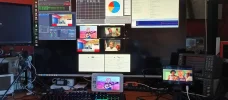
Producing the 4 channels - one is a LIVE "News Feed"...

And outputting a Multicast to VMA Transport Stream Analyser and from here to VMA Mosaic.

IMG_20260531_191144_636.webp

Using two Dektec Modulators and two DtLoop sessions, the TS is being modulated to DVB-T and DVB-S2. The small TV in the middle is receiving DVB-T, the small monitor on the right is connected to a GTmedia V7 Pro and showing the DVB-S2 transponder.

All that is missing is a DVB-T amplifier and antenna, as well as a satellite uplink converter, amplifier and antenna...
 
1780470818039.webp

1780470835790.webp

1780470884095.webp

Expanded and improved VMA MUX to support 8 services, each with EPG and teletext.

This is now a self-contained playout solution: no hardware besides the PC is required for UDP TS generation in unicast or multicast. Add an ASI output card and an external modulator, or use a PCIe/USB modulator directly, and the generated multiplex can be fed into a real DVB-T/DVB-S/DVB-C RF chain.

1780471101844.webp

1780471094639.webp

I am using Dektec DTA-2174 and a Promax MD-170 DVB-T modulator and/or a Dektec DTA-2115 modulator (also tried successfully with Dektec DTU-315 - a USB modulator).

1780471080858.webp

I am in broadcasting mode...
 
Fantastic software solution. What is the recomended PC spec to run this?
 
I am using an Intel Core i9 and a RTX4070Ti.
Dektec DTA-2174, or similar ASI Out capable card from Dektec, and production modulator in 19" rack or Dektec modulator like DTA-3115 or DTU-315 or, best bet, any second hand Dektec modulator from eBay at much lower price.

Without modulation you can still use the TS for IPTV and stream it in unicast or multicast inside the network.

But beware that you need a suitable network infrastructure with managed switches that support IGMP Snooping: How to configure IGMP Snooping for IPTV network on L2 Managed switches using the new GUI | TP-Link Portugal
 
Back
Top