Restoring a working antique dish to full functionality..

Picture 2 says it all, she has a wobbly bottom and top. Petalised dishes are unfortunately subject to warpage (as are women)


The far rim should be in line with the front rim, no need to string yet but the next step is to undo all bolts between reflectors a bit, elevate as high as you can at 0 degrees/top lip as close to the wall as possible, then shake like hell before tightening everything back again in the same position.

Only when the cat is otherwise busy of course (and you have a handy helper)

No need for a laser thingy, this is all old school
 
Last edited:
Forgot to mention, the critical bolts to the polarmount will also need undoing for Christine to revert to a beauty.
 
Looking back

 
I can totally understand how the outer sections of the petals could move or even change position over time ...but I can't get my head around the area of the dish in the centre area inside the perimeter of the polar mount ring _could_ move once bolted up as it would require moving aluminium bolted to a steel ring as thick and heavy as scaffold pole.
seems so unlikley to have moved at all...wheras the petals beyond the polar mount ring would be subject to wind or even gravity over time...only having the aluminiums shape to keep structure ?

I'm gonna fire up the scanner and scan what I have of the 2 manuals both dish and polar mount.
The polar mount on its own required 2 men to lift into place with frequent breaks ..it was so heavy.
But then I guess the height of the pole was a factor..
6 foot above ground and 2 foot into the ground....so it had to be lifted 6 foot in the air.
 
Last edited:
Ok..happy this will now be preserved..
So for anyone interested :- have at it.
zip files not accepted so a link to my dropbox
lol
 
I can totally understand how the outer sections of the petals could move or even change position over time ...but I can't get my head around the area of the dish in the centre area inside the perimeter of the polar mount ring _could_ move once bolted up as it would require moving aluminium bolted to a steel ring as thick and heavy as scaffold pole.
seems so unlikley to have moved at all...wheras the petals beyond the polar mount ring would be subject to wind or even gravity over time...only having the aluminiums shape to keep structure ?
Christine could have been warped during the installation, earlier forum images might show it though I'm sure somebody would have pointed it out.

It is also possible the extender panels had something to do with the error in shape.

What is not in doubt is the Ku band performance will be compromised by the current shape. Most petalised dishes will have tolerances built into the holes on the polar ring to enable the panels to settle down correctly before nipping up the bolts.


Here is the general adjustment for Prodelin PF dishes, though the installation of the refector is supposed to be carried out face down on a level surface, not always available on a 4.5m

Use thin cord across the reflector diameter from rim to rim, at four places. One
end of each string should be taped to the rim just to one side of the seam
between two petals. The other end should be fastened 180 degrees opposite. All
four strings should lightly touch where they cross at the center. The distance
from center of the reflector (hub to plate) to the strings should be 16.09.
3. If the reflector does not check out as described above within approximately a
1/4", reflector adjustment may be done. Identify the point on the rim that is either
high or low. Loosen the four bolts on the long and short angle brace behind the
radial line of the reflector. Gently push or pull on the reflector rim until it is
brought into position. While one installer holds the rim, the other should tighten
all the brace bolts fully. Repeat this process as required, loosening and
tightening only one set of braces at a time.


And on AI
The Prodelin Series 1374 3.7-meter antenna features an 8-panel, compression-molded glass fiber reinforced polyester (SMC) reflector reflector. When assembling or performing a "shakedown" panel alignment (historically referred to as a mechanical compliance check or settling process), achieving high surface accuracy is essential to prevent sidelobe degradation and maximize signal gain—especially for Ku-band operations. [1, 2, 3]
The structural alignment checklist and shakedown process for the Prodelin 1374 includes:

1. Reflector Pre-Assembly & Shakedown Setup


    • Loose Hardware First: When bolting the 8 individual petals to the central hub/support frame, keep all seam and radial hardware finger-tight. Do not torque bolts down section by section. [1]
  • The "Shakedown" Action: Physically grasp the outer rims of opposing panels and give the un-torqued reflector structure a gentle shake/jolt. This allows the interchangeable SMC panels to naturally seek their factory-molded datum points and settle flush along the connecting seams
 
Last edited:
The extender panels having had an effect I totally understand..
probably responsible for that ebge anomaly bottom right petal.
They have sadly gone now ...and the original dish edge plates are lost to time (aluminium 2 hole strips about 14cm long with 2 holes spaced about 10mm apart) .
Part 9 in the manual.....unless of course I can find them again amongst all my junk.
They were removed when the extender panels were fitted....so looks like I at least have new replacements to make.
rgds
 
Last edited:
I wouldn't consider remanufacturing anything for what is a 35+ year old design, there are more modern 2.2-2.7m dishes being more or less given away these days.
 
The extender panels having had an effect I totally understand..
They have sadly gone now ...and the original dish edge plates are lost to time (aluminium 2 hole strips about 14cm long with 2 holes spaced about 10mm apart) .
They were removed when the extender panels were fitted....so looks like I at least have new replacements to make.
rgds

I wouldn't consider remanufacturing anything for what is a 35+ year old design, there are more modern 2.2-2.7m dishes being more or less given away these days.
Yes ..I get it...but she's my old girl ..
Has great sentimental value and I love her.
So I will do what I can to patch her up.
She may have gone a bit deaf but so have I.
lol
 
Start by straightening out Christine first, with her size you should get QO-100 without a Sheila threesome.
 
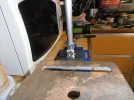
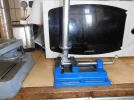
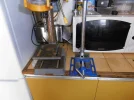
Miserable day here unlike yesterday with lots of bright sunshine....so had to move operations into my kitchen..
scuse the mess..
I wish I had room for a proper workshop.
Anyhoo..thought I'd give the new 23mm cutting tool a go.
cut down into the lnb throat about another 2mm and got a much better fit.
It will support the pipe upright without friction or external assistance.
I'm well pleased with it.
Looking at the photo of my drill press ...I think a bit of TLC wouldn't go amiss.
 

Attachments

  • P1010006.webp
    P1010006.webp
    465.9 KB · Views: 53
  • P1010007.webp
    P1010007.webp
    629.8 KB · Views: 41
  • P1010008.webp
    P1010008.webp
    443.9 KB · Views: 35
Last edited:
Miserable day here unlike yesterday with lots of bright sunshine....so had to move operations into my kitchen..
scuse the mess..
I wish I had room for a proper workshop.
Anyhoo..thought I'd give the new 23mm cutting tool a go.
cut down into the lnb throat about another 2mm and got a much better fit.
It will support the pipe upright without friction or external assistance.
I'm well pleased with it.
Looking at the photo of my drill press ...I think a bit of TLC wouldn't go amiss.
Just a bit of steel wool and 3 in 1

You could eat off that worktop, you should see mine.
 
Hey Stephen ..I really need to pay you for the feed not least because I'm considering removing the scalar rings from the waveguide.
Obviously a destructive process.
Hear me out..there is method in my madness.
In the same way C band lnbs and their scalars are seperate and adjustable...I am thinking that since my dish may well be non standard thus full illumination may be an issue...the distance between waveguide apex and scalars may be critical.
I believe Invacom produced a feed assembly to combat this issue.
Pulsat used to sell them but sadly no longer

ADF120 Invacom Adjustable Feedhorn C120 Fitting​

I know the dish still needs alignment ...but your thoughts on the above would be most appreciated.
rgds

Theory of function...

RF Energy Entry: Radio frequency (RF) energy enters the antenna from a standard waveguide interface, propagating electromagnetic modes down the throat of the horn

Impedance Control: These grooves alter the boundary conditions at the wall. They present a reactive (near-zero tangential electric field) surface for both vertical and horizontal polarizations equally

Mode Equalization: By forcing the electric and magnetic fields (the HE₁₁ hybrid mode) to match symmetrically at the boundaries, the horn eliminates differences between the E-plane and H-plane radiation patterns

Beam Shaping & Efficiency: The resulting symmetrical beamwidth provides uniform illumination across a parabolic reflector dish. This suppresses side lobes, minimizes edge diffraction, and reduces spillover energy pointing past the dish edge, maximizing total antenna gain and efficiency.
 
Last edited:
Hey Stephen ..I really need to pay you for the feed not least because I'm considering removing the scalar rings from the waveguide.
Obviously a destructive process.
Hear me out..there is method in my madness.
In the same way C band lnbs and their scalars are seperate and adjustable...I am thinking that since my dish may well be non standard thus full illumination may be an issue...the distance between waveguide apex and scalars may be critical.
I believe Invacom produced a feed assembly to combat this issue.
Pulsat used to sell them but sadly no longer

ADF120 Invacom Adjustable Feedhorn C120 Fitting​

I know the dish still needs alignment ...but your thoughts on the above would be most appreciated.
rgds

RF Energy Entry: Radio frequency (RF) energy enters the antenna from a standard waveguide interface, propagating electromagnetic modes down the throat of the horn

Impedance Control: These grooves alter the boundary conditions at the wall. They present a reactive (near-zero tangential electric field) surface for both vertical and horizontal polarizations equally

Mode Equalization: By forcing the electric and magnetic fields (the HE₁₁ hybrid mode) to match symmetrically at the boundaries, the horn eliminates differences between the E-plane and H-plane radiation patterns
20260928_115007.webp
Beam Shaping & Efficiency: The resulting symmetrical beamwidth provides uniform illumination across a parabolic reflector dish. This suppresses side lobes, minimizes edge diffraction, and reduces spillover energy pointing past the dish edge, maximizing total antenna gain and efficiency.
If you need an adjustable feed I have one here. I think I cut the out scalar ring off for a project, but sure it would be perfectly usable.
 
If you need an adjustable feed I have one here. I think I cut the out scalar ring off for a project, but sure it would be perfectly usable.
20260928_115007.webp
 
If you need an adjustable feed I have one here. I think I cut the out scalar ring off for a project, but sure it would be perfectly usable.
Do you still have the scalar rings intact because that is the part I would find useful...since I already have suitable waveguide tubing ?
 
Do you still have the scalar rings intact because that is the part I would find useful...since I already have suitable waveguide tubing ?
Ooops jumped the gun there Scopus ..didn't see the pic immediately..
Yes those rings are the crucial bit.

If you're selling ....I'm buying...
pity about the loss of the outer ring ..but as you say will most likely be just fine.

I suspect it was originally an ADF120 with 4 rings.
lol
 
Last edited:
Ooops jumped the gun there Scopus ..didn't see the pic immediately..
Yes those rings are the crucial bit.

If you're selling ....I'm buying...
pity about the loss of the outer ring ..but as you say will most likely be just fine.
lol
You can have it with pleasure, can't see me needing it again. Postage and the cost of a cheap bottle of red will do me VS. PM me your address and I'll get it in the post.
 
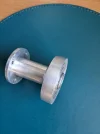
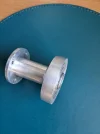
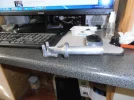
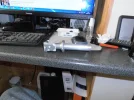
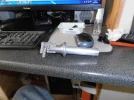
Some pix of the feed tube in the LNB throat..
self supporting using hot snot as a temporary support medium.
This will be replaced with epoxy when testing is complete.
rgds
 

Attachments

  • P1010009.webp
    P1010009.webp
    818.4 KB · Views: 18
  • P1010010.webp
    P1010010.webp
    839.5 KB · Views: 17
  • P1010011.webp
    P1010011.webp
    792.9 KB · Views: 19
  • P1010012.webp
    P1010012.webp
    1.1 MB · Views: 28
You can have it with pleasure, can't see me needing it again. Postage and the cost of a cheap bottle of red will do me VS. PM me your address and I'll get it in the post.
Bugger !

Forgot about the wine tax when I posted out
 
Back
Top