Satlook Color HD taster

Huevos

Satellite Freak
My Satellite Setup
57E to 58W, C-band and Ku, DVB-S2, 4:2:2 and blindscan.
My Location
38.5ºN, 0.5ºW
A picture is worth 1000 words so check out the YouTube video (sorry about the audio).

[video=youtube;rKLDiGF4fSo]http://www.youtube.com/watch?v=rKLDiGF4fSo[/video]

Good points:
  • Total control over everything (band, polarisation, DiSEqC 1.0, 1.1, 1.2, USALS, Go-To-X).
  • Doesn't need any transponder data.
  • Shows all relevant data (MER, BER, NIT, S/N, corrected bits, uncorrected blocks, constellation diagram, etc).
  • 5" colour TFT screen (FTA MPEG2 visualisation).
  • Lithium battery lasts forever.

Not so good:
  • Pretty bulky, but, if nothing else, that seems to impress clients, even female ones.
  • I don't feel confident that the semi-rigid nylon case is going to protect that big screen when it's bouncing around in the boot of my car with all my other gear. I think I'll probably end up getting a peli case for it.
 
Very nice but I have question to owner while he's got motorized setup as I can see on video. Can satlook measure extreme low and high SR transmissions?
Few examples:
Astra 1E/3A 23.5° E
12660 V 477 1/2
12661 V 555 3/4
Atlantic Bird 2 8.0°W
12748 H 716 1/2
Intelsat 907 2 27.5°W
11495 V 44100 9/10
Thanx in advance
 
1-45 MSymbols/sec but I'm guessing that's for DVB-S, not S2. Can't lock the transponder on 27ºW... And I can't even see the low symbol rate transponders on the spectrum so I can't be sure they are there. If they are they are very low power.
 
Huevos said:
  • I don't feel confident that the semi-rigid nylon case is going to protect that big screen when it's bouncing around in the boot of my car with all my other gear. I think I'll probably end up getting a peli case for it.
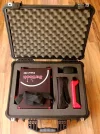
Got a peli case now... Big enough for my backup meter and the Digiair too. Solid as a rock.
 

Attachments

  • peli-1550.webp
    peli-1550.webp
    53.3 KB · Views: 128
Result, looks a sturdy case.
 
@Huevos

I have problem with Satlook Color HD. When I am tuning the dish on the astra 3 with frequency 11635V. It gives no lock status in the spectrum analyze mode. When I switch to the digital mode I got a lock on the frequency 11635V and can read out the s/r and ber status. I have replaced the lnb from different vendors like inverto and mti (lnb). Still no lock in the spectrum mode.

My question is do you have the same problem on your Satlook Color HD?
 
@Huevos

When I am adjusting the cross polarization of a LNB on a HD channel. The ber indication goes very quickly to 1E08. Do you have also the same results?
 
Stinger said:
on the astra 3 with frequency 11635V. It gives no lock status in the spectrum analyze mode.
I don't know, because that transponder is on the spot beam so it is down in the weeds for me. But it sounds like normal behaviour to me. In spectrum mode the meter locks on any strong transponder so it can quickly identify the satellite, and that transponder won't necessarily be the one you have got the marker on, but the signal strength does correspond to the marker.

Stinger said:
When I am adjusting the cross polarization of a LNB on a HD channel.
Adjust the skew using the spectrum. Aim for the tallest peaks with lowest noise level in between. Afterwards you can verify with the digital info, but the spectrum is better for adjusting because it give instant feedback.

Stinger said:
The ber indication goes very quickly to 1E08.
>1E08 means there is less than 1 error in every 100 million bits sent. Instead of using BER, use MER as this still gives useful information even when the signal is almost perfect.
 

Attachments

  • 23E-10635V.webp
    23E-10635V.webp
    74.4 KB · Views: 103
@Huevos

Do you get a steady lock on the astra 3 with frequency 11635V? When I use the satlook color hd in spectrum mode with vertical low setting. I get no lock at any good en high signal transponder. Only a lock in the digital mode. I think my satlook color hd is faulty.

Can you please explain why you chose the MER instead of de BER measurement? And why should I use the spectrum mode to adjust the cross polarization of a LNB. Can you please give me some examples. Many thanks in advance.
 
Stinger said:
Do you get a steady lock on the astra 3 with frequency 11635V?
As I said above that is a spot beam transponder. I'm 2.5º, and 1900km from the beam centre so there is not a lot of chance of me locking that.

Stinger said:
When I use the satlook color hd in spectrum mode with vertical low setting. I get no lock at any good en high signal transponder. Only a lock in the digital mode. I think my satlook color hd is faulty.
In spectrum mode the meter locks the first transponder it can. I've never paid much attention to this but maybe it only locks DVB-S transponders in spectrum mode. Not that it matters because this is only for NIT identification, not any serious measurement.

Stinger said:
Can you please explain why you chose the MER instead of de BER measurement?
>1E08 is the end of the BER scale so there is no way for you to see if what you are doing is improving reception. On the other hand MER shows reception improvements even when the signal is completely error free.

Stinger said:
And why should I use the spectrum mode to adjust the cross polarization of a LNB.
You mean skew, right? You use the spectrum because it is real-time, so it gives instant feedback. The digital readout, on the other hand, lags behind the adjustment, so it is good for verifying an install once it is aligned but no so good while doing the adjustment.

Stinger said:
Can you please give me some examples.
Examples of what?
 
Huevos said:
As I said above that is a spot beam transponder. I'm 2.5º, and 1900km from the beam centre so there is not a lot of chance of me locking that.
What do you mean with "spot beam"? Because I do not understand it.


Huevos said:
>1E08 is the end of the BER scale so there is no way for you to see if what you are doing is improving reception. On the other hand MER shows reception improvements even when the signal is completely error free.
When I am adjusting the dish and lnb. I can see via the MER value if the signal is going to be better or worst.

Huevos said:
You mean skew, right? You use the spectrum because it is real-time, so it gives instant feedback. The digital readout, on the other hand, lags behind the adjustment, so it is good for verifying an install once it is aligned but no so good while doing the adjustment.
Can you please give me an example when adjusting the skew in the spectrum mode? I use mostly the x-pol function of the satlook color hd.
 
Spot Beam is a narrow beam, which covers only a reduced area. Imagine a lamp: you can either allow the light cone to be wide or narrow. If it is wide, you will illuminate a big area (circle), but with low intensity. If you use a narrow beam, you illuminate a smaller circle, but with increased intensity.

Spot beams are used for two combined reasons:

a) to prevent people outside the coverage area to receive the broadcast
b) to allow people within the coverage area to use smaller dishes or have an increased signal level (important for DVB-S2)

Cheers,
vma
 
vma said:
Spot beams are used for two combined reasons:

a) to prevent people outside the coverage area to receive the broadcast
b) to allow people within the coverage area to use smaller dishes or have an increased signal level (important for DVB-S2)
c) Frequency re-use. I.e. so there can be multiple target audiences in different locations watching different channels/transponders, that are broadcast on the same frequencies from the same satellite.
 
Stinger said:
Can you please give me an example when adjusting the skew in the spectrum mode? I use mostly the x-pol function of the satlook color hd.
You want the peaks to be as high as possible and the troughs to be as low as possible. Just use your eye/experience, rather than the electronic tape-measure to decide what is best. It's a bit like looking at two people... you don't need a tape measure to decide which one is the taller.
 
I have a again a problem with the satlook color hd. It does not matter on which satellite I have tuned in. In the high frequency on the horizontal or vertical with 22Khz off. In the spectrum is mode it says 67.5dBuV but in the digital mode it says 54.3 dBuV. See also the picture that I have included. I have contacted with Emitor and the told me it is a buy in the firmware. I am not sure of it correct. Can someone also test it for me? View attachment 43798View attachment 43799
 
I only have the Satlook Digital Color, which does not show the signal power on the constellation diagram.

My guess is that the support guy you spoke with is wrong:

The spectrum shows the SIGNAL LEVEL, while the constellation screen is showing the SIGNAL POWER.

Signal level is used for analog transponders, while signal power is used for digital ones.

The difference is explained in this excerpt from Rover Instruments booklet "Understanding Digital TV" (_http://roverinstruments.com/news.php?lingua=2&idnews=76):

ANALOG - You measure the voltage of a single video carrier and express it in units. The most suitable
unit, used by almost everyone, is dBµV, ideal value: 60 dBµV level.

DIGITAL - This measures the power of the complete channel (Average Channel Power), calculating the
total power of each carrier (power, not voltage). The unit should be, logically, the milliWatt, or rather dBm
(0 dBm = 1 milliwatt), but if you still use dBµV for convenience, ideal value 50 dBµV.

Cheers,
vma
 
I know that Huevos owns a Satlook Color HD. I am interested to know what he has to say.

But having the signal level on the digital menu doesn't really make much sense. I could rather imagine (or would hope) that the firmware programmer hasn't explained the function correctly to the author of the manual...

Cheers,
vma
 
Back
Top