Zone 1 or Zone 2 with 40mm LNB

I'm no expert on feed horns but I'd have thought the further away from 28e you get, the worse a Sky LNB with oval feed horn will perform due to the skew.
I'm a bit late replying to this, but the Astra 1, 2 and 3 series satellites all have an offset in their transmission skew, it's approximately 8 degrees clockwise IIRC. For the Astra 2 satellites in the UK & Ireland, this makes it have a skew value that would otherwise me more reminiscent of a point between the Astra 1 and Hot Bird satellites. For example, where I live a satellite TX at 28.2 East with zero offset would have a RX skew of -22.4 degrees - however the Astra 2 birds offset this to being -15 degrees. At 19.2 East the RX skew is -10 degrees, however at 13 East, since Eutelsat satellites have zero offset, the skew where I am is -13.9 degrees.

Therefore in my case, the difference in skew angle between reception from 28 East and 13 East is just over 1 degree - and using a Zone 1 or 2 dish with corresponding LNB the signal difference from adjusting the skew when moving the dish from one satellite position to another would be so tiny as to be unnoticeable. A small adjustment of the skew on the same dish would also be adequate for fine-tuning reception from 19 East.
 
Can you post a photo? The spirit level is to level the whole dish I believe, though it doesn't really matter if a fixed dish is not quite level. If the LNB looks to be in the correct position it'll be ok.

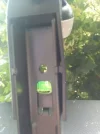
Photo from underneath.
I also include a photo of the pole, does this level matter or can it be compensated by the dish elevation?

Imagepipe_5.webpImagepipe_6.webp
 
If the top of the LNB holder is flat on the top of the arm then it should be ok. In the photo of the LNB, on the right side is the deformation caused by the small protrusion (presumably where it snapped)? If so cutting or grinding it flat might improve the fitment.
 
I think a photo of the front of the dish and showing the pole as well would help someone to answer your questions.
Not sure this shows much but here goes, this picture shows dish at 19.2e, when doing a quick signal test it seems more "stable" with late 80s percent on most frequencies.

Imagepipe_7.jpg

Ultimate goal is to get the 28.2-5 which is easy to find but lots of transponders are low signal and the strong ones I'm not even getting to the same level of a zone 1 dish. Similar with 37 and 40mm lnbs.

I think what might help is to show an augmented photo of the position if the sats in the sky, this will show what the dish is seeing and also some spectrum pictures from my Dr HD D15.
 
If the top of the LNB holder is flat on the top of the arm then it should be ok. In the photo of the LNB, on the right side is the deformation caused by the small protrusion (presumably where it snapped)? If so cutting or grinding it flat might improve the fitment.
Yes the top of the lnb holder is flat so Luke you say will be ok, I won't think this is a problem now.
On the right it's caused by the plastic not being long enough for the tooth to go in the hole.
 
Did you try raising the dish? 19.2e is a little higher in the sky so if 28.2e is partially obscured by the roof line it would make sense you'd get better results from 19.2e.

If you already have a zone 1 on the house, why not get an octo LNB for it and point the zone 2 somewhere else?
 
Did you try raising the dish? 19.2e is a little higher in the sky so if 28.2e is partially obscured by the roof line it would make sense you'd get better results from 19.2e.

If you already have a zone 1 on the house, why not get an octo LNB for it and point the zone 2 somewhere else?

Yes I have tried, I will try again now you have reminded me that 19.2 is a little higher.

I wanted to avoid cables going over the roof as it's a terrace house and this would be the only way. Plus I wanted to see if I could get a signal where the zone 2 currently is which it now appears might not be possible.
 
FWIW, could you possibly drill holes through in the horizontal under-the-edge surfaces (also known as the "sofits") of the roof, on both sides of the house, and then run the cable up through the hole on the "dish side", and then across the roofspace void and down through the hole on the other side and down to the hole in the wall that leads to the Rx?

Quite a lot shorter cable, and less likely to be subject to cable damage due to wind and rain.
 
I can feel the innuendo coming but I have measured up and can raise the mount by 9 inches.
Question is, until I try I won't know if this will be enough to improve 28.2e.
I want to try this as my next step.
Maybe the forum knowledge can tell me if this will make the slightest bit of difference.
 
You say you can raise the dish by 9" ATM - but could you put an extension section onto the existing pole with a clamp to secure the two sections together (or even replace the existing pole with a longer one)?

With a big & heavy dish then that could cause the pole to bend (as it did with one of mine - but that was "solved" with a lot of extra braces to nearby stuff, including the neighbour's fence!), but a Zone 2 dish should not cause that because it is comparatively light.
 
Last edited:
Before you lift it up, peak as best you can on 28e. Then put your hand/wrist over parts of the dish face, if it doesn't lower the signal then that part if the dish is likely not receiving signal and probably blocked by the roof. If the bottom of the dish is not receiving signal but the top is, the lifting the dish will only help.
 
Before you lift it up, peak as best you can on 28e. Then put your hand/wrist over parts of the dish face, if it doesn't lower the signal then that part if the dish is likely not receiving signal and probably blocked by the roof. If the bottom of the dish is not receiving signal but the top is, the lifting the dish will only help.
I have done some tests with my meter which only shows percentage.
On 10714H, channel 4, when placing a washing up bowl (I initially used a rolled up foam mat but no difference)
Lower section under the top screws on the front of the dish it lost approx 20-25%.
Upper section it lost approx 40-45%.
I would think it would be good for it to be raised by those 9". This won't cost me anymore and worth a shot.
 
Well I'm pleased to report that I have raised it another 12-13 inches instead and the db count has gone up by approx 3db which appears to be enough for a stable signal on the weeker transponders which are now 10.5db minimum. :Y
 
I wouldn't say the black eco is anything special though it's light, small and very cheap :)

I got my hands on a couple of the Eco LNBs. They do work pretty nicely on the Zone 2 and allow me to get them close enough for proper 19.2°E and 13°E reception. As you say, they're very very light and dirt cheap!

However I've realised that it's only optimal with 19.2°E as the LNB in focus. The screw of the main LNB mount stops any LNB from being able to get close enough for the 6° separation on the left hand side! Has anyone got around this with a different LNB mount/bodge on the Zone 2 (I'm just using a cheap 40mm adapter one found on Ebay, which looks basically the same as the 38mm in terms of screw placement)?

Having said that, instead of 7°E-13°E-19.2°E I'm now more interested in 13°E-19.2°E-28.2°E so this won't be an issue (can easily get close enough for 9° separation on the screw side).

Got another Eco on order, I think they look pretty neat as they're so minimal, and I quite like the green cap :D
 
When I had a multi sat setup, I found these Inverto brackets to be the best.

Inverto bracket
 
Grind off the screw part and use a zip tie or jubilee clip to secure the LNB, or super glue the LNB to the holder?

Another reason I like the Black Eco is because it's shape means you get more in/out adjustment like a long neck LNB :)
 
When I had a multi sat setup, I found these Inverto brackets to be the best.

Inverto bracket
They are pretty useful and quite good, especially as the bar can be bent a little so that the outer LNBs are a little bit closer to the dish face - and facing more towards the centre of it - than similar rigid bars. OTOH there is a tendency for the LNB clamps to fracture between the two mounting bolt holes - but a cable tie around that area "fixes" the problem.

PS: They are not specifically "Inverto" (nor are they often advertised as such) - any suitable 40mm diameter body LNB can be fitted. OTOH, would be difficult to fit a 40mm to 23mm reducer into those LNB clamps

Edited: However, I did manage to fit one into the feedarm holder on one cheap 80cm dish, and then attach this sort of bar to the part of the reducer that extends back beyond that feedarm holder - thus a 23mm LNB (This Inverto) on the centre line and 40mm LNBs in the "outboard" clamps. That gets 46E on the centre-line LNB and 42E & 52E on the outboard board ones, i.e. 3x sats at 4 & 6 degree spacings.
 
Last edited:
They are not specifically "Inverto" (nor are they often advertised as such)

Merely quoting the Amazon link where they are listed as such...
 
Back
Top