
You are using an out of date browser. It may not display this or other websites correctly.
You should upgrade or use an alternative browser.
You should upgrade or use an alternative browser.
Astra 2G at 28.2E: General Discussion
- Thread starter PaulR
- Start date
A
Archive4
Guest
Measles?

Pride Of Cucamonga
Regular Member
- My Satellite Setup
- Cheap piece of junk Spanish (Tecatel) 120cm(x110) dish, Inverto Ultra twin LNB and Sky HD box.
- My Location
- Valencia (city)
Regarding the uplink issue, I've often wondered why 2E is floating about at 28.3E on its own while the rest of the Astras are at 28.2E? There must be some good reason for it.
Best argument seems to be avoiding conflict with 26E on Middle East Beam, but then why not move them all to 28.35?

hvdh
Specialist Contributor
- My Satellite Setup
- Dr.HD F16, TBS 5927, T-55, Laminas 120 cm
- My Location
- Oss, NL (5.5°E 51.8°N)
If what is described in this ITU Recommendation isn't the reason, then at least it is interesting to read!Regarding the uplink issue, I've often wondered why 2E is floating about at 28.3E on its own while the rest of the Astras are at 28.2E? There must be some good reason for it.
https://www.itu.int/dms_pubrec/itu-r/rec/bo/R-REC-BO.795-0-199203-I!!PDF-E.pdf
Astra 2E nominal is 28.35°E (not 28.3°).

timo_w2s
Retired moderator
- My Satellite Setup
- Vu+ Duo 4K SE
Dr.HD F15
- My Location
- Maidenhead, UK & Helsinki, Finland
If what is described in this ITU Recommendation isn't the reason, then at least it is interesting to read!
https://www.itu.int/dms_pubrec/itu-r/rec/bo/R-REC-BO.795-0-199203-I!!PDF-E.pdf
Astra 2E nominal is 28.35°E (not 28.3°).
Thanks. It's a bit technical, but I guess the two key paragraphs are:
One possible solution to the problem of adjacent channel interference is to provide a slight
separation between co-located satellites. A study performed in Canada showed that an improvement
in isolation can be obtained in the case of two satellites transmitting cross-polarized adjacent
channels by separating these satellites by a fraction of a degree such that they are seen as two
distinct orbital locations by the feeder-link transmitting antennas but as co-located by the smaller
receiving antennas. This removes almost completely the susceptibility of overall link adjacent
channel C/I to rain fades on the feeder links at the cost of a small gain loss at the receiving terminal.
The WARC ORB-88 decided that administrations could place the satellites of a same group of
satellites (i.e., sharing the same nominal position in the Plan) at any position no further than
0.2° away from the nominal position, provided that the agreement of the other administrations on
that orbital position is obtained. The advantage of this arrangement is that it permits additional
discrimination between feeder links (large transmitting antennas) whilst for the purposes of
reception of the down link (small antennas) these satellites can still be considered as being at the
same position.
A
Archive4
Guest
Anyone heard of " Fag Papers "Thanks. It's a bit technical, but I guess the two key paragraphs are:

M60
Regular Member
- My Satellite Setup
- Fixed 28.2E Triax TD64, Freesat PVR + Panasonic Freesat TV's
- My Location
- Northern England
What sort of level in dBuV or in dB down from an adjacent carrier (eg TP66).a new "bump" at 11.112H has appeared.... probably in preparation of the new TP switches....
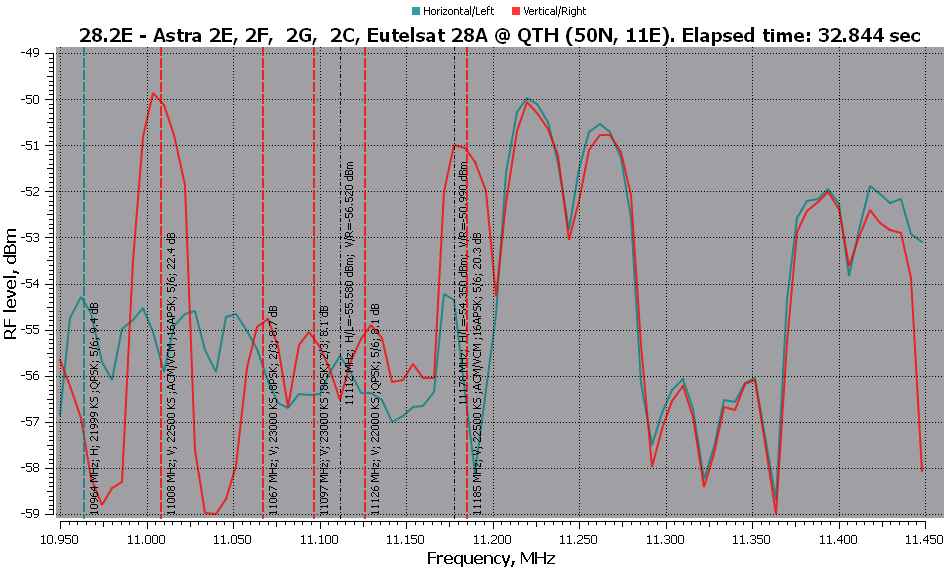

peeter3000
Member
- My Satellite Setup
- 125x140cm Mabo
3m AerialAS30,
80cm Triax
TBS5922
CrazyScan 1.0.1.94.
(Lenovo T420)
- My Location
- Estonia(EU)
same here more than week

popolon
Member
- My Satellite Setup
- Teleste 5m,invacom quad (28.2E), invacom quattro (26.0E). Triax multiswitch (1in, 8 out)
-TT 1600 PCI. Prof 3701 PCI.
-DR HD F15
-Ariva ferguson A120
Aerial 3m dish (7W-28.5E) + motor+ invacom quad.
-Ariva ferguson A220.
- My Location
- Finland
If remaining 28A have now transfered (at least signal is same worse as 11307V/H), those are now on 2F UK, not on 2E UK. As otherwise signal level is totally different from 2E UK...
M60
Regular Member
- My Satellite Setup
- Fixed 28.2E Triax TD64, Freesat PVR + Panasonic Freesat TV's
- My Location
- Northern England
I'm seeing these at much higher level here in the UK, will measure them shortly once my Horizon meter has charged up (forgot to put it on charge last night!). Look very much like 2E UK spot here, the Freesat Home TP has much improved quality levels too.If remaining 28A have now transfered (at least signal is same worse as 11307V/H), those are now on 2F UK, not on 2E UK. As otherwise signal level is totally different from 2E UK...

solly
Specialist Contributor
- My Location
- Tel Aviv, Israel
Noor tv New Frequency Setting from 2nd July 2015
Satellit - ASTRA -2G
Frequency - 11.553 GHZ
Polarization - HORRIZANTAL
Symbol Rate - 22000KSYMS
FFC - 5/6
Transponder - 95
Please Stay Tuned >>>>>>>
Our Aim To Spread Love and Peace across the world
Satellit - ASTRA -2G
Frequency - 11.553 GHZ
Polarization - HORRIZANTAL
Symbol Rate - 22000KSYMS
FFC - 5/6
Transponder - 95
Please Stay Tuned >>>>>>>
Our Aim To Spread Love and Peace across the world
timo_w2s
Retired moderator
- My Satellite Setup
- Vu+ Duo 4K SE
Dr.HD F15
- My Location
- Maidenhead, UK & Helsinki, Finland
What are you comparing it to? For me the 2F spots on 11.307/11.344 where much lower signal level to the usual 2F spots. The same could be for these new 2E spots. The only way we will know for sure is to check the signal variation over 24 hours, but I'm sure they are on 2E as I am not sure 2F can do these frequencies.If remaining 28A have now transfered (at least signal is same worse as 11307V/H), those are now on 2F UK, not on 2E UK. As otherwise signal level is totally different from 2E UK...
popolon
Member
- My Satellite Setup
- Teleste 5m,invacom quad (28.2E), invacom quattro (26.0E). Triax multiswitch (1in, 8 out)
-TT 1600 PCI. Prof 3701 PCI.
-DR HD F15
-Ariva ferguson A120
Aerial 3m dish (7W-28.5E) + motor+ invacom quad.
-Ariva ferguson A220.
- My Location
- Finland
What are you comparing it to? For me the 2F spots on 11.307/11.344 where much lower signal level to the usual 2F spots. The same could be for these new 2E spots. The only way we will know for sure is to check the signal variation over 24 hours, but I'm sure they are on 2E as I am not sure 2F can do these frequencies.
I am comparing to 10700-10936 2E UK spot that has really better signal levels than 2F UK. So I would have expected these to at least have even slight better level than those at 11307 2F UK. But now these are exact same levels here in Finland.
M60
Regular Member
- My Satellite Setup
- Fixed 28.2E Triax TD64, Freesat PVR + Panasonic Freesat TV's
- My Location
- Northern England
What you have to also consider with these latest migrations this morning is, like all the other E28A ones, the co-channel H/V TP allocations degrades C/N and quality due to LNB crosstalk. Different LNB's will perform differently in this respect but would envisage it to have a clearly noticeable difference on the fringes.
I'll do some C/N and quality measurements tonight across these new TP's to see what the improvement looks like here in the UK. I know previously anything close to 8dB C/N was considered good here on E28A, the C3 and C4 spot migrations saw C/N go up to 15.5dB on one of the TP's with the rest between 14 and 15dB. Will measure the 2G migrated TP's too as not checked those yet.
I'll do some C/N and quality measurements tonight across these new TP's to see what the improvement looks like here in the UK. I know previously anything close to 8dB C/N was considered good here on E28A, the C3 and C4 spot migrations saw C/N go up to 15.5dB on one of the TP's with the rest between 14 and 15dB. Will measure the 2G migrated TP's too as not checked those yet.
Nalleman
Member
- My Satellite Setup
- 1,8 Channel Master, Black Pro LNB with CM feedhorn for 28 E which is my main interest when watching TV.
Using two VU+ DUO 4K SE, a VU+ DUO 2 and an Octagon SF8000.
Fixed dishes at: 42 E (0,75 m), 39 E (1,2 m), 28,2/28,5 E (1,8 m), 19,2 E (1,5 m), 13 E (1,1 m), 9 E (0,7 m) and 1 W (0,7 m).
- My Location
- Sweden
Well the transfer from Eutelsat 28A to Astra 2E(?) made things worse as expected.
11385 H/V and 11425 H/V are even weaker than 11306 H/V and 11344 H/V here.
11306 and 11344 59-65 % ( with usual daily variations).
11385 and 11425 right now varies between 49-63 %. One minute around 50 % and the next 30 seconds around 60 %.
Don´t know if this is due to the LNB but the same fact does not exist on 11306 and 11344.
I can still get stable reception but I think I would almost certainly loose 11385 and 11425 in heavy rain. Maybe there will be more problems in the evening with 11385 and 11425.
2G UK stable reception (with daily variations) between 61-73 % with the verticals beeing the strongest and 10 994 H the weakest.
12 422 H (2F UK?) is around 55-60 %.
11385 H/V and 11425 H/V are even weaker than 11306 H/V and 11344 H/V here.
11306 and 11344 59-65 % ( with usual daily variations).
11385 and 11425 right now varies between 49-63 %. One minute around 50 % and the next 30 seconds around 60 %.
Don´t know if this is due to the LNB but the same fact does not exist on 11306 and 11344.
I can still get stable reception but I think I would almost certainly loose 11385 and 11425 in heavy rain. Maybe there will be more problems in the evening with 11385 and 11425.
2G UK stable reception (with daily variations) between 61-73 % with the verticals beeing the strongest and 10 994 H the weakest.
12 422 H (2F UK?) is around 55-60 %.
Last edited:
A
Archive4
Guest
Interesting comment, we discussing this txp on the Iberia thread, where it appears much lower than other uk txps.12 422 H (2F UK?) is around 55-60 %.
Will check the other txps you mention when I get home tonight
timo_w2s
Retired moderator
- My Satellite Setup
- Vu+ Duo 4K SE
Dr.HD F15
- My Location
- Maidenhead, UK & Helsinki, Finland
Here are my results from band A in South Bucks now that Eutelsat 28A has gone:
105 2G E -- 11.224H -- 73%
106 2G E -- 11.225V -- 74%
107 2G E -- 11.264H -- 72%
108 2G E -- 11.265V -- 76%
109 2F UK -- 11.306H -- 80%
110 2F UK -- 11.306V -- 82%
111 2F UK -- 11.344H -- 80%
112 2F UK -- 11.344V -- 81%
113 2E UK -- 11.390H -- 80% (was 68%)
114 2E UK -- 11.390V -- 78% (was 70%)
115 2E UK -- 11.426H -- 80% (was 71%)
116 2E UK -- 11.426V -- 78% (was 65%)
105 2G E -- 11.224H -- 73%
106 2G E -- 11.225V -- 74%
107 2G E -- 11.264H -- 72%
108 2G E -- 11.265V -- 76%
109 2F UK -- 11.306H -- 80%
110 2F UK -- 11.306V -- 82%
111 2F UK -- 11.344H -- 80%
112 2F UK -- 11.344V -- 81%
113 2E UK -- 11.390H -- 80% (was 68%)
114 2E UK -- 11.390V -- 78% (was 70%)
115 2E UK -- 11.426H -- 80% (was 71%)
116 2E UK -- 11.426V -- 78% (was 65%)