Astra 2E: General Discussion (Post-Testing)

Status
Not open for further replies.
Nice catch! What kind of optical aid do you use? A telescope, a zoom lens, or.. ?

Equipment is sort of standard stuff, Canon 7D and a 100mm/f2,0 lens.
The most important part is the tripod, really heavy and stable (can be used
as a ladder). Finding the sweet spot where noise is low helps a lot.
ISO 200, black frame subtraction and cold weather in my case.
The lens covers 12 degrees horizontally, usefull to get many satellites to
identify a single new one among them. Some randomly disappear when
no reflexions come in your direction.
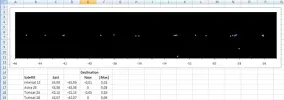
Satpos.webp

Excel diagram used for "pattern matching" with photos.
 
Cool, I like the concept! :-applause
 
Equipment is sort of standard stuff, Canon 7D and a 100mm/f2,0 lens.
The most important part is the tripod, really heavy and stable (can be used
as a ladder). Finding the sweet spot where noise is low helps a lot.
ISO 200, black frame subtraction and cold weather in my case.
The lens covers 12 degrees horizontally, usefull to get many satellites to
identify a single new one among them. Some randomly disappear when
no reflexions come in your direction.

View attachment 59915

Excel diagram used for "pattern matching" with photos.

Is that Astra 2D that's hanging way below the main cluster?
 
Equipment is sort of standard stuff, Canon 7D and a 100mm/f2,0 lens.
The most important part is the tripod, really heavy and stable (can be used
as a ladder). Finding the sweet spot where noise is low helps a lot.
ISO 200, black frame subtraction and cold weather in my case.
The lens covers 12 degrees horizontally, usefull to get many satellites to
identify a single new one among them. Some randomly disappear when
no reflexions come in your
 
Last edited:
Fascinating photos @Waveguide, thank you. There appears to be five objects in the 28.1 ~28.5 cluster. 1N, 2A & the two EB's, any idea what the 5th one is?
 
Fascinating photos @Waveguide, thank you. There appears to be five objects in the 28.1 ~28.5 cluster. 1N, 2A & the two EB's, any idea what the 5th one is?
Hopefully 2F.

Sent from my GT-I9205 using Tapatalk
 
Great stuff there waveguide, we've got a more reliable source in you than the tracking sites!
 
Great stuff there waveguide, we've got a more reliable source in you than the tracking sites!
Yeah I was just thinking we've got so desperate for news we're now physically looking at the satellite to see if it's moved... :-rofl2 What next? Someone's going to build a space ship so they can go up and give it a nudge?
 
good morning to all
the signal 2a not change yet
it be tomorrow night ?
 
12460h on 2a
sky 3d remove service last night no pid found ?
 
TLE was updated. 43.5 and nowhere else
 
I just had a look and it was still there half an hour ago.

View attachment 59903

It's the one on the left side. The pair on the right side are the Turksats at 42E.
Trying to identify the one in between, Nigcomsat 1R perhaps. Hard to find information
on all the space-junk that show up in pictures. Lots of moving stuff too.
Clever use of photography to identify satellites in geostationary orbit. What length of exposure? It looks fairly long. From the noise this looks like a tiny section of the frame.
 
From the exif of the photo: exposure time 61 seconds.
 
I'm very impressed with that photo, you can see the satellites are geostationary as over the 61sec exposure time they don't move however the stars obviously do!
 
Clever use of photography to identify satellites in geostationary orbit. What length of exposure? It looks fairly long. From the noise this looks like a tiny section of the frame.

The exposure times have been between 30 to 90 seconds, still testing
what effect it has on noise levels. Wireless remote control using B (bulb)
is neccesary, even the smallest vibration ruins the picture.

The entire image covers 12 degrees horizontally so only the leftmost
part was shown here. Satellites only cover a few pixels so the full image
will only show the star trails untill you zoom in to 100%. No fancy software
at all, Canon ZoomBrowser has level adjustment and cropping and that's all I used.
Images start as a gray sheet but all the detail is in there. (Big city = light pollution)

Using the calculator on www.wilmslowastro.com I have found out that I
have a "satfinder" with 20 arcseconds resolution. Very limited function
though, only works at night and with a clear sky. How do I mount the camera
on the dish...? Naaah - forget it!
 
I use a 2 second self timer option when taking long exposure photos to avoid camera shake as I don't have a remote but it works well. Is there a best time to take satellite photos? Soon after sunset? Would love to give it ago myself but I probably don't have a good enough camera or lens.
 
Waveguide, how dark is the sky there?
 
Maybe waveguide can produce a daily photo updating its movments, playing one after the other and making a video?
 
Status
Not open for further replies.
Back
Top