Astra 2E: Iberia & Balearics Reports

Status
Not open for further replies.
How does lower power increase lifespan? The limiting factor is fuel surely?

Of course fuel is a limiting factor - probably the most significant factor - but it isn't the only one.

When not illuminated, the craft rely upon Li Ion Batteries. Remaining Useful Life depends upon all sorts of factors, of course, such as the number of charge/discharge cycles and duty (relates to rate of charge and rate of discharge, the latter being associated with total power output).

It's a challenging business, monitoring and managing them but, put simply, if you run them too hard for too long they won't last as long as perhaps they otherwise might.
 
How does lower power increase lifespan? The limiting factor is fuel surely?

Yes, my understanding is that total power is decreased, i.e. number of transponders reduced, to adjust the reduction on solar array performance, but individual TP power ins maintained.

For instance, in the case of 2D and 2A North I have seen exactly the same levels of power since day one to the last day of operation, this to me is an indication that the power output of the TP's are maintained very stable over the lifespan of the bird.
 
Yes, my understanding is that total power is decreased, i.e. number of transponders reduced, to adjust the reduction on solar array performance, but individual TP power ins maintained.

For instance, in the case of 2D and 2A North I have seen exactly the same levels of power since day one to the last day of operation, this to me is an indication that the power output of the TP's are maintained very stable over the lifespan of the bird.

Yes, I don't see why they would even make reducing individual transponder power an option - pointless over engineering. If SES / broadcasters want to tighten the footprint, it's much more efficient to lower the FEC .
 
As I have mentioned in post #274 there has been a definitive improvement of reception of 2E here, when 2E started there was no 24x7 of BBCHD, lost it mid afternoon and midnight, whether this is due to Satellite relocation or power increase, I don't know.
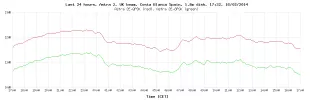
Huevos has been plotting signal strength for some time now and it does look like there has been an increase in signal strength since 11 Feb. Please see attached charts.

The second chart shows the 2E SNR reference to C4 HD on 2F. This shows 2E has increase by about 1 dB reference to 2F since 11 Feb. Using a reference reading takes out climate effects as both 2E and 2F should be effected about the same.

I would say as 2E is new the increase is probable due to SES adjusting the direction of the satellite beam to get optimum coverage over the UK and we are seeing the effect of this adjustment.

Some of the transponders are labelled as 2F based on kingofsat but they show a 2E 24H cycle. So I would say kingofsat is wrong. If they were 2F they would be near horizontal lines as they are reference another 2F transponder.

Terry
 

Attachments

Last edited:
I would say as 2E is new the increase is probable due to SES adjusting the direction of the satellite beam to get optimum coverage over the UK and we are seeing the effect of this adjustment.


Terry


That's the most likely reason.
 
why go to all the bother of modding an offset LNB for a PF dish when there are really good PF lnbs available?
Because it out performed the alternative until Badr5 launched.
 
Huevos has been plotting signal strength for some time now and it does look like there has been an increase in signal strength since 11 Feb.
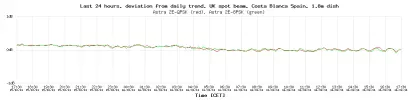
I realigned the dish at 2014-02-11 17:15. Picked up quite a bit of signal on 2E for no loss on 2F. This allows for the slightly easterly positioning of 2E. But this is nothing to do with the power level coming down from the satellite. 10847V has always worked 24/7 for me on a 1.1m dish. And if you compare the last 24 hours against the daily trend since the satellite was switched on you get a dead flat 0dB line, so absolutely no change.

deviation-from-the-mean.webp
And here are today's levels used for that comparison.

last-24-hours-graph.webp
And here is a screengrab of BBC1 HD using a 1.1m dish at the lowest signal point of the day according to the above graph.
BBC1HD.webp
 
Interesting ............... many thanks.
 
I took it off and used it to start a dedicated Topic! There should have been a "Redirect" but clearly it didn't work.

Give me a mo and I'll Post up a Link to it :)


Edit: Voila
 
Nor any assumed: We're just awfully tidy chaps! ;)
 
I realigned the dish at 2014-02-11 17:15. Picked up quite a bit of signal on 2E for no loss on 2F. This allows for the slightly easterly positioning of 2E. But this is nothing to do with the power level coming down from the satellite. 10847V has always worked 24/7 for me on a 1.1m dish. And if you compare the last 24 hours against the daily trend since the satellite was switched on you get a dead flat 0dB line, so absolutely no change.

Hi Huevos, I am not arguing your observations but just adding a little bit to the equation.

I have not realigned my dish and or LNB since before start of 2E, I had my dish adjusted for maximum performance with 2F, it is a 1.2 Tecatel offset, I spent the best part of an hour with a Prolink 4C+ so I am sure that at the time was perfect, last time I did readjusted was a few weeks before 2E.

When 2E was launched and BBCH HD was moved I lost BBC HD from around 2:00 to 7:30 and from around 17:10 to 18:00, a few days ago I saw that I had a power increase of around 1.5db being shown on my DM800S meter and as a result I had BBC HD 24x7, so my quick assessment was that there had to be a power increase or satellite attitude realignment, but your observations may indicate otherwise.

I am reluctant to believe that the wind had realigned my dish ^_^ but I am going to realign the dish to 2E to see if there is further gain.

When you mention that you have BBC 24x7 with 1.1mtrs, what type of dish this is ?, Is this true before or after realignment to 2E ?
 
I have noticed others have seen an increase in signal strenght sincce day 1? I have, my friends 1.9 near the golf course can now see 10803 H which it could not before (may be a fault on the LNB because that was the only weak signal) other dishes in the area have seen an increase in signal across the board. Has 2e moveved from 28.35 closer to 28.2?
 
Last edited by a moderator:
When you mention that you have BBC 24x7 with 1.1mtrs, what type of dish this is ?, Is this true before or after realignment to 2E ?
Salva, all my records are from a 1.8m dish. That is the dish that was realigned. I realigned that dish after seeing 2E was not at 28.2E, but 28.35.

The 1.1m dish is connected to the first tuner on my Vu+ Ultimo because that is the preferred tuner on that receiver and that is the receiver that is used for daily family viewing so would give me early warning of any potential problems. Dish is a Famaval LH110, so nothing special.

The satellite has only been on for 10 days so far. To make a useful graph with one pull every 24 hours you'd need about 150 days data. All my daily graphs do one pull every 10 minutes so output is 144 increments. But if you go through current data (allowing for the realignment on the 11/2) each day is within a couple of tenths of a dB of the first day's records (sometimes lower, sometime higher).
 
I would say as 2E is new the increase is probable due to SES adjusting the direction of the satellite beam to get optimum coverage over the UK and we are seeing the effect of this adjustment.


These are fixed beams, the only adjustment SES can make is in the satellite position.

I don't know where all this speculation comes from about moving beams and adjusting transponder power. Astra 2D was remarkably consistent throughout its life, as is every other satellite.
 
I have noticed others have seen an increase in signal strenght sincce day 1? I have, my friends 1.9 near the golf course can now see 10803 H which it could not before (may be a fault on the LNB because that was the only weak signal) other dishes in the area have seen an increase in signal across the board. Has 2e moveved from 28.35 closer to 28.2?
All I can say is I'm glad I went to the bother of keeping proper automated records. Stops people trying to rewrite history.

Code:
-     Updated       |   10803
-------------------------------
2014-02-16 17:11:56 |   11.62     
-------------------------------
2014-02-15 17:11:55 |   11.79 
-------------------------------
2014-02-14 17:12:00 |   11.82 
-------------------------------
2014-02-13 17:11:55 |   11.74
-------------------------------
2014-02-12 17:11:55 |   11.62
------------------------------- dish realigned here
2014-02-11 17:11:56 |   10.69    
-------------------------------
2014-02-10 17:11:35 |   11.27      
-------------------------------
2014-02-09 17:11:35 |   10.80 
-------------------------------
2014-02-08 17:11:34 |   10.98
-------------------------------
2014-02-07 17:11:35 |   11.39
-------------------------------
2014-02-06 17:11:34 |   11.27
 
It isn't speculation at all, just normal procedure: Any amount of modelling still has limitations and it is only when the craft is in position that the actual, as opposed to the theoretical, parameters can be monitored, measured and refined - and within the constraints imposed by fixed elements such as the juxtaposition of the various antennae. But not only can the position of the craft be altered, but also its attitude. The latter is a very useful tool.

That process also continues throughout the operational life of the craft and hopefully few if any adjustments are required. But it is not a given that the condition of the craft as it left the clean environment of production still pertains at the point it is fired up in anger - or subsequently.

I do, however, agree that people can be persuaded that something has changed when actually it may well not have done. Huevos' recent highly informative observations bear that out.

It is far more than "Fit & Forget" and it is only by extensive, thorough and continuous management that we on the ground perceive solid lifetime performance.
 
I do, however, agree that people can be persuaded that something has changed when actually it may well not have done.
I think most likely thing is they go back to a transponder at a slightly different time of day and this makes them believe something has changed, when in fact they are just seeing normal daily trend.
 
The only two TPS i actively keep an eye on are BBC one HD ( 2f ) and bbc two HD ( 2 e ). When first launched watching over a 24 hour period 2e was consistantly weaker than 2F. Now they are the exact same strenght here in Madrid. Im watching them enough to compare times of day as appropriate.

Oddly 2A north seems a touch weaker than normal but i have not kept a strong eye on it , principally though i dont have margin for heavy rain with it in the morning and used to.
 
A strange thing happened here... A few minutes ago, around 22:40, in obidos/caldas area, my receiver showed for a few seconds 14 to 16% signal with a 1.8m PF. It's been consistently at 0% since the change to 2E and around here everybody says we are in a null area. What can this be? Interference from another satellite?

I forgot to say it was in bbc one and bbc three sd. 10773H 22000 5/6 and only lasted half a minute or so and reached a maximum of 16%. The receiver stars showing pictures with 19-20%.

I'm trying to catch it again with no luck.
 
The only two TPS i actively keep an eye on are BBC one HD ( 2f ) and bbc two HD ( 2 e ). When first launched watching over a 24 hour period 2e was consistantly weaker than 2F. Now they are the exact same strenght here in Madrid. Im watching them enough to compare times of day as appropriate.

Oddly 2A north seems a touch weaker than normal but i have not kept a strong eye on it , principally though i dont have margin for heavy rain with it in the morning and used to.


Are you sure about BBC one HD being on 2f, according to kingofsat both BBC one and two HD are on the same transponder on 2e. Some of the ITV HD regions show on 2f
 
Status
Not open for further replies.
Back
Top