Astra 2E: Iberia & Balearics Reports

Status
Not open for further replies.
This is all about pretending that a dish is bigger than it really is, to make more money.
That's not true. Everyone is selling the same product.
 
Perhaps 2E has not had sufficient solar charge to keep signal equal in "night mode" ie when away from the sun, just a thought.
It's been up there 5 months. I'm sure that long enough to top up the batteries.
 
Hm so does all this mean that everyone reporting reception in this thread is wrong about what dish size they are using? That means virtually all "1.2m" dishes are, in fact, 1m.... Rather misleading for everyone else...
 
Hm so does all this mean that everyone reporting reception in this thread is wrong about what dish size they are using? That means virtually all "1.2m" dishes are, in fact, 1m.... Rather misleading for everyone else...
It is very misleading. There are dozens of reports of "1.3" dishes which are 1.2 to most people. "1.9" reports are really 1.8.
It's a similar situation to Spanish supermarkets, where it's common for products to only half-fill the box, or less. You've been fooled into buying something smaller than you thought, but paying the price of a larger product.
 
I spotted that this morning during homes under the hammer BBC1, thought the dish I put up on Wednesday was moving in the wind, such a relief when it came back:oops:
Picture lost 11.05, back 11.15. First day it happened thought the lnb was dying :O)
 
Probably dish area would be a better idea?
Posiblemente/Possibly.

No todo el mundo sabe lo que tiene instalado o compro.
Por desgracia algo que no tenemos en cuenta, aparte de las medidas, es el rendimiento de la antena, un ejemplo, podemos tener una antena de 150cm con un rendimiento del 60% y una antena de 130cm con un rendimiento del 80%.
Con 130cm tendremos mas señal.
Con 150cm tendremos menos señal (PF/Offset).
Pocas antenas indican el rendimiento (Wavefrontier T90 si, por ejemplo).

Lo que tengo en casa.
Antena motorizada de 94cm, medida real de 98x90cm, tiene una superficie de 0'692m² y como tiene un rendimiento muy alto, la venden como una antena de 100cm.
Con esta ganacia (dB.).- 10,7-11,7Ghz= 40,2dB 11,7-12,5GHz= 41,0dB 12,5-12,75GHz 42,0dB.

Antena fija al Astra19ºEste, Gibertini OP130 (138x123cm) no se vende actualmente.
Con esta ganacia (dB.).- 10,7-11,7Ghz= 42,0dB 11,7-12,5GHz=43,0dB 12,5-12,75GHz= 44,0dB.

Puedo garantizar la Gibi130 miente, actualmente ya no la fabrican, esta claro verdad.

La calidad del diseño no se tiene en cuenta, por eso algunas antenas de la misma medida cuestan mas que otras, aparte de pagar la marca, la calidad tiene un precio.

----------------
Not everyone knows what they have installed or purchased .
Unfortunately we do not have something in mind , apart from the measures, the performance of the antenna, an example , can have a 150cm antenna with a yield of 60 % and a 130cm antenna with a yield of 80 %.
With 130cm will have more signal.
With 150cm will have less signal (PF/Offset) .
Few antennas indicate performance (T90 Wavefrontier if , for example).

What I have at home.
Motorized antenna 94cm , real measure 98x90cm , has a surface as 0'692m² and has a very high performance, sold as 100cm antenna .
With this gain (dB ).- 10,7-11,7Ghz= 40,2dB 11,7-12,5GHz= 41,0dB 12,5-12,75GHz 42,0dB.

Fixed antenna Astra19ºEast, Gibertini OP130 ( 138x123cm ) is not currently sold .
With this gain (dB ).- 10,7-11,7Ghz= 42,0dB 11,7-12,5GHz=43,0dB 12,5-12,75GHz= 44,0dB.

I can guarantee Gibi130 lying , now no longer manufactured, this clear truth.

Design quality is not taken into account , so some antennas of the same size cost more than others, apart from paying the brand, quality has a price.

Un aficionado a estos temas, auditor de redes.
A fan of these issues, networking auditor.
 
Last edited:
Picture lost 11.05, back 11.15. First day it happened thought the lnb was dying :O)

Yes, for the first time I have lost 10847 for the last two mornings.
 
Hm so does all this mean that everyone reporting reception in this thread is wrong about what dish size they are using?
No, because most of the way through the thread we've been quoting both dimensions, or the dish model number (LH110, Fibo90, etc).
 
Dish must be too small if it went offline, here it is just a bump on the signal graph. but no loss of channels.
With a small dish on the fringes I have always suffered solar outages for a few days twice a year(spring/autumn), whilst my dish could be bigger it has worked perfectly in good weather for the channels I want except during these events.
I thought this was normal as when 1n was in situ my setup suffered solar outages for a few minutes and always around the same times. My dish size is limited by my budget .
 
With a small dish on the fringes I have always suffered solar outages
Doesn't matter how big the dish is. Once the satellite is in front of the solar disc there is an increase in noise in the region of 10dB. To overcome that you would need an SNR in the region of 18dB to start with.
 
With a small dish on the fringes I have always suffered solar outages for a few days twice a year(spring/autumn), whilst my dish could be bigger it has worked perfectly in good weather for the channels I want except during these events.
I thought this was normal as when 1n was in situ my setup suffered solar outages for a few minutes and always around the same times. My dish size is limited by my budget .

Yup dish size does nothing - I have a 2.4M here in Valencia - much bigger then needed and gives 100% SS and 100% SQ on my Humax Foxsat HD - yet I too get the solar outages twice a year. For a few days in succession they totally wipe the signal for about 2-4 minutes then all returns to normal again.

I actually look forward to the outages as it gives me a change to inspect the dish alignment using the focus of the LNB in the dead centre of the dish and I can see at once if there is anything getting in the way of the signal by looking for any shadows on the dish!!!
 
Unsure if I need a bigger dish or not as one comment said "dish must be to small if it went offline" and the other said "Doesn't matter how big the dish is. Once the satellite is in front of the solar disc there is an increase in noise in the region of 10dB. To overcome that you would need an SNR in the region of 18dB to start with." Confused as I know my dish is on the edge as I do not get all transponders on 2E but assumed that increasing it would not cure solar outages. Sadly S/N ratios for me are confusing in the world of VHF radio a S/N pf 18dB is pretty rubbish but I suspect in digital satellite are fairly good, I really do not know
Edit must have been writing this during Joddles reply so one quesion already answered, cheers.
 
It's been up there 5 months. I'm sure that long enough to top up the batteries.

I would agree, but when in transit from 43 to 28 do they keep the solar reflectors open or closed? If closed, during transit could batteries have been slightly depleted and need a few extra days, or weeks , to reach full power for "sun down" transmission
 
do they keep the solar reflectors open or closed? If closed, during transit could batteries
Once the the solar array is open it is like that for the duration. Same with the antennas.

Also these batteries don't take weeks to charge. They need to be charged and ready for the next cycle in less that 24 hours. And right now there are about 30 transponders in operation so demand is over 3kW just to run the PAs.

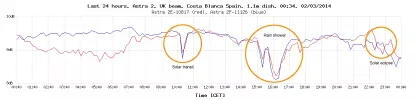
But let's put this in perspective. Even a light rain shower has a much worse affect on signal than operation on batteries.

chart.webp
 
Love the chart Huevos re rain fall affecting signal. Some time ago I saw some calculations of just how much microwave energy gets absorbed by rain. Can't rememer all the details but they clearly showed how when the microwaves meet the rain water how much engergy gets converted to heat and so is lost to us for viewing - pretty dramatic I recall - and it made me marvel at the fact that with so much water already naturally in the atmosphere mopping up the microwaves even on a "dry" day, enough of that tiny amount of energy still gets though to us on the ground to resolve a signal! - I wish I could find the article again!
 
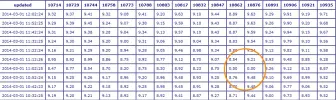
10818 is the TP on 2E with the strongest signal for me - but why does my Foxsat box receive it as 10817? I notice that on Huevos' table above it is labelled 10817 as well. I also see on the table that actually 10906 has the strongest signal and is therefore a good candidate for aligning purposes.
I was watching the Andrew Marr show this morning and lost reception just as the Kaiser Chiefs starting playing at the end of the show just before 11.00. I thought it was another shower but when I looked out the window is wasn't raining so I guess it might have been a solar outage judging by the graph above, as I get BBC1 on 10818 and this is the most shower-proof channel.
 
Last edited:
10818 is the TP on 2E with the strongest signal for me - but why does my Foxsat box receive it as 10817? I notice that on Huevos' table above it is labelled 10817 as well.
10817500 kHz. It's just a case of should you round up or round down when converting to MHz.
 
Aparte de lo comentado, el control automatico de frecuencia (CAF) compensa luego el error (OK +2Mhz), +3Mhz muy justo.
--------------------
Apart from the mentioned, the automatic frequency control (AFC) after offset error (OK +2Mhz), +3 Mhz very fair.
 
Status
Not open for further replies.
Back
Top