Beginning of a new Sun Cycle

Channel Hopper

Suffering fools, so you don't have to.
Staff member
My Satellite Setup
A little less analogue, and a lot more crap.
My Location
UK
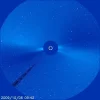
First images of some sunspots, it's been a year since anything flared up on the surface of the Sun, and like buses, two turn up at the same time.

_http://sohowww.nascom.nasa.gov/pickoftheweek/

For the first in a new cycle, these eruptions are rather bigger than expected.
 
And a link to the potential of solar activity initiating/inducing seismic tremors on orbiting satellites.

_http://www.vukcevic.co.uk/solarcurrent.pdf
 
That´s hot :)

Soho reports even hotter one´s coming up
 
And there was me thinking you were refering to The Sun starting to support the tories after backing Labour for the past 10 or so years...Is there maybe a correlation between the sun cycles and The Sun cycles???
 
Unfortunately it's not a joke (unlike the 'news'paper).

We have about two weeks before the new spots arrive from the far side, and there could well be more about to start.

Whilst the news over here avoids the inclusion of solar data, over in Russia for example, the weathermen take the activity quite seriously, in both the way it affects the climate, and the effects it has on people.

Not to forget the satellites you and I are taking signals from are highly sensitive to any changes from the Sun.
 
And some additional pictures from the 'other side'.
 

Attachments

  • latest2.webp
    latest2.webp
    23.1 KB · Views: 30
  • latest.webp
    latest.webp
    29.3 KB · Views: 30
On the way, plus a(nother) comet.
 

Attachments

  • latest2.webp
    latest2.webp
    131.7 KB · Views: 24
  • latest3.webp
    latest3.webp
    123.5 KB · Views: 24
Comets, urrk :eek:
I rather have sunspots than comets in the Earth area.
 
dig deep said:
Comets, urrk :eek:
I rather have sunspots than comets in the Earth area.

Comets rarely cause damage on, or above the planet's surface, sunspots however are the precursor to a lot of communication disruption, and, as per the link within the second post, activity on this planet as well.


Hold onto your hats, something big appears to be on its way round.
 

Attachments

  • latest5.webp
    latest5.webp
    23.6 KB · Views: 25
When comets hit us they do it in Full Speed !

Solar storm will kill gadgets :cool: mostly.
 
dig deep said:
When comets hit us they do it in Full Speed !

Solar storm will kill gadgets :cool: mostly.

A comet would have to hit the ground/ocean at a final diameter of some 2 kilometres. At the fastest speed and minimal angle (ie perpendicular to the surface/head on) the original diameter would have to be some 7 to 10 kilometres in diameter.

Very few comets have that sort of mass (the Oort belt has some rather large stuff sitting out there though), and even fewer are anywhere near the orbit of this planet.

The average collision rate of planetary / climate damaging comets is approximately 1 in every 50 million years. Real global killers are about six times less common.
 
Yes :eek:
The last one was here for 65 M years ago so it is time....


:cool: :)
 
It still has to be rather large before it hits the atmosphere, and the big ones are being watched.
 
Don't forget that Jupiter and the other gas giants do a very effective job, with their large gravitational fields, of mopping up a lot of space debris so that it isn't around to hit the Earth.
 
A list of stuff in the solar system by diameter

_http://en.wikipedia.org/wiki/List_of_Solar_System_objects_by_size
 
Still, if a NEO (Near Earth Object) is spotted we can´t do much about it.

Not now, perhaps in a near future.

The Gas Planets saves us (usually) but there is a 60 Million years chance. We had a big one in russia, let us hope for another 60MY break :)
 
dig deep said:
Still, if a NEO (Near Earth Object) is spotted we can´t do much about it.

That is a different question, the technology will not exist for a few years yet, so the need to preserve as much atmosphere as possible is high up on the list.
 
The sun is getting busy this week

_http://sohowww.nascom.nasa.gov/data/realtime-images.html

The pick of the week is also rather unique.
 

Attachments

  • Sliding plasma.webp
    Sliding plasma.webp
    7.8 KB · Views: 26
Many believe solar magnetic activity affects people on earth.

Here's a site that deals with this subject.

_http://spaceweather.com/
 
Back
Top