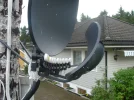
Dual T90 setup

ChrizK

Member
My Satellite Setup
Samsung 40" LED 3DTV UE40C7705WS-XXE (built-in DVB-S2 tuner), Panasonic DMR-BS750EGK (built-in DVB-S2 tuner), Vu+ Solo HD, 2 x T90 (39E-30W)
My Location
Just outside Oslo, Norway
Hi everyone,

Attached are some photos of my dual T90 setup. It is located just outside Oslo, Norway.


A. Antennas

Two T90 antennas

T1 - Center 26E
39E-36E-31.5E-28.5E-26E-23.5E-19.2E-16E-13E-9E

T2 - Center 4W
7E-5E-1W-4/5W-8W-12.5W-15W-22W-30W

Inverto Black Ultra LNBs are used for all feeds, except for the circular LNB used for 36E which is a Golden Interstar
102.

Unfortunately we do not have line-of-sight further east than 39E.


B. Switches and cabling

Both T90s are mounted on a tree pole a few meters from our house (yes, it is a tree pole, but it works very well for us).
The DiSEqC switches are installed at the pole. The coax cables that go from the pole over to the house are 5-way
shielded (135 dB) and go through a cable tube. The approx 50 coax cables between the LNBs and the switches are quad
shielded (120 dB).

To protect the switches a little extra from the Norwegian winters they are installed inside IP boxes.


C. Receivers

1. Samsung 40" LED 3DTV UE40C7705WS-XXE with built-in S2 tuner
* 16 feeds through an EMP-Centauri S16/1PCP-W3 in DiSEqC 1.2 mode.
* Feeds: 39E-36E-28.5E-26E-23.5E-19E-16E-13E-9E-7E-5E-1W-4/5W-12.5W-15W-30W

2. Panasonic DMR-BS750EGK (twin S2 tuner with Blu-ray recorder)
* 4 feeds through 2 x Spaun SAR 411 WSG in parallell (2 LNB inputs)
* Feeds: 28.5E-19E-13E-1W

3. Vu+ Solo
* 19 feeds through an EMP-Centauri S16/1PCP-W3 in DiSEqC 1.1 mode, daisy chained with 2 x Spaun SAR 411 WSG
* Feeds: 39E-36E-31.5E-28.5E-26E-23.5E-19.2E-16E-13E-9E-7E-5E-1W-4/5W-8W-12.5W-15W-22W-30W


ChrizK
 

Attachments

  • 1.webp
    1.webp
    179.1 KB · Views: 767
  • 2.webp
    2.webp
    212.4 KB · Views: 762
  • 3.webp
    3.webp
    118.4 KB · Views: 1,804
  • 4.webp
    4.webp
    51.8 KB · Views: 900
  • 5.webp
    5.webp
    175.2 KB · Views: 809
  • 6.webp
    6.webp
    118.9 KB · Views: 583
Cripes!

That a pretty substantial and extensive installation - thanks for sharing those pics.
 
The most I've seen fixed to a tree stump has been a Zone 2 $ky dish, not two T90's!:eek::D Love it mate!:-righton
 
Oh my dearest what a nice setup, great job in all aspects.:-righton
 
Top job

I wish I could go for two dishes, but the wife will most likey leave.
 
Are you sure you've got your priorities right?
 
Excellent set up.:)
 
Nice installation! What will you do when that tree rot away?
 
Hello Chriz,

Very nice. What made you bias the west dish so far to the east? And what about the tenth LNB without the cable attached? Was that for 27ºW? Or are you just using it to hang the 30ºW LNB?
 
:-worship what can I say?
 
Hey guys, thanks for the kind comments. Much appreciated.

RimaNTSS – When the tree rots I will get a nice tan working outside in the sunshine cabling another setup :-)

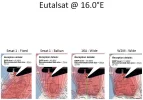
Huevos – During planning I went through the theoretical exercise of comparing the strength of the beams with the antenna gain at various LNB offsets (from center). Based on the T90 gain graph it was an objective to have weak beams within +/- 10 degrees from center.

For the East dish I wanted 26E in the center which is quite weak (especially the FSS beam). That let me keep two other birds with a couple of weak beams (36E and 16E) in the range with the most gain.


For the West dish I wanted to have 4.2W in the center since Amos 3 is a little weak as well. When receiving 4W on the same LNB as the stronger 5W, I thought it would be a good to have the center a little closer to 4W than 5W. That let me secure reception of 4.8E's Europe FSS beam too.


I have attached a few of the EIRP slides I used during planning and the T90 gain graph I used (perhaps the one made by RimaNTSS is better) as well as the spreadsheet with the “grand plan”.


The tenth LNB is at approx 27W and you are right - I use it just to hang the 30W LNB. (I did some testing and for me Intelsat at 27.5W was too weak for reception at that offset).
 

Attachments

  • 4-5W.webp
    4-5W.webp
    77.6 KB · Views: 234
  • 5E.webp
    5E.webp
    65.2 KB · Views: 213
  • 26E.webp
    26E.webp
    76.4 KB · Views: 205
  • 36E.webp
    36E.webp
    73.6 KB · Views: 202
  • 16E.webp
    16E.webp
    78 KB · Views: 207
  • 39E.webp
    39E.webp
    52.1 KB · Views: 182
  • 9-10E.webp
    9-10E.webp
    63.2 KB · Views: 202
  • T90_gain.webp
    T90_gain.webp
    44.1 KB · Views: 210
  • Grand_plan_April_2011.webp
    Grand_plan_April_2011.webp
    144.1 KB · Views: 224
ChrizK said:
the spreadsheet with the “grand plan”.
I like the bit "Hope wife accepts 1.8m for 2D".
 
ChrizK said:
I used during planning and the T90 gain graph I used (perhaps the one made by RimaNTSS is better)[/COLOR][/SIZE]
Speaking about the graph…. I did draw it just according to personal feelings and logicality (I think). But for sure, there is a way to make this graph more precise. Maybe some of T90-users had exactly measured data, taken at the same day and time on same receiver or another measurement device and with same LNB. For example, if some has 80cm offset antenna with LNB in it’s focus and he measured signal on some transponder from some satellite, than by placing same LNB to T90 would find place on T90 rail on which signal to the same transponder of same satellite is exactly the same. And then similar measurements should be done with different size of offset antennas. So, basically it is needed to do measurements with 30-35-40-45-50-55-60-65-70-75-80-85-90-95-100cm antennas. Afterwards, by processing all the data, mentioned graph could be drawn with maximum precision. And maybe, in the future that will be helpful to new or even old users of this toroidal toy.
What do you think, is that crazy idea or has some future and need for those measurements?
 

Attachments

  • graph.webp
    graph.webp
    40.3 KB · Views: 142
A very nice setup and some excellent cabling work.

Two constructive comments,

One, I would cover the tops of those switch boxes to keep the rain out, (or water when the snow melts off them) unless you totally sealed the top coax entrances it may still leak and could fill with water. (you are putting a cover on the front of them right?) (Water has a way of finding it's way into anything) Or a small weep hole on the bottom would let any water that did get in out.

Second, using a tree is good for the environment, none of those nasty steel poles affecting the weather by causing the next ice age, but sometimes can be a headache for mounting a heavy dish (or dishes) to it, that one looks dead, (I hope) the problems I have run into with people using trees as antenna masts is that over time the mounts loosen up or the tree twists or bows as it dries up in the summer and in the winter when it gets wet, you could loose lock on some of the weaker birds, then as they rot away your stuck looking for a new location.

And again a very nice job, I would like to see your switch schematic.
 
Great setup,must of took sometime doing it,thx for sharing m8
 
MARK - It's a fun hobby :)

RimaNTSS - I like your idea a lot :)

It would also be nice to do something as simple as measuring the loss in the most common DiSEqC switches on a per port basis. After having read the review of EMP-Centauri S 8/1PCP-W2 (P.168-W) in TELE-satellite (10-11/2007) I seriously considered to do the same test on the S16/1PCP-W3.

Terryl - Good points mate :)

I actually have a transparent "plastic hat" that I use to cover the top of boxes, but I took it off for the photos. I plan to make a better looking one… :) I absolutely agree that water always finds a way. It really tore me apart that I had to put cable glands on top of the boxes, but I found no better way....

Regarding the tree pole - there are a few drawbacks, but in sum I found it to be best location. I will probably have to do some adjustments as time passes, but that is just part of the fun. I use a Smartmeter S10.

I have attached a table shedding some light on the switching.
It was not made with sharing in mind, but I will try to explain the columns :-)

A) LNB output
Syntax: "F19E-3" is output 3 from LNB/feed 19 East.
Colour: Yellow is the lower East dish. Orange is upper West dish.

LNB outputs Extra 1, 2 and 3 are fairly long coax cables that go through the cable tube via our house and from there to another location for a possible future third dish. I have a spare TD110, and Dishpointer for Android suggests that I might have line-of-sight for 42E, 45E and 53E. Today these cables just have terminators attached.

B) Switch input
Syntax: "S3-BB" is committed port BB on switch 3.
Syntax: "S1-4" is uncommitted port 4 on switch 1.
Syntax: "S2-4-AA" is committed port AA on the switch that is connected to uncommitted port 4 on switch 2...
Colour: Each switch also has a colour code just to make the table easier to read.

C) Cable gland
Syntax: "B2-8" is cable gland 8 on box 2. B2 is the bigger of the two boxes. I have (or had) a drawing on paper showing where on the boxes the various glands are located.


S1 is to the right in the biggest box. It is controlled by the livingroom TV (built-in DVB-S2 tuner) via DiSEqC 1.2.

S3 & S4 are both in the smallest box. They are controlled by the livingroom PVR (twin DVB-S2 tuner) via DiSEqC 1.0.

S2 is to the left in the biggest box. It has two DiSEcQ 1.0 switches daisy-chained to port S2-4 and S2-12. The switches are controlled by a Vu+ Solo via DiSEqC 1.1 and DiSEqC 1.0 (in that order).
 

Attachments

  • cabling.webp
    cabling.webp
    66.1 KB · Views: 172
I made an overview slide showing the total setup.

The SlingBox aspect of this is kind of important to me as I am travling a little bit.
I use all three types of SlingBox clients (SlingPlayers). Still working on completing this part of the setup.
 

Attachments

  • my_setup.webp
    my_setup.webp
    85.7 KB · Views: 239
  • TV.webp
    TV.webp
    56.2 KB · Views: 243
That is just brilliant!
(Especially the tree mounting.)

:-worship

It is soo nice seeing a little-out-of-the-ordinary setup.

...you must have super tan by now, you obviously spent your summer aligning those T90s.

thanks for sharing.
 
You're a true inspiration. Thanks for sharing.. I hope your wife will accept a 1,8m dish, and I'm looking forward to see more pictures :-)
 
Back
Top