fibre lnb from global invacom

FTTH said:
just drop me a PM.
Unfortunately, until you've been a member a bit longer and made a few more posts you won't have PM privileges. We had to introduce this rule to stop spammers abusing our forum.

Anyway, much better to post in open forum so that everyone can benefit!
 
PaulR said:
Unfortunately, until you've been a member a bit longer and made a few more posts you won't have PM privileges. We had to introduce this rule to stop spammers abusing our forum.

Anyway, much better to post in open forum so that everyone can benefit!

No Problem - I didn't realise.

I've been developing Fibre to the Home solutions for years, primarily for international use and broadband applications. These are now working really well into the Sattelite area in the UK (an if used correctly you can deploy hybrid Data/Sat systems).

With a capabilty of delivering Terrabits of info...
Multiple TV & Data TX/RX all on one single fibre it is going to become more adopted.


A couple of highlights

Fibre cable Choice

Optical Fibre is fragile, no two ways about it is 125um in diameter (0.125mm) and it is glass. On its own it will be easily crushed, fractured etc.. Also, bend it too much and the light will be lost within.

Fibre cables are protected in many stages.. Primary coating (250um) Buffer (600/900um), Kevlar, outer jacket..

All these components matter, Outside deployment of Fibre cable is putting it under pretty extreme conditions.

Check all your cable is
* Crush resistant
* UV Stabalised
* Water Blocking (Water inside fibre cables is Not a good thing)
* Corosion resistant ( you will be suprised what some cables will use to provide crush resistance).

we generally supply 2 types.

* 3-3.5mm Crush resistant, bend resistant,UV stable water blocking cable.
* 5-7mm microduct cable (upto 1- 12Fibres, cable for direct bury or wall mounting)

The 3 - 3.5mm cable is neat and works well but we have found that areas of risk are better served with a rugged 5 or 7mm microduct.


Connectivity

Splitters

We have found that many of the 'splitters' used for Sat distribution are poor.
FBT (fused biconical taper) - essentially 2 fibres twisted together under heat, OK for 1x2 splitters but we are seeing them supplied as 1x8 and even 1x16... Not ideal as these are essentially just multiple 1x2's spliced together (high losses, poor uniformity and not really futureproof for hybrid data/sat systems).

Choose Higher quality Planar splitters (planar lightwave circuit), like an optical microchip.
These give lower losses, better results and will be futureproof (as long as you source quality ones), they also perform better in extreme tempretures.


Connectors

Joining fibre you have a few methods.
(consider that the core of the fibre inside that 125um glass is just 9um... thats the bit you need to align) This is why it is critical you choose an effetcive connectorisation method.


Splicing (needs a £6k machine)

Mechanical Splicing (needs a £0.5-0.7k cleaving tool)
Feil Termination Connetcors (needs a £0.5-0.7k cleaving tool)
Pre-terminated Cables (get someone else to make the cable up for you).

Splicing is the best.. big installers should consider this option.
Smaller installers, you have the choice of pre-term or feild term. Feild term will reward quickly as cables can be made to length onsite quickly (all product in stock for fast deployment).


Housing Splices/Splitters/Connetcors

Choose solutions with cable management, IP protection (ingress protection) and UV stability.
We have been supplying a variety of solutions (64, 32, 24, 16, 8, 4 and even 2 Fibre capacity).


A few things to remember with fibre.

* It does not like being bent tightly
Bend it smaller than a coke can and you will have trouble (30mm Radius). Opticreach cable can achieve 15mm and even 7.5mm radius.

* It does not like being crushed.
Cable clip with care guys

* It hates water
Make sure the jacket is UV stable and the cable contains Water blocking material

* Don't feed after midnight...
Oh no. Thats Gremilins. Forget that one.

* Dirt is Fibres Enemy
..
With a Core of 9um a wee bit of oil off your skin can mess up a connection. Clean your fibre connectors with care.


Fibre is going to be a key Element in tommorow networks... Learn to love it.
Want to know more - don't PM me ;)
(kstone at opticreach.com)

Some snaps...
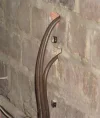
7mm duct.webp < 7mm Microduct containing 12 Fibres. Note required radius to enter wall.
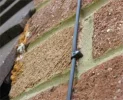
3mm cable.webp3.5mm Duplex Cable (2x fibres for multi Sat Install)
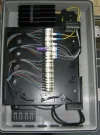
64 Fibre.webp < 64 Fibre Distribution Point with SPlitters
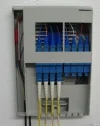
8 Fibre.webp 8 Fibre Distribution Point (150x100mm)
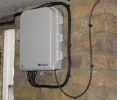
16 way.webp 16 Fibre Distribution Box Inc Splitters
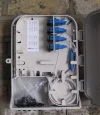
16way loaded.webp 16 F highbrid Data / Sat Box (incl Splitters)

 
Invacom said:
You MUST install an optical attenuator of around 10dB if you intend to use our product as a solution to overcome long distances.

Hope the above gives you guys some help but feel free to ask questions if you want to.

I assume the same applies using one receiver over a short distance. The reported problem on our test ( I didn't carry out the test myself) was that low band performance was very poor.
If we had used an attenuator would performance been up to a normal LNB?

Can anyone explain why Telesatellite magazine gave this Invacom LNB such an over- enthusiastic report? They were testing a prototype but the article raised many people's expectations.
 
I used a fibre LNB for a 100m run from 90cm dish into a quattro converter with no attenuator, worked fine, but then I guess 100m is not considered a long distance for fibre.
 
Hi All,

Ok to clear up the confusion regarding Distance versus Optical signal strength.

The laser inside our LNB is rated at +7dBm but typically outputs at a level of around +6.2dBm.
The Maximum permissable optical lever at a converter is -3.5dBm. If you intend to use a point to point solution clearly you will need to introduce loss. Our converters will not operate correctly if level's into them are too high.

Please remember that loss can be introduced not only in the splitters but also in the connectors themselves and the back to back bullet connectors. One back-to-back connector can typically introduce 0.5dBm.
 
Do you have a standard Rule of thumb that you generally work to?

To get below -3.5dB using splitters as a method of attenuation you would need to split at least 4 times.

1:1 = Requires a 16dB Attenuator
1:2 = requires a 10dB Attenuator

etc...
 
FTTH said:
Optical Fibre is fragile, no two ways about it is 125um in diameter (0.125mm) and it is glass. On its own it will be easily crushed, fractured etc.. Also, bend it too much and the light will be lost within.
FTTH said:
(consider that the core of the fibre inside that 125um glass is just 9um... thats the bit you need to align)

125um is a standard external diameter for multimode fibre with shortwave lasers with a 50um or 62.5um core, 9um core is a single mode size used with longwave lasers. Are you saying the Invacom LNB's use long wave lasers and need single mode 9um cable? That seems strange choice to me as your only looking at runs up to several hundred meters I would have though so multimode with common (and a lot cheaper) 125um cable with 62.5um or 50um core would seem to be the logical choice?
 
OldBen said:
125um is a standard external diameter for multimode fibre with shortwave lasers with a 50um or 62.5um core, 9um core is a single mode size used with longwave lasers. Are you saying the Invacom LNB's use long wave lasers and need single mode 9um cable? That seems strange choice to me as your only looking at runs up to several hundred meters I would have though so multimode with common (and a lot cheaper) 125um cable with 62.5um or 50um core would seem to be the logical choice?

The cost difference between the Glass in Multimode and Singlemode cables is minimal (in fact generally SM is cheaper as the volume of production is higher).
WHat genrally keeps Multimode alive is the cost of the Active kit (LED lasers for Multimode are cheaper than Singlemode Lasers).

Invacom Use singlemode (9um).
They need to, if it were point to point LNB<>Set top you could use multimode easy. But this is point to multipoint through upto 32 splits, this will introduce quite a bit of loss.
Essentially the losses on this are similar to going 60km on fibre.

Singlemode all the way, it's future proof. Multimode is on its way out.

If Invacom are sensible they will start to harness the fact that with singlemode you can transmit multiple wavelengths down one fibre, possibly multisat down 1 fibre (upto 16). I don't know if this is in their roadmap, but they would be crazy not to.. this is where fibre will truly start to knock Copper out the park.

Lets see what comes around the corner.
 
Ah, the splits are optical? I assumed it was repeater with electronics. Can't see multi-mode going away, its a lot cheaper in volume for the reasons you mention with lasers and diodes. DWDM is very effective for long distance lengths, but can't see the complex kit being cost effective for LNB connections!
 
OldBen said:
Ah, the splits are optical? I assumed it was repeater with electronics. Can't see multi-mode going away, its a lot cheaper in volume for the reasons you mention with lasers and diodes. DWDM is very effective for long distance lengths, but can't see the complex kit being cost effective for LNB connections!

All Passive optical.
You could achieve 64 splits on optical today happily without any electronics (that really opens up where you can deploy your Distribution Points).

The LNB needs a laser, but these are pretty cost effective.
The big seller is copper price per m vs fibre, it will save a fortune.

The Biggest problem is the Customer end. The addition of a media convertor between the cabling and the Set-top is the issue today. It will get cheaper, but that is what is preventing this taking off fast.
(Global - Feel free to comment).

Multiple wavelengths... You dont need DWDM, you can deploy CWDM quite happily. You'll get 16 Channels here passively just using filters. This will not fit all applications but on Large Multisat installs it would work very well.
 
Just thought I would give you all an idea of where we look to be heading into the future with Fibre.

From the origional start of transmitting just Satellite frequencies we have now incorporated terrestrial as well onto the same fibre. Thus you can distribute a full IRS system using Fibre and individual customers can choose to have satellite, Terrestrial or Satellite/Terrestrial depending on what converter they have in their home.
The next stage is possibly to add a further Satellite position onto the fibre using a different wavelength or even add data to the system however care has to be taken that you do not end up with a product that becomes so expensive that it no longer becomes cost effective.
 
Invacom said:
From the origional start of transmitting just Satellite frequencies we have now incorporated terrestrial as well onto the same fibre. Thus you can distribute a full IRS system using Fibre and individual customers can choose to have satellite, Terrestrial or Satellite/Terrestrial depending on what converter they have in their home.
That does include Bands II and III I hope. Radio distribution is an important part of my setups and I would think I'm not alone.
 
No, don't think it does Paul, I believe it is essential to completely filter out both VHF radio and analogue TV signals. But in fairness I'm installing many communal multipoint systems where the customers no longer ask for FM or DAB radio.
 
But some Europeans countries like Finland still use Band III for DVB-T and DVB-T2...
 
rolfw said:
I'm installing many communal multipoint systems where the customers no longer ask for FM or DAB radio.
That's astonishing.

(Wanders away muttering about the state of the world nowadays)
 
Very few people have separate radio tuners now Paul, most listen on smallish portables, their TVs or on internet radios.
 
timo_w2s said:
Perhaps one day fibre LNBs will be considered standard - no signal loss between the receiver and dish and no interference problems. The only downside (apart from cost) is having to run another cable for powering the LNB.

There's no need for another cable; use the coax to carry the 12-volt supply.
 
Yes, that's what I did on my last job, used a power injector at the bottom and a grouped combiner at the dish/aerial, one side to the aerial, the other to the Fibre LNB.

@ Invacom, would be really nice if possible to see an OCTO converter and even better, the twin converter made in a slightly more robust case, for use as a dish alignment adapter for standard meter, with output for LNB power.
 
Ha Potami Redneck said:
There's no need for another cable; use the coax to carry the 12-volt supply.
If you are running coax too you might as well get a standard LNB and save a load of cash!
 
The difference is, DC can be run over a lot longer length than the IF signal, as the attenuation at IF frequencies is much higher (approx 30dB/100m). Fibre on the other hand has almost neglible attenuation at less than 0.5 dB per km. Any DC volt drop caused by DC resistance can easily be compensated for by increasing the voltage.
 
Back
Top