How low can this be?

  • Thread starter Thread starter Archive7
  • Start date Start date
A

Archive7

Guest
Our building has 15 apartments and there is a garbage room next to our private parking lot.
The light bulb in the garbage room is only 40W filament type (incandescent) and lasts for many years.
Over the past few months the light bulb had a habit of disappearing and it seems that someone who can't afford to buy a light bulb has found a free shop, as it only takes few seconds to unscrew it and walk away.
Obviously we need a light in this room as the guys who take the bins out come at night and they need to see the bins otherwise they will not touch them.
I need few ideas how to put some light in the room, without spending a fortune on safe guarding it with special lamp holders that need a professional to take the bulb out.
This last time I put an old light bulb that I have in my apartment instead of using a new one. At least whoever takes the bulb will not enjoy it for long.
But I would really appreciate any ideas on what else I can do to put some light in the room.
 
Tape some wire to the outside of the bulb that's connected to the base contacts, and when they come to unscrew it they get a zap... :D

Or if electrocution's not allowed, fit a bulkhead light with security bit screws (which any decent sparky would have in their toolbox) to lock the bulb inside the thing, yeah it'll cost more than replacing bulbs, but it's more convenient to stop a cheapskate stealing them from an area where it's essential to be lit...

Oh, and set up a spycam to watch the thief in action, and then name & shame them in the apartment complex... :)
 
Until the Spy Cam gets nicked ..... :-rofl2:(
 
These ideas would surely put me in jail for manslaughter.
Besides, what if the bulb dies and someone wants to replace it?
I wasn't suggesting that the culprit is one of our tenants and even if I see "who 's done it" using a spycam, it will be a total stranger.
C'mon guys, I want some light, not the perfect trap.
 
C'mon guys, I want some light, not the perfect trap.

Erm:

fit a bulkhead light with security bit screws (which any decent sparky would have in their toolbox) to lock the bulb inside the thing, yeah it'll cost more than replacing bulbs, but it's more convenient to stop a cheapskate stealing them from an area where it's essential to be lit...

If it's an "outside job", then they'll be deterred by the security bit, that if the informed, reliable bulb-changers are informed of, will be able to replace... :)

That's the trouble with thieving bar stewards, they make life difficult for the rest of us who are protecting our own...
 
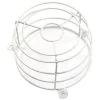
You need something like this puppy.

Code:
http://www.northerntool.com/shop/tools/product_200461671_200461671
 
Coat the bulb and holder with something that's bright purple and will come off (and you might want to add some of that postcode smart water as well) , and will be semi-permanent (can't think of the appropriate word ATM) on the hands of the low-life scum.

Then, anyone else can change a dead bulb if they use thin rubber gloves without being stained.
 
Cage.webp
You need something like this puppy.

Code:
http://www.northerntool.com/shop/tools/product_200461671_200461671
That's a good idea and quite cheap. The only problem is that it rated 120V and our mains supply is 230VAC. Will look for something similar with this rating. Perhaps I can use only the wire cage and replace the bulb with a LED lamp so it will last for several years,
I was thinking of using a smoke detector cage, but it is too expensive. Thanks.
 
View attachment 101322
That's a good idea and quite cheap. The only problem is that it rated 120V and our mains supply is 230VAC. Will look for something similar with this rating. Perhaps I can use only the wire cage and replace the bulb with a LED lamp so it will last for several years,
I was thinking of using a smoke detector cage, but it is too expensive. Thanks.

The cage is a better idea, but use some form of relatively "unusual" screws (torxs, star-drive, Allen key/hex-drive, and so on) to secure it in place - then change the screw types from time to time, and then the low life will soon get tired of trying to ensure he has the right tools to remove the cage (and the time/expense of finding/buying the correct tool-type to remove it).
 
If you fasten whatever cover with screws like this (or some other non-standard) it may make life more difficult
upload_2016-12-16_22-39-41.webp
Speaking of 'how low!' I'm always surprised when in France just how many toilet seats in supermarkets go missing
 
Superglue the lamp socket to the flex, then superglue the new bulb to the socket.

You could also wire up the garbage room door handle to the electricity supply or pay somebody peanuts to stand guard over a light bulb.

What is the current minimum rate for employment where you live ?
 
Superglue the lamp socket to the flex, then superglue the new bulb to the socket.

You could also wire up the garbage room door handle to the electricity supply or pay somebody peanuts to stand guard over a light bulb.

What is the current minimum rate for employment where you live ?

Just a few "problems" there: how to change the bulb when it blows/"manslaughter" when the low life "departs this mortal coil"/deciding who will pay for the minimum wage (8-16hrs per day, depending on the time of year/7 days a week/ 52 weeks a year = "quite a lot", and a lot more than actually replacing the nicked bulbs/ ensuring that the "moron" - as he would have to be to take on a job like that! - stays awake for the whole time he is "on duty" ) :)
 
Your comment makes little sense, here at least though I may have had a few too many chocolate liqueurs this evening.
 
View attachment 101322
That's a good idea and quite cheap. The only problem is that it rated 120V and our mains supply is 230VAC.

Actually that doesn't really matter, as the 120v rating on the website is just a thing to not confuse americans, I have several examples of north american light sockets and they're all rated for up to 550 Watts at 250 Volts, even the sockets with the built-in pullswitch which I would never use more than 60 watts in myself (they use a cardboard insulator(!!) between the socket and metal case!), so you could happily fit that light fitting on your 230v supply without any worry... :)
 
Actually that doesn't really matter, as the 120v rating on the website is just a thing to not confuse americans, I have several examples of north american light sockets and they're all rated for up to 550 Watts at 250 Volts, even the sockets with the built-in pullswitch which I would never use more than 60 watts in myself (they use a cardboard insulator(!!) between the socket and metal case!), so you could happily fit that light fitting on your 230v supply without any worry... :)

Just a few little problems there too:

What most people don't understand is that the N.American 240V/250Vac systems are NOT the same as those in Europe because the former is a 3-wire system where the "middle one" is earthed/grounded to the centre tap of the distribution transformer, and the other two run from the ends of that transformer winding at what I sometimes call "+/- 120V to ground" i.e. they are never more than a nominal 120Vac ("ish") to ground - therefore the live-ground insulation is rated for 120V, NOT 240/250V, operation!

Also, I would never use ANYTHING with cardboard insulation between mains live parts and ground - just think what would happen if it gets damp (say when an upstairs pipe leaks water into the floor above the lampholder, or - getting back to the OP's original post - the room is very cold and condensation occurs on the room ceiling and runs down the cable into the lampholder)? Frankly, it is dangerous and an accident waiting to happen.
 
Thanks for all the suggestions.
I took a closer look at the bulb housing and it is a good quality type that is screwed to the ceiling. It seems to have a thread for attaching a lamp guard, usually made of opaque plastic that I can buy easily from my local shop and this can save me the work of screwing the smoke guard shown above. Obviously the original guard was nicked in the past.
The question is how to secure this plastic guard to the lamp holder? Perhaps use some sort of glue that can be removed later on when the bulb needs replacement.
In the meantime I have a stock of several used 40W bulbs that I can use if this turns out to be a frequent nicking.
 
Thanks for all the suggestions.
I took a closer look at the bulb housing and it is a good quality type that is screwed to the ceiling. It seems to have a thread for attaching a lamp guard, usually made of opaque plastic that I can buy easily from my local shop and this can save me the work of screwing the smoke guard shown above. Obviously the original guard was nicked in the past.
The question is how to secure this plastic guard to the lamp holder? Perhaps use some sort of glue that can be removed later on when the bulb needs replacement.
In the meantime I have a stock of several used 40W bulbs that I can use if this turns out to be a frequent nicking.

Without a pic of the lampholder and the guard you would be using it is difficult to make suggestion as fixing the two together - but could you drill 3 holes in the ceiling around the latter, use some wall plugs, and then some of the more unusual secure screws I mentioned in an earlier post.

I would not use a glue, or anything else that does not need some form of tool, because if you can remove the guard easily then so can the low-life.
 
Back
Top