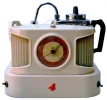
Is your electric clock tardy?

Llew

cerca trova...
Staff member
My Satellite Setup
Triple Dragon, Dreambox 8000, Echostar AD3000ip, TBS6522,6925,6983 PCie cards.
Gibertini 1.25m motorised dish driven by the AD3000, with either Inverto BU Quad or Norsat / XMW Ka LNBs . SMW 1.05m + 3 other dishes. Speccy: Promax HD Ranger+
My Location
The Flatlands of East Anglia
That'd only apply to old style motorised clocks. All modern digi clocks (like the one in the picture) have an internal crystal oscillator. Can't let science get in the way of a 'good' news story though!
 
I was wondering why the church bell in the village wasn't dead on 7am....
 
The battery powered clock in the Hall stopped overnight and I went to change the battery, only to find that it had leaked! - so nothing to do with the European Grid "problem" :rolleyes:
 
That'd only apply to old style motorised clocks.
Not true. My digital clock (Philips AS290) uses a LED display chip which is timer controlled by a tap off the mains transformer. Old, but still OK after many wake-up calls :)

AS290.webp
 
That would also explain why my AC motor in the gramophone ran slower than usual....
 
Apparently one of the European Grid suppliers' contribution to the Grid hasn't been up to the job recently, dragging down the normally stable 50Hz frequency :-doh

Shouldn't affect us in the UK, we have a High Voltage DC interconnection between European countries and here, so their frequency can be all over the place, but the DC won't care once it's inverted into British 50Hz... :)

But if you're concerned, you can always sit and watch the National Grid's frequency here:

Dynamic Demand
 
Shouldn't affect us in the UK, we have a High Voltage DC interconnection between European countries and here, so their frequency can be all over the place, but the DC won't care once it's inverted into British 50Hz... :)
I believe my own eyes. Happened to notice my display was two minutes slow. Never seen any deviance before (disregarding local power failures). That's what prompted me to check around for the possible reason.
 
I believe my own eyes. Happened to notice my display was two minutes slow. Never seen any deviance before (disregarding local power failures). That's what prompted me to check around for the possible reason.
I noticed the times on my CCTV cameras were all out of sync the other day, a difference of +/- 5 minutes between them all. But these all run on 48v PoE and are internally converted to DC, so guess they either have crystals with not the best tolerance or using the CPU internal oscillator.

Electric cooker clocks are likely to use the mains frequency as a reference.
 
Not true. My digital clock (Philips AS290) uses a LED display chip which is timer controlled by a tap off the mains transformer. Old, but still OK after many wake-up calls :)

View attachment 115278

I did say 'modern!' :-)
 
I believe my own eyes. Happened to notice my display was two minutes slow. Never seen any deviance before (disregarding local power failures). That's what prompted me to check around for the possible reason.

Pure coincidence, Europe's mains is not directly connected to ours to provide the disruptive frequency issue, last week the grid was pulled down hard due to the cold snap though, so could have been that, though it wasn't by much so the time being out by so much must have gone unnoticed over quite a while... :)
 
What is a MBbuffer?
No idea. Just looked at it -mine's a AS390, not 290. Just a paint job on the bottom, no decals etc. removed.
Schematic : low-voltage top secondary winding feeds to LED display driver chip.

AD390 Schematic.webp
 

Attachments

  • Radio.webp
    Radio.webp
    67.6 KB · Views: 4
Pure coincidence, Europe's mains is not directly connected to ours to provide the disruptive frequency issue, last week the grid was pulled down hard due to the cold snap though, so could have been that, though it wasn't by much so the time being out by so much must have gone unnoticed over quite a while... :)
I did say possible reason...
 
Back
Top