Wanted Looking for channel master feedhorn

Well, if this feedhorn fits to 3040661 flange, does that mean that feedhorn model is 611606007? This is question to all who know, as me and scopus have some doubts. I just want to be 100% sure.
 
That cover is certainly different to the feedhorns I have here. I've also got the option with a six bolt flange.

Nothing here with a good seal though, but it wouldn't matter with an inverted dish.
 
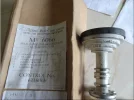
I have a CM feedhorn here which looks identical to the picture above. On the rim where the eight holes are is a marking - 3040661. There is no other identification marking on the feedhorn.

I have the original invoice from 2007 which says that is part number 611606007. But though it was described as part number 611606007 on the invoice, that does not guarantee it is what you are looking for.
 
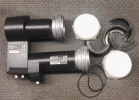
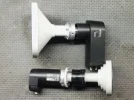
A link to two different feed designs , courtesy of Wod

 
I think @player10 is completely right in saying
the feed horn on the left wideband feed while the one on the right must norrower band feed horn
on the left side of the picture feedhorm model #611606007 , and at the right side is model #611606207
 
I have a CM feedhorn here which looks identical to the picture above. On the rim where the eight holes are is a marking - 3040661. There is no other identification marking on the feedhorn.

I have the original invoice from 2007 which says that is part number 611606007. But though it was described as part number 611606007 on the invoice, that does not guarantee it is what you are looking for.


Mine also is numbered on its rim 3040661 - bought new around 2002

feed.webp
 
also came with adapter pieces for regular l.n.b holder

feed 2.webp
 
First of all thanks @scopus for sending me original CM feedhorn. I had several flanges (mostly from old flange LNBs) which I thought will fit perfectly to the feedhorn, but found out that not all of them can be ideally connected to CM flange by all 8 screws. Nevertheless, several of them matched. Moreover, for my project 4 screws are more than enough. So, project was about adopting IBU single and twin to CM and Prodelin feedhorns and make LNBs interchangeable between feedhorns. Ideally I wanted to standardize OD of both feedhorns, but did not succeed in that. It is impossible to reduce flanges to 40mm (to use in standart Ku-band holder). So 48-50mm OD would be optimal in case of both flanges (CM and Prodelin) then same LNB holder could be used.
But the main issue, IMHO again, is the fact that Prodelin feedhorn has slightly bigger waveguide diameter than most nowadays LNBs have. So when LNB like IBU is used then the end of waveguide of it should be corrected to match waveguide of the feedhorn.
Well, I stripped LNBs, cut their feedhorns off, made waveguides OD ~21mm, and there you go- new flanges attached to feedhorns symmetrically, just stick LNB inside, tighten couple of grub-screws and test the reception. I am sure that distance from flange to the reception sensors inside the LNB is very important. But, unfortunately, in case if IBU single this distance is almost not possible to change (perhaps 1-3mm). In case of IBU twin, there are some ~50mm of waveguide which can be cut away. If somebody have clear understandig about needed distance, please tell it.
I will not be able to do reception tests as those LNBs will be sent to friend of mine tomorrow. Hopefully he will give feedback to me, then I will copy to you all.
 

Attachments

  • IMG_20190906_105355 (Large).webp
    IMG_20190906_105355 (Large).webp
    164.5 KB · Views: 51
  • IMG_20190906_110059 (Large).webp
    IMG_20190906_110059 (Large).webp
    131.4 KB · Views: 53
  • IMG_20190906_113609 (Large).webp
    IMG_20190906_113609 (Large).webp
    176.1 KB · Views: 51
  • IMG_20190906_150751 (Large).webp
    IMG_20190906_150751 (Large).webp
    90 KB · Views: 61
  • IMG_20190906_151322 (Large).webp
    IMG_20190906_151322 (Large).webp
    167.8 KB · Views: 60
There is a guide to the distance that signals can travel down a circular waveguide, in order to be detected efficiently by a probe, though it is based on waveguide diameter, lower and upper frequency cutoff, and the end stop distance to the probe. In your case the differences of the throat length is less important as the match between the inner diameters at the flange.

You can easily eliminate the 'step' by adding the aluminium of a beer can inside, with some makes (K cider , in a black can being exceedingly thin) moulding themselves very well to the interior. Shrinking the diameter to a point that mimics the actual frequency you are having trouble receiving is worth carrying out on signals close to the background noise.

Take care as it is also razor sharp at the edges.
 
Last edited:
@RimaNTSS did you receive feedback from your friend?
 
No, have no feedback yet. As far as I know, he got the package arrived but could not make any tests. Will let know when I know something more.
 
Back
Top