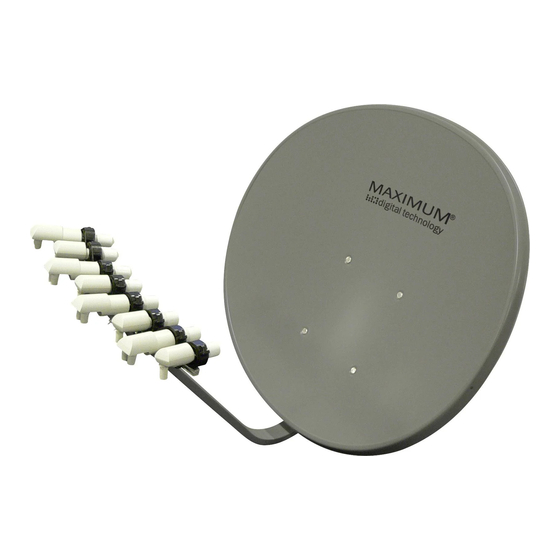
Maximum T-85 multifocus_bad signals on the edges

Max_2000

Member
My Satellite Setup
T-85 10 LNB 5W-28.2E
My Location
Germany
Hello,
My first post here.
I have a Maximum T-85 multifocus dish with LNBs covering from 5w to 28.2e.
The signal of the center satellites e.g. Hotbird is excellent but gets worse as we move sideways.
The signals are not good enough on Astra 23, Astra 28, Thor and 5w.
Location: eastern Germany near Berlin.

What could be the problem of the setup?
 
Hello @Max_2000 ,
Welcome to the forum! :-welcome1

About your dish: have you set the dish skew angle of your dish, according to the needed skew angle?
That angle depends on the center satellite longitude, and the two extreme satellite longitudes (5W and 28.2, in your case). And on your location (Lat & Lon), of course.

When your dish skew angle is not right, at the edges the LNBs are too high, or too low, causing non-optimal reception.

Greetz,
A33
 
Hello,
My first post here.
I have a Maximum T-85 multifocus dish with LNBs covering from 5w to 28.2e.
The signal of the center satellites e.g. Hotbird is excellent but gets worse as we move sideways.
The signals are not good enough on Astra 23, Astra 28, Thor and 5w.
Location: eastern Germany near Berlin.

What could be the problem of the setup?
Post a picture of the instalation from front and side.
 
Is there a tool or website that can help me with these calculations?

The most accurate calculator I know that can be downloaded from the internet is the CAHORS one.
See: Visio Bigbisat Software
(The whole thread is informative.)

Alas, the 'central' satellite cannot be chosen in that program. I have made a calculator that allows to do that (and so allows calculating monoblock skew, with one 'head' at the center). So I could put your relevant data in my spreadsheet, and let it do the calculation for you,

But when your central LNB is about halfway between the two extreme LNBs, the Cahors outcome will be fine.
There is also the satlex multifeed calculator, but I remember concluding that is not really accurate for multifeed (dish) skew, and you cannot choose the central satellite either.


What you could test, in the meantime:
Assuming you have aligned the dish on your central satellite, you could try to rotate the dish skew to align better for one extreme satellite position. When the satellite reception at the other extreme then also improves, you indeed had a dish skew problem.
The beauty of such multifeed dishes is that the skew rotation leaves elevation and azimuth for the dish intact, so you cannot mess up those while rotating the dish skew.
Of course, before testing: note the present skew angle; so that you can find back your present skew value, if needed.


Greetz,
A33
 
The most accurate calculator I know that can be downloaded from the internet is the CAHORS one.
See: Visio Bigbisat Software
(The whole thread is informative.)

Alas, the 'central' satellite cannot be chosen in that program. I have made a calculator that allows to do that (and so allows calculating monoblock skew, with one 'head' at the center). So I could put your relevant data in my spreadsheet, and let it do the calculation for you,

But when your central LNB is about halfway between the two extreme LNBs, the Cahors outcome will be fine.
There is also the satlex multifeed calculator, but I remember concluding that is not really accurate for multifeed (dish) skew, and you cannot choose the central satellite either.


What you could test, in the meantime:
Assuming you have aligned the dish on your central satellite, you could try to rotate the dish skew to align better for one extreme satellite position. When the satellite reception at the other extreme then also improves, you indeed had a dish skew problem.
The beauty of such multifeed dishes is that the skew rotation leaves elevation and azimuth for the dish intact, so you cannot mess up those while rotating the dish skew.
Of course, before testing: note the present skew angle; so that you can find back your present skew value, if needed.


Greetz,
A33
Many thanks.
Here are my coordinates in the attached picture.
Looking forward to the results from your spreadsheet
 

Attachments

  • SmartSelect_20250203_190713_Gallery.webp
    SmartSelect_20250203_190713_Gallery.webp
    24.6 KB · Views: 38
What could be the problem of the setup?

The main problem comes from the lack of experience and knowledge about offset multi feed (multifocus) antennas.
Please pay attention to this:
size 71 cm x 91 cm
Verstärkung (0° Position bei 12.5 GHz): 38,7 dB

Leistungsabfall bei Position +/ -10°: 0,5 dB
Leistungsabfall bei Position +/ -15°: 2 dB
Leistungsabfall bei Position +/ -24°: 4,5 dB

from here:
 
It also could be that the mounting mast is not plumb, it has to be absolutely vertical up and down and left to right or you will not be tracking the Clark belt as you should. If off by a few degrees you will loose signals on the LNB's mounted on the outer ends of the dish.
 
Many thanks.
Here are my coordinates in the attached picture.
Looking forward to the results from your spreadsheet

So, xx.540633N, yy.432483E in decimals.
range 5W to 28.2E
But what is your central satellite longitude (LNB above the arm)?

Greetz,
A33
 
It also could be that the mounting mast is not plumb, it has to be absolutely vertical up and down and left to right or you will not be tracking the Clark belt as you should. If off by a few degrees you will loose signals on the LNB's mounted on the outer ends of the dish.
Will double check that. Strong winds may have screwed it up a bit.
 
So, xx.540633N, yy.432483E in decimals.
range 5W to 28.2E
But what is your central satellite longitude (LNB above the arm)?

Greetz,
A33
The central position is 11 degerees east (halfway between Hotbird and eutelsat 9.0)
 
The central position is 11 degerees east (halfway between Hotbird and eutelsat 9.0)

So here is the outcome: +1.75 degree.
The multifeed-skew of the dish (and/or rail) should be measured in the plane, perpendicular to the looking angle of the central LNB. So I usually measure it at the back plane of the central LNB.
Zero degrees means: rail horizontally.

Max_2000  Multifeedskew  Schermafdruk_2025-02-04.webp


I am, by the way, curious to the individual skew angle of your extreme LNBs, as I am presently checking/testing a little theory of mine.
After you did finetuning on the skew of your individual LNBs, what are the skew-angles that you find on your extreme LNBs?

5W would have +13.7 degree skew (dishpointer). Or is it in practice, after finetuning, nearer to +4.0 degrees?
28.2E would have -3.6 degrees (7.5 degree pre-skew correction inclusive). Or is it in practice, after finetuning, nearer to +7.0 degrees?

At the moment I am not able to build a test setup, myself. So if you can give this information for your setup, I'd be happy :-) .


Greetz,
A33
 
So here is the outcome: +1.75 degree.
The multifeed-skew of the dish (and/or rail) should be measured in the plane, perpendicular to the looking angle of the central LNB. So I usually measure it at the back plane of the central LNB.
Zero degrees means: rail horizontally.

View attachment 160719


I am, by the way, curious to the individual skew angle of your extreme LNBs, as I am presently checking/testing a little theory of mine.
After you did finetuning on the skew of your individual LNBs, what are the skew-angles that you find on your extreme LNBs?

5W would have +13.7 degree skew (dishpointer). Or is it in practice, after finetuning, nearer to +4.0 degrees?
28.2E would have -3.6 degrees (7.5 degree pre-skew correction inclusive). Or is it in practice, after finetuning, nearer to +7.0 degrees?

At the moment I am not able to build a test setup, myself. So if you can give this information for your setup, I'd be happy :-) .


Greetz,
A33
Thanks a looot.
I am motivated to test. Hope the weather would be nice in the weekend .
 
Hello,
I live in the Berlin region in Germany.
I plan to re-adjust my Maximum T-85 multifocus dish and add new sats once health and weather improve.
I can receive 9e and thor but almost nothing in between. I receive Astra 4.8 with good signal but there is nothing watchable there.
I thought of receiving the feeds on 7e and 3e but I am not sure whether I can receive these sats with my setup and location or not.
I would appreciate practical advice on reception in this range 1w-9e.
 
Last edited:
And here from my experience with the T90 i have better signal on the 45e for example
with the lnb higher. The same happens and on the other side 1.9e i believe most of the
technicians are not good (experience) in these dish category. And the person who came
here took a long time to find west to east all satellites.
 
And here from my experience with the T90 i have better signal on the 45e for example
with the lnb higher. The same happens and on the other side 1.9e i believe most of the
technicians are not good (experience) in these dish category. And the person who came
here took a long time to find west to east all satellites.
Same here.
The signals of Astra 28 and Eutelsat 5 w (on the edges) are much better with the LNB higher.
But as the guys say, this is a sign of improper setup.
I find people here have more knowledge than many technicians. I enjoy reading the comments as they have the passion required to achieve best results. A hobbyist can become a good technician but not vice versa.
 
The signals of Astra 28 and Eutelsat 5 w (on the edges) are much better with the LNB higher.
But as the guys say, this is a sign of improper setup.

When this is the case, both east and west symmetrical, the whole dish elevation should be lowered a bit. That then means better reception at the extremes, a bit worse reception centrally.

You can see the elevation difference in my multifeed calculation above: "dish elevation, best for extreme satellites positions". That calculation is for a horizontally straight rail (such as a Triax rail); I don't know if the T90 has still a slight curvature, horizontally? But that curvature might not be enough, given this symptom.

Greetz,
A33
 
I find people here have more knowledge than many technicians. I enjoy reading the comments as they have the passion required to achieve best results.

Well, also we hobbyists are not specialists in everything. But in a forum as this, it is the combined special expertises of the members that make it special.
And, when we do make a mistake (I too am still learning by making mistakes, sometimes!), other members hopefully correct that.

Greetz,
A33
 
Back
Top