
My modified Inverto MultiConnect System setup in Helsinki

timo_w2s

Retired moderator
My Satellite Setup
Vu+ Duo 4K SE
Dr.HD F15
My Location
Maidenhead, UK & Helsinki, Finland
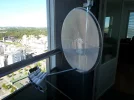
Here's my setup in Helsinki, Finland: A clear plastic 80cm dish with 6 LNBs looking at 5°E, 9°E, 13°E, 19.2°E (centre), 23.5°E, 28.2°E.

The dish is a bit small for my location but is as big as I could get on the small balcony and still be able to close the door. ;)

I swapped one of the Inverto MultiConnect white LNBs for an Inverto Black Ultra LNB (plus homemade bracket) which dramatically improved reception of some Astra 2 south beam and Eurobird channels. Seems those MultiConnect LNBs aren't very good for fringe areas.

I also added another MultiConnect bar to the existing one to allow me to see a bit further around the arc to 5°E. As Astra 4 is pretty strong at my location I can get away with the 14.4° offset for the stronger Nordic beams.

In the winter vertical transponder reception is blocked by the glass panels which can be used to close off the balcony from the elements (snow, rain and wind!).

I also have a wideband UHF yagi (not pictured) above the dish pointing towards Tallinn to pick up DVB-T transmissions from Estonia and local channels from Finland.

All this is connected to a Technomate 6900 receiver via an EMP-Centauri P.168-W V2 DiSEqC 8 way multi switch.
 

Attachments

  • pic1.webp
    pic1.webp
    84.6 KB · Views: 286
  • pic2.webp
    pic2.webp
    92.6 KB · Views: 360
  • pic3.webp
    pic3.webp
    125 KB · Views: 249
  • pic4.webp
    pic4.webp
    103.9 KB · Views: 223
That's pretty darned impressive, given all the constraints!
 
Thanks Tivù. I'm pretty happy with what I've managed to get so far. Reception could be better but I can live with what I got.

Reception on a Technomate 6900
(Percentages below are signal quality readings. Usually anything above about 44% is OK, below that it starts to break up)

28.2°E: Mixture of strong, weak, and nothing
Astra 2A/2B North beam, strong signal on all transponders, quality 75-85%
Astra 2A/2B South beam, only 24h stable picture from 11.817GHz/V (Dave, Gold, Watch, etc) with around 47%, some others are watchable in the evenings and some like the BBC and Channel 5 transponders have no signal ever.
Astra 2D is obviously not receivable.
Eurobird Steerable1 transponders vary from 50-65% quality.
Eurobird Fixed transponders a few of the verticals come in at around 45-55%, not a peep from the horizontals.

23.5°E: Astra 3B pretty good but the older Astra 1G was slightly stronger by a few percentages
Astra 3A: Nothing
Astra 3B: Horizontal channels about 60%, Verticals about 70%.

19.2°E: All pretty good reception
All transponders are between 66% and 77% across the various satellites. Except the polish spot beam was 81% when active.

13°E: Most pretty good reception
All transponders are between 62% and 78% across the various satellites.

9°E: Bit dodgy
Vertical transponders in standard DVB-S mode are between 62% and 68%
Horizontal transponders in standard DVB-S mode are between 46% and 55%
No reception of DVB-S2 transponders

5°E: Nordic beams boom in
Nordic beam horizontal transponders between 60-70%
Nordic beam vertical transponders between 70-80%
A couple of European beams come in at about 45%

DVB-T:
Estonian DVB-T MPEG4 multiplexes all come in at about 95% quality, except a low powered HDTV test multiplex in Tallinn which I haven't received (assuming it's even on air)
Local Finnish DVB-T MPEG2 multiplexes are 98% quality even though the aerial points 90° in the wrong direction (out to sea).
In the spring I even managed to get an out of band (Band III) local VHF test HDTV broadcast at 55% quality stable picture.

When I slide the glass in front of the dish a couple of percentages drop off the horizontal channels but most are still just as watchable as before. However, with the exception of a few transponders on Astra 4 I loose all vertical channels. But on the plus side my dish stays nice and dry and doesn't get blown about in the wind or get covered in snow. No change in DVB-T reception.

Anyone still reading this? ;)
 
Very impressed with what you have done considering it's an "inside job" and a very nice view you have too.
 
Since I started this thread a few years ago I've changed my Helsinki setup slightly. After buying an Dr.HD F15 signal levels improved on all satellites and I'm able to pick up some new transponders from 9°E and 23.5°E. I also moved the 5°E Multiconnect LNB to 1°W (which is not great reception being 20° off centre) and pick up 5°E on a separate renovated BSB dish (there's whole other thread about in this section).

Yesterday I installed a new 80cm clear dish on the other side of the balcony to pick up some westerly satellites (approx 30°W give or take few degrees, cough) and attempted to camouflage it somewhat with fake ivy... not sure if the end result is that good but I'm trying to minimise the impact of yet another dish on my relatively small balcony!! I really am trying hard to resist the urge to put up one more dedicated dish for 1°W.

I went for the clear plastic dishes as the are partially covering windows and so let the light pass through and are less obtrusive when looking out. I'm using fake plants as real ones tend to die every winter when it drops below -10°C and the pots freeze solid...

Reception on the new dish is OK but it's only looking at about 9° elevation so if there are heavy clouds or rain in the distance the signal can disappear easily. The signal seems to fluctuate quite a lot too but luckily in clear weather it keeps a lock.

Anyway, here are the results.:
 
Really impressed with what you've managed to do in such a small situation. And this time we get to see the terrestrial aerial which seems to be a log periodic rather than a yagi. Did you change this?
 
PaulR said:
Really impressed with what you've managed to do in such a small situation. And this time we get to see the terrestrial aerial which seems to be a log periodic rather than a yagi. Did you change this?

Thanks, yes the log periodic is a bit more compact and does a good job across the whole band. During some good DX conditions last summer I managed to get a couple of Latvian multiplexes. It's not so good at out of band signals to at 90° offset so I hung a short bit of wire on the back of the aerial and it seems to have distorted the reception pattern enough to get some strong local DVB-T2 HD channels in Band III without causing problems for the main UHF reception. Hey, if it works... :D
 
Back
Top