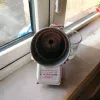
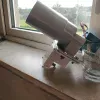
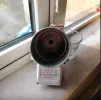
Wanted Polariser barrel

I have yet to see any polarmounted offset dish run into issues of pole, or ground clearance when non-inverted.

Inverting will also allow an easier counterweight design, once the Mabo starts chewing up actuators.


Considering butchyboy is a newcomer to C-Band my thoughts were that it might be best to keep things as simple as possible and provide encouragement to get started and view a few pictures.
He has a dish, it is mounted and he has a feed clamp on it, it is a relatively simple task to get a twin probe C-Band LNBF onto his existing setup in its current non inverted orientation.
The finer niceties such as polo pipes and any considerations of mounting inverted can be introduced afterwards if they are required.

As we know he will be able to receive 40.5W at his location with the dish it its normal orientation and the feed can be waterproofed, my personal suggestion would be that is where to start.

If he chews up an actuator I will send him a second hand Geotrack 24" actuator free of charge apart from the cost of postage.
It was refurbed by myself a few years ago and is better quality than the commonly available actuators on sale today such as Super Power Jack.
 
Last edited:
So my existing chaparral c band would be no know use ??.
 
So my existing chaparral c band would be no know use ??.


I aint up to speed on them rotors as I never used one.
However, you got nowt to lose by sticking a dielectric plate into it and trying a scan on 40.5W or any of the strong signal circular polarity satellites you have line of sight to.

My instinct tells me the dielectric plate wants to be at 45 degrees to the probe you can see in the feed barrel.
There are a few forum members who a "rotor men" they might pop along shortly with more accurate advice?
 
Cheers moonbase m8,be nice as you say if some co rotor guys jumped on here for advice.
 
Cheers moonbase m8,be nice as you say if some co rotor guys jumped on here for advice.


It's a quick job to test it out, just shove a plate into it, strap it on, aim the dish and try a scan.
It aint gonna cost you owt and you aint gonna break anything.

You could set your dish on 19.2E on Ku-Band, swap over the Ku-Band LNB for the C-Band setup, nudge the dish 0.8 degrees further East onto 20.0E and get scanning.
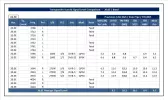
It was a good while since I did a scan on 20.0E but there look to be three strong frequencies still on there that I was locking with a lot of margin above the lock level.

I have attached a picture below from my 20.0E scan, the three strong frequencies are those with SR of 27500

.
20.0E C-Band.webp
 
The only c band lnbs I have at this moment are the 2 with co rotator,but I'm wondering will the work on circular polarisation without the co rotor wired to the box.

Or will the work with just the plate in the lnb and no wires connected to box?.
 
The only c band lnbs I have at this moment are the 2 with co rotator,but I'm wondering will the work on circular polarisation without the co rotor wired to the box.

Or will the work with just the plate in the lnb and no wires connected to box?.
The l.n.b will work without wires to a box .... they are just to power the small motor for adjusting the probe position.

As has been said the plate should be at 45 degrees to the probe ... and as Moonbase said, 20 east would be a good satellite to try .. its a strong C band signal - and can be picked up with a dish as small as 1 metre .. if every thing is orientated correctly and the receiver is on the correct polarity - you stand a decent chance of seeing something with your co rotor.
 
The l.n.b will work without wires to a box .... they are just to power the small motor for adjusting the probe position.

As has been said the plate should be at 45 degrees to the probe ... and as Moonbase said, 20 east would be a good satellite to try .. its a strong C band signal - and can be picked up with a dish as small as 1 metre .. if every thing is orientated correctly and the receiver is on the correct polarity - you stand a decent chance of seeing something with your co rotor.
Correct way lnb should be,my pics earlier were upside down.
 

Attachments

  • IMG_20210408_175907.webp
    IMG_20210408_175907.webp
    373.4 KB · Views: 21
  • IMG_20210408_175930.webp
    IMG_20210408_175930.webp
    538.4 KB · Views: 25
Correct way lnb should be,my pics earlier were upside down.
The plate needs to go inside/ across the l.n.b throat in one of the red line positions ... one of them will be correct - l.o.l.
plate 1.JPG
 
butchyboy, just stick a plate in, strap it on and do a scan.
It dont matter what way up it is on the dish for circular polarity as long as you have the plate at 45 degrees to the probe.
 
Well guys I cannot do any tests yet as I'm waiting in rimants lnb holder to arrive and also I do not have a dielectric plate here.
Any where in uk I can buy one ?.
 
You asked where to buy one, they are £2.95p plus postage, no loan required unless you are skint.
was only joking lol,have just ordered one :)
so hopefully its here next week and Rimants lnb holder and my cone head feedhorn for my offset dish.so waiting on them 3 items to arrive.,oh and sorry for being a pain on all these questions.
but i feel its good to ask from others who have a lot more experience in the field.i am a total newbie to c band.
been on ku band all my life,so im excited to start dabbling in c band,thanks a million for all your help advice and input,even to some of the smart ones :D

as arnie said i,ll be back with more questions when i start experimenting for real here :)
 
Last edited by a moderator:
I aint up to speed on them rotors as I never used one.
However, you got nowt to lose by sticking a dielectric plate into it and trying a scan on 40.5W or any of the strong signal circular polarity satellites you have line of sight to.

My instinct tells me the dielectric plate wants to be at 45 degrees to the probe you can see in the feed barrel.
There are a few forum members who a "rotor men" they might pop along shortly with more accurate advice?
A waterproof cover should be put over the front (unless Butchyboy inverts the dish), otherwise the feed electrics and potentially the LNB will fill with water.
 
I aint up to speed on them rotors as I never used one.
However, you got nowt to lose by sticking a dielectric plate into it and trying a scan on 40.5W or any of the strong signal circular polarity satellites you have line of sight to.

My instinct tells me the dielectric plate wants to be at 45 degrees to the probe you can see in the feed barrel.
There are a few forum members who a "rotor men" they might pop along shortly with more accurate advice?
Since the probe isn't working, the LNB is fixed on either LHCP or RHCP, so Butchyboy will need to manually adjust the dielectric to get both polarities.
 
Since the probe isn't working, the LNB is fixed on either LHCP or RHCP, so Butchyboy will need to manually adjust the dielectric to get both polarities.
manually adjust once to find correct adjustment,or manually adjust the whole time?.
 
Since the probe isn't working, the LNB is fixed on either LHCP or RHCP, so Butchyboy will need to manually adjust the dielectric to get both polarities.
3 wires come from the servo on the lnb,would there be some kind of switch i could get to use inside my house to turn the probe?.
 
manually adjust once to find correct adjustment,or manually adjust the whole time?.
Each time you change from a LHCP to a RHCP ...
or you could remove the probe motor and manually shift the probe instead of moving the plate
 
Back
Top