Tests of 120cm antennas

Blah :P Yes, but we *think* the Gibertini will outperform the CM, but will it? Maybe the Gibby is worse that we think? :)

I am not for a minute suggesting we should bring in 1.5 m dishes in as these are not *comparable* in size, whereas the 1.2m Gibby and the 1.2m SMC dishes are....
 
2- perform exact measurements of dishes, if possible, calculate their offset angles, opening angles, Focal points, "Le point G";
3- check whether original feedarms hold LNB in proper place and LNB is pointed to the right spot on the surface of the dish. Laser-pointer will be used to check aiming of LNB.
4- will install IBU in original LNB holder on original feedarms and point antennas (one by one) to satellite which has variety of transponders across whole frequency range, and where are weak and strong signals. And is better this satellite is on the top of the arc. I think that will be 28,2*E

Look forward to the end results of this project.
Hopefully you will document each stage ( photographically ) of this process especially the laser hitting the hotspot on each dish, just too help us " hope for the best amateurs "

Regards
 
Hopefully you will document each stage ( photographically ) of this process especially the laser hitting the hotspot on each dish, just too help us " hope for the best amateurs "
You bet. Will do my best. But that will take some time, I think about 1/2 a year.
Have I been stingy about posting lots of pictures? I actually afraid that admins will start to be angry I am spending server's space.
 
Agree with Riverblue, if Gibertini dish 125cm than it, only because of bigger size should work better than CM1,2m by some 8%. But, from another hand if we compare 2 dishes 1,2m and using proper LNBs at the same weather conditions we will, most likely have exactly the same performance of systems. Or difference will be under possibility to do precise measurements.
Another issue- I do not have Gibi 1,25, do not want to spend money on it, and, TBH, do not want to spend any money for any dishes anymore. It is time to stop someday.
I have aluminum 1,2m PFA Kathrein, can also try to add it to test.

A 1.25m dish may not necessarily have a greater gain than a 1.2m. The overall area is not necessarily all used for signal reception.
Additionally a 1.2m prime focus dish would naturally have a greater area than an offest version, so why include these ?
(Theoretically a 1.2m square prime focus dish would have the greatest area of all)
 
A 1.25m dish may not necessarily have a greater gain than a 1.2m. The overall area is not necessarily all used for signal reception.
Very true. A metal dish quite often will have a large rolled edge to give it strength.

Additionally a 1.2m prime focus dish would naturally have a greater area than an offest version...
Not sure I understand that. An offset dish will have a larger surface area simply because it has a greater vertical dimension but the effective reflective area as seen by the LNB should be the same. What will be different is the focal point.

(Theoretically a 1.2m square prime focus dish would have the greatest area of all)
If you mean a literally square dish then yes. But I'd like to see the matching feedhorn first!
 
I do not have Gibi 1,25, do not want to spend money on it, and, TBH, do not want to spend any money for any dishes anymore. It is time to stop someday.
Ooooh. That's a bold statement from someone clearly inflicted with "the bug"... 8)
What about those 1.2m plastic dishes in Belgium, that you need for your 1.2m comparison project?
Or what if a 2.4 meter SMC (CM or Prodelin) came up for sale in Latvia???
 
I have a CM120 and a Gibi 1.25 but sadly they are on opposite sides of Europe!! I would be curious how they compare but it's not going to happen with mine any time soon.
 
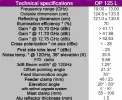
Actually, we are faced here by cheating, this time by Gibertini! They name their dish "OP125 1.25 M Gibertini satellite Dish" but, in reality, it has 121cm working area size! They are not first ones and not the last ones who do this to sell more!
In that case, it would be fairly enough to add Gibi1,25 to the test. The only problem for me, as I have already stated, I do not want to buy dishes anymore. Moreover, if dish is made not from plastic.
 

Attachments

  • ScreenHunter_133 Jan. 29 23.13.webp
    ScreenHunter_133 Jan. 29 23.13.webp
    57.3 KB · Views: 36
And how is that? From the LNBs perspective, the offset dish looks circular @ 120cm, no?

Only with an offset dish with a greater vertical dimension, elliptical dishes will show far less to the feedhorn (and their illumination to the satellite will similarly be reduced).
 
A metal dish quite often will have a large rolled edge to give it strength.
Not only metal dishes have edges, also plastic ones. I think when we speak about dish size we should always speak about horizontal size of the working area.
 
My 1m CM has a fairly small radius at the edge leading into a short straight edge for adding strength. Certainly much less non-reflective edge than some metal dishes I've seen.
 
Only with an offset dish with a greater vertical dimension, elliptical dishes will show far less to the feedhorn (and their illumination to the satellite will similarly be reduced).
Please explain.
Only negative effect (as opposed to avoiding LNB and feed-arm shadowing on small area dishes) I can think of is phase-dispersion of the incoming signal.
 
Please explain.
Only negative effect (as opposed to avoiding LNB and feed-arm shadowing on small area dishes) I can think of is phase-dispersion of the incoming signal.


The effective area 'seen' by the satellite on an offset elliptical dish of 1.2m diameter is going to be somewhat less than that of a standard offset dish. The resultant sidelobe reduction has a positive effect on the signal quality received, despite the lower overall gain of the antenna. Gregorian antennas would be similarly improved, the optics having different properties but leading to a similar improvement.
 
The effective area 'seen' by the satellite on an offset elliptical dish of 1.2m diameter is going to be somewhat less than that of a standard offset dish. The resultant sidelobe reduction has a positive effect on the signal quality received, despite the lower overall gain of the antenna.
I don't understand this at all. Do you mean to compare an offset with a primary focus dish perhaps? Or maybe a "conventional" offset dish with a $ly type offset dish?

Gregorian antennas would be similarly improved, the optics having different properties but leading to a similar improvement.
I believe that Gregorian, and the other dual reflector type Cassegrain, benefit in three areas. Firstly having a longer focal length gives extra gain, Secondly altering the optical characteristics on the secondary reflector gives greater selectivity and thirdly, but least, by placing the LNB in a position where it can accessed more easily.
 
For this test to have any meaning it needs to be mapped against a reference.

Put up one of the dishes. Get it perfect. And then don't touch it again for the duration of the test.

Then when you test each dish you just add/subtract the result of the reference dish at the same instant as the test dish. So if reference dish is SNR 8.5dB and test dish is 8.7dB you record 0.2dB as your result on that dish. This is a self adjusting system so it doesn't matter what time of day, etc. the tests are done.
 
Back
Top