Traditional vs Modified Elevation/Declination Angles

dovercat

Member
My Satellite Setup
Televes 1mtr dish (102x113cm, Gain at 11GHz 40.5dB, Beamwidth 1.98degrees)
Televes 0.5dB LNB
(gain 57dB, discrimination 25dB, oscillator stability +/-2MHz, phase noise max-75dBc@10KHz)
Moteck 2100 Diseqc
Comag sl100hd
My Location
51.6 N, 1.2 W Didcot UK
Since everyone else seems to rate the moteck sg2100 highly, I have decided to replace my failing moteck with a new one.
Well to be honest it is because they can be had for so little money in comparison to other diseqc motors, at least if you shop around. Makes them kind of disposable if installation is straight forward, not up a ladder or paying someone else.

Reading the manual again I have a question.
Why does the Moteck sg2100 instruction manual use the traditional polar mount setup angles, latitude = eleveation?
Do all diseqc H-H mororised mounts do this?
Are they different from traditional polar-mounts that can use the modified elevation/declination angles instead for improved tracking of satellites low in the arc - close to the horizon, while not effecting the tracking of satellites high in the arc?
I assume the moteck uses the traditional angles as the declination angles it instructs you to use also match the traditional system rather than the modified one.

For example
Traditional polar-mount angles are what the moteck manual uses.
Latitude 51. 90-51 = 39 elevation on the motor
Latitude 52. 90-52 = 38 elevation on the motor
For my location 51.6 North this would mean using 38.4 elevation on the motor.

The modified elevation angles you would use on a polar-mount for improved tracking of satellites low in the arc are.
Latitude 51 > 51.67, 90-51.67 = 38.33 elevation on the motor
Latitude 52 > 52.66, 90-52.66 = 37.34 elevation on the motor
For my location 51.6 North this would give
51.6 > 52.27, 90-52.27 = 37.73 elevation on the motor
Can I use this angle like I would for a polar mount, instead of the one in the moteck manual or will it not work?
 
dovercat said:
Can I use this angle like I would for a polar mount, instead of the one in the moteck manual or will it not work?
Yeah you can and you should. The reason for the difference is you are on the surface of the planet, not at the orbital centre. This means your southern most satellite is about 2000 km closer to you than your east and west most satellites, so you need a bit more declination when looking south than when looking west or east. If you do the motor elevation based on the traditional method you will be about 0.68º low at each end of the arc.
 
Use what works, it is very difficult to set anything lower than half a degree in any case, as the scale is too small.
 
rolfw said:
it is very difficult to set anything lower than half a degree in any case, as the scale is too small.
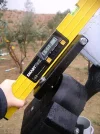
I use my level.
 

Attachments

  • leveling-diseqc-motor.webp
    leveling-diseqc-motor.webp
    70.7 KB · Views: 214
  • leveling-1224-motor.webp
    leveling-1224-motor.webp
    52.9 KB · Views: 174
In modern systems the dish design is what gives the modified angle, the motor as before does all it can to track the line in space at an angle equal to your latitude.

Trust me when I say, you are taking operating instructions too seriously (but it is nice to see they sometimes include a bit of paper with writing on).
 
Channel Hopper said:
In modern systems the dish design is what gives the modified angle, the motor as before does all it can to track the line in space at an angle equal to your latitude.
If you set up a motor according to your latitude (90 - latitude) your motor shaft will be parallel to the earth's polar axis which means you will be tracking infinity hence the error.
 
I don't quite understand the term 'tracking infinity'. Please explain.

(as a novice, I've always used an analyser when I can't trust man-made directions)
 
I agree with rolfw. Trying to set up with anything less than 0.5 degree precision is pointless, even if you can achieve it (which the crudeness of the bracketry renders difficult).

Let's face it, you'd then need to apply the same precision to every other mechanical aspect ie Pole less than say .05 degrees out of true in any direction, perfect application of torque when tightening clamps (motor to pole, dish to motor stub and dish bracket slider) to avoid torsion, inadvertent skewing or slippage.

Bung it up, set motor latitude to within half a degree by eye and take the cumulative mechanical errors out by adjusting the dish bracket.

Science is fine, but Engineering is better!
 
If my figures are correct it is more than 0.5 degrees difference at my latitude not less. The mount has markings in degree steps and it is relataively easy to set it up halfway between two markings for 0.5 degrees of accuracy. Besides I have a inclinometer from the days when traditional polar-mounts were the only option for motorisation. Some setups can make the pole perfectly vertical, which is after all the aim, the instructions do not say get the pole sort of vertical within +/-0.5 degrees will work, sort of.

It just striked me as odd that the instructions seemed to use the wrong figures so I wondered if there was a reason besides simplicity that they did. Since these mounts track more of the arc go lower to the horizon than traditional polar-mounts with acturators, I would of thought it was more critcal. But then I suppose for KU band uses much smaller dishes and higher powered satellites than the C-band dishes and satellites the modified system was designed to eek out the last bit of signal from.
Still how much more would it cost them to print instructions using the better figures.
 
dovercat said:
......... the instructions do not say get the pole sort of vertical within +/-0.5 degrees will work, sort of.

Actually, 0.5 referred to the Motor bracket only, in continuation of the previous Posts.

I mentioned 0.05, not 0.5, as a realistic error for a Pole (given that most hobbyists use only a basic spirit level). Certainly half a degree error in the pole would make tracking difficult.
 
Excuse me for bringing the science back into the subject, but I've been scratching my head over this since your post http://www.satellites.co.uk/satellite/dish-setup-single-sat-multi-sat-motorised-systems/153494-some-declination-angle-confusion.html Huevos.

Similar to what you said, at mid latitudes, you're not at the centre of the geo-orbit, and you're not on the same orbital 'plane' either. It's hard to visualise in 3D, but if your motor axis is parallel to the Earths axis, then you will be looking 'under' the arc.
In a 2 dimensional point of view, with the geo-orbit drawn out as a circle, and a slightly smaller circle placed inside to one side, there is increasing difference in size further from that side where they touch, which would be your due south. But if you tilt the smaller circle upward in the middle, representing the motor axis tilted due south slightly', looking from above it becomes more elliptical and there is less error between the circles.

I've got my 1metre set up with the 'traditional' elevation/declination values, and I get satellites from 0 south to 35 east no problem. I could see the modified polar angles becoming more important at larger (>2.5m) dish sizes where the beamwidth becomes smaller.
I'm no Scientist, but i do ike my engineering to be correct. When i first got a motorised dish, I was puzzled why there was no elevation control and then I learned about declination. I'm normally playing with Az-El mount 6.5m and 9.3m dishes for my day job, and motorized DBS dishes is a slightly different ball game. Hope you like my diagrams.
 

Attachments

  • disharcsside.webp
    disharcsside.webp
    17.1 KB · Views: 146
  • disharcs.webp
    disharcs.webp
    17.4 KB · Views: 142
Hi,

Well all this talk about verticals and angles made me go out and check the pole was vertical on my T&K's. Actually it was about 3mm out of true West-East, soon cured with a substantial hammer!!

Dovercat, as you seem to be a quite precise person, where did you source your location figures? I only ask as I got mine from Dishpointer and now checking with my satnav, I find that there is a discrepancy of 0.4°. Given that you can only approximately position where yor dish is via Dishpointer do you think it might be worth checking at your dish site with a satnav?

Pete
 
Tivù said:
I agree with rolfw. Trying to set up with anything less than 0.5 degree precision is pointless, even if you can achieve it (which the crudeness of the bracketry renders difficult).

Let's face it, you'd then need to apply the same precision to every other mechanical aspect ie Pole less than say .05 degrees out of true in any direction, perfect application of torque when tightening clamps (motor to pole, dish to motor stub and dish bracket slider) to avoid torsion, inadvertent skewing or slippage.

Bung it up, set motor latitude to within half a degree by eye and take the cumulative mechanical errors out by adjusting the dish bracket.
I don't agree. You are saying there is a chain of errors but that isn't true. If you use a level at the motor the motor will be set to whatever angle the level reads irrespective of what strange angles may exist below it. If the motor is leaning east or west though that is a different matter as that cannot be corrected at the motor.

BTW 0.5º just isn't good enough for me. On my 1224, Astra 2D lock is just 3 clicks wide, i.e. 0.25º or looked at another way 0.125º either side of nailed.
 
Channel Hopper is right.
Some dish elevation scales are off by as much as 2 degrees. There is play in motor tube shafts.
This is one thing you do by the numbers and then fudge to get best results. It is always a compromise.
 
futumsch said:
I was puzzled why there was no elevation control and then I learned about declination.
Declination and this tracking error are two different things. Imagine this: draw a perfect circle on the floor 10 metres in diameter. The circle on the floor is the geostationary orbit. Stand dead centre of the orbit. Now your feet are dead centre but your head is not, it's at 51º latitude. Because of this your eyes need to look downwards to be looking at the orbital circle. This is declination.

The tracking error is something different. Step forward a couple of paces to allow for you being at the planet's surface rather than the orbital centre. Now the satellites in front of you are closer to you than the ones at either side so you need to look downwards at a steeper angle to be looking at these satellites. To compensate for this the motor axis needs to lean forward in relation to the earth's axis.
 
Huevos said:
I don't agree. You are saying there is a chain of errors but that isn't true. If you use a level at the motor the motor will be set to whatever angle the level reads irrespective of what strange angles may exist below it. If the motor is leaning east or west though that is a different matter as that cannot be corrected at the motor.

BTW 0.5º just isn't good enough for me. On my 1224, Astra 2D lock is just 3 clicks wide, i.e. 0.25º or looked at another way 0.125º either side of nailed.

Yes, I think in cases like yours greater precision is probably de rigeur. Must try to remember than not all of us have the luxury of virtually infallible signals on the main Satellites of interest :)

I do take your point that using your fancy level jobbie takes out small fore and aft errors in pole plumb, though. A good point, well made.

But don't you find that when you finish off the assembly and mount the Dish to the stub, for example, that not only can it be quite a task to get the dish bang on the frontal datum on the stub but it can also be a bit of a sod to keep it there whilst tightening up the clamps? Many of us have found that a little tricky, especially with heavy dishes like the TD110 and particularly if compelled to work in less than benign locations.
 
You need to tweak declination anyhow when you adjust your dish, elevation alone is not enough to get it tracked right, North/west orientation most often is the cause to most errors, after you have that right move on to declination tweak, test south and extreme east and extreme west, after that tweak elevation and back and forth til you peaked max signal on all sats....
 
sonnetpete said:
Hi,

Well all this talk about verticals and angles made me go out and check the pole was vertical on my T&K's. Actually it was about 3mm out of true West-East, soon cured with a substantial hammer!!

A man after my own heart!

Suitably equipped with a Manchester Screwdriver, the world is your lobster :-rofl2

I micro-align the Azimuth of my Patio Mounted 1.1m by means of a judicious kick with the heel of my boot in the appropriate corner of the paving slab. Saves all that tricky spanner stuff. Elevation micro-alignment is by means of plywood wedges inserted under the relevant corners of the slab!

It's only a hobby, after all - and the results are excellent :)
 
Tivù said:
Actually, 0.5 referred to the Motor bracket only, in continuation of the previous Posts.

I mentioned 0.05, not 0.5, as a realistic error for a Pole (given that most hobbyists use only a basic spirit level). Certainly half a degree error in the pole would make tracking difficult.

The two adjustments available in the motor brackets plus the two in the dish clamping/declintion set up can be used to correct irregularities in pole setting, (from experience) up to around five degrees.
 
Nice! I've never been that far out .................. :cool:

Another vote for "whatever works" :)
 
Back
Top