Troubleshooting signal - what am I missing?! (multi-lnb)

OldBen

Mad Scientist
My Satellite Setup
Triax TD110 with multi LNB 28.5E, 23.5E, 19E, 13E Inverto Black Ultra's (Black Premium on 28.5) into multiswitch.
My Location
UK
Slightly tearing my (grey) hair out with this, so looking to see if anyone else can spot something I missed.

So I have a 1.1 Triax dish on a ground mount in the garden, the focal LNB is 23.5E (Skylink as its weakest), then I have 28.2, 19E & 13E arrange either side on a Triax multii-lnb bracket. 13, 19 and 23.5 are Inverto Black Ultra Quattro's, 28.2 is a Inverto black premium (for physical spacing I think I chose that)

I put the system in 15 years ago, very little problems since, but I knew one day the LNB's would reach end of life, last year 13E was mostly missing on a re-scan so I think that LNB failed and I have not replaced as we hardly ever used it.

Lately 28.2 has been a little weak, it started with a few channels but then the main stuff started to loose picture occasionally. I had assumed someone had whacked the LNB bracket - a little tweak seemed to bring signal back but now it's gone totally - I assumed LNB on way out with the hot weather of late.

I picked up a Triax Gold Quattro to swap out on 28.2, but I still have a weak signal - I would add I am using an Emitor Satlook Lite meter at the dish to measure strength, not using telly, multi switch not in the loop. It's a 1.1m dish so even with offset 28.2 should be blowing the doors off.

I have checked positioning about 10 times, 23.5 is fine, 19E is fine, locks and strong signal on both so the dish and multi LNB bracket can't have moved or they would all have be out of alignment.

Started cutting bushes in the garden near the dish in desperation - but if it was that 19 and 23 would be blocked too!

What am I missing?:(
 
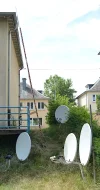
take a picture of the antenna and show the picture
 
Can you confirm that you're setting the LNB up before the multiswitch? If you can get a valid signal on your meter for each of the four outputs it can only be your multiswitch at fault or, whisper it quietly, you've got your outputs and inputs mixed up.
 
take a picture of the antenna and show the picture
Don't have one to hand, but it looks like every other multi-LNB setup - what are you looking for?
Can you confirm that you're setting the LNB up before the multiswitch? If you can get a valid signal on your meter for each of the four outputs it can only be your multiswitch at fault or, whisper it quietly, you've got your outputs and inputs mixed up.
The LNB's are quattro, so there is no setting they are fixed output. Your correct though that you need to make sure your using the meter on the right output for the transponder your looking for - in my case Low/Vertical and I am using 10937V with Channel4 on the meter. I have tried another transponder in case I made an error but its overall low signal you can see it with a sweep on the meter.

Don't forget this has all been working for 15 years so nothing is wired backwards, with the Satlook attached to the LNB directly the multi-switch is not involved.
 
15 years on a run of 75 ohm coax is a possibility that something may have gone a bit sour, the jacket on section of the coax may be sitting in the sun somewhere for that long, a small crack in the PVC jacket could have let some water in, over the years that can cause signal desegregation on the shielding, this can cause a drop in the overall signal, or a leak from external signals into the shielding.
 
Don't have one to hand, but it looks like every other multi-LNB setup - what are you looking for?

Well, we forum readers prefer to see the real situation around the dish.
Here's an example of something strange.
How would you guess that there is a tall ladder on the signal path from the satellite to the antenna if I don't show you the picture?


chisto.webp
 
...the focal LNB is 23.5E
.....
I have checked positioning about 10 times, 23.5 is fine, 19E is fine, locks and strong signal on both so the dish and multi LNB bracket can't have moved or they would all have be out of alignment.

When the central LNB is fine and the outer LNBs are not fine, I would think the multifeed rail is no longer at the proper skew/tilt angle.

What type multifeedrail do you have?

Greetz,
A33
 
he has a Triax multii-lnb bracket
which certainly does not allow him to raise only the LNB for the 28°E satellite

A few years ago I used this antenna for 28E - 24E - 19E -13E - 9E - 7E
but a distant tall poplar grew and the 24E signal stopped.
As can be seen from the picture, the LNB for 28E is higher than the others.
The holder I used allows the aluminum rod to be bent upwards.
I am in Belgium near the border with Luxembourg. The signal from 28E is very strong here.7LNB.webp
 
Last edited:
Don't have one to hand, but it looks like every other multi-LNB setup - what are you looking for?

The LNB's are quattro, so there is no setting they are fixed output. Your correct though that you need to make sure your using the meter on the right output for the transponder your looking for - in my case Low/Vertical and I am using 10937V with Channel4 on the meter. I have tried another transponder in case I made an error but its overall low signal you can see it with a sweep on the meter.

Don't forget this has all been working for 15 years so nothing is wired backwards, with the Satlook attached to the LNB directly the multi-switch is not involved.
To assist (not much), the forum did have major incidents thanks to a couple of idiots portraying as like minded enthusiasts.

From your original thread (truncated)

 
he has a Triax multii-lnb bracket

Ah, OK. I forgot that he mentioned it.

So it will be the lower one of this sat4all picture, I assume:
community.sat4all.com/uploads/default/original/4X/3/d/9/3d9b78ab379cb369249ed6ef39e744ddae32a2be.jpeg
The rail can indeed be skewed by rotation around the central screw.

@OldBen : If you want I can calculate the needed multifeed skew for 28.35E till 13E with 23.5E central, for your location. I'd need your latitude and longitude, roughly, for that.

Greetz,
A33
 
The "magic" tool that allows finding the correct position in three-dimensional space for the 28°E LNB is this one:

But for a person to use it successfully, the function of his brain responsible for 3D orientation must be working well.

Otherwise, in theory calculations are a very good thing, but in practice there is a discrepancy between the expected result and the actual one that is achieved.

magi4entool.webp
 
Did a few of the Triax multifeeds over the years and they're pretty stable, however, it only takes a pigeon or similar to land on it a few times for it to be moved, also the individual LNB skew can be changed. I stopped using the Black Ultra LNBs a long time ago, found them noisy, so reverted to Triax standard quatro LNBs for multiswitch systems
 
Did a few of the Triax multifeeds over the years and they're pretty stable, however, it only takes a pigeon or similar to land on it a few times for it to be moved, also the individual LNB skew can be changed. I stopped using the Black Ultra LNBs a long time ago, found them noisy, so reverted to Triax standard quatro LNBs for multiswitch systems
And when a really fat pigeon sits on the front end of a Lenson Heath dish, the corroded arm can break off at the elbow.
 
Otherwise, in theory calculations are a very good thing, but in practice there is a discrepancy between the expected result and the actual one that is achieved.

That, of course, is very much dependent on how good your equations for the calculations are to begin with.
I've seen many approaches and equations for multifeed distances and multifeed skew that are theoretically not very good, as far as I'm concerned. They can be approximations, at best, or maybe coincidentally hit the actual needed value.

Multifeed skew can be calculated quite accurately, as far as I know. Proper multifeed distance calculations have the problem that the BDF (beam deviation factor) is often no more than an approximation, and the curvedness of the rail towards the dish is a variable that is often not differentiated.

However: Every setting of the dish should indeed be checked in practice, for maximal/optimal reception!

Greet,
A33
 
o.k. can you give me a reasonable explanation how did I managed this without any equations / calculations?

sas7Lnb.webp
 
o.k. can you give me a reasonable explanation how did I managed this without any equations / calculations?

Well, you obviously had very easy access, to experiment.

But I don't understand the relation between your question, and the reaction that I gave to your earlier statement?


Apart from that: I've almost always used approximations and trial and error for distances between LNBs, on multifeed setups. I had easy access to my dishes, too.

For multifeed skew, this is sometimes another thing, I find.
For a triple LNB (made for a triax 65), on a triax 78, trial and error is almost obligatory, I find, because the zone of workable skew angle is very, very narrow, and also dependent on the dish's elevation angle. So there I also use (systematical) trial ad error, to get a good angle. (Having a calculated starting value helps, though.)
But for a triple LNB on a triax 65-like dish, the zone of workable skew is so wide, that it is about impossible to find the 'best' skew angle, I found. So in that case I used the exact calculated value, to be sure I had the optimal value in case of very bad weather.

Greetz,
A33
 
Last edited:
o.k. can you give me a reasonable explanation how did I managed this without any equations / calculations?
I've completed many multifeeds, always using meter only, started wit the centre feed and moved the dish elevation and azimuth to get the very best signal and quality reading, then set approximate LNB bar slope using the settings from the instructions and fine tune with the most extreme LNB and work inwards. then chack everything again when all tightened up. That method has always worked for me, always had a DiSEqC motor at home though, this was always for customers.
 
and even more professional would be to check any weak transponder that suffers from interference from a neighboring satellite on almost the same or close frequency
 
Hi All, thanks for the replies, sorry busy all weekend and didn't get a chance to check the forum Friday after I posted.

Ignore 13E, it's not bad signal the LNB is totally dead as a parrot, pining for the Fjords, failed, deceased, no more.

15 years on a run of 75 ohm coax is a possibility that something may have gone a bit sour, the jacket on section of the coax may be sitting in the sun somewhere for that long, a small crack in the PVC jacket could have let some water in, over the years that can cause signal desegregation on the shielding, this can cause a drop in the overall signal, or a leak from external signals into the shielding.
Could be, but that would have no impact when I attach the meter directly to the LNB - only the meter and the cable in circuit with the LNB, and if the test cable was bad then it would not work fine on 23 and 19. Meter on 23 and 19, which will show 80% and lock transponder no problem, 28 its about 60% signal strength maybe 65% when pushing pulling around.

I did use decent WF100 and compression plugs to try and mitigate against that sort of thing.
(Just a note my phone is skewed here, the LNB bracket is no where as a dramatic angle as it looks - see better pic below)

IMG_1651.webp
Well, we forum readers prefer to see the real situation around the dish.
Here's an example of something strange.
How would you guess that there is a tall ladder on the signal path from the satellite to the antenna if I don't show you the picture?
Yes fair point, I was more thinking I have missed something stupid, but having fussed around with it a lot I am still stumped.

The dish is jammed in down the side of the house, it looks really tight but its worked perfectly for the past 15 years so the major features like the house and shed are not an issue - I began to suspect the growth on the hedge (28 being on left of the central LNB, signal coming more from the right) so I took the cutters to it on Saturday morning!

The only thing I can think of that I have not yet eliminated is there a tree in the neighbours garden that is long and thin and probably a meter higher than previous years... but... if you stand behind the dish and look down the LNB arm the tree is pretty dead centre, and the signal for anything but 23E has to be coming from one side or other.

IMG_1632.webp

To assist (not much), the forum did have major incidents thanks to a couple of idiots portraying as like minded enthusiasts.

From your original thread (truncated)

Ah, that's not this, that was my original setup with a motor and @rolfw kindly helped me out with! I moved about 6 years later and this is the fixed dish I have had since.

This is what it looked like when I started to troubleshoot, with all the original LNB's in place:
IMG_1223.webp

I've completed many multifeeds, always using meter only, started wit the centre feed and moved the dish elevation and azimuth to get the very best signal and quality reading, then set approximate LNB bar slope using the settings from the instructions and fine tune with the most extreme LNB and work inwards. then chack everything again when all tightened up. That method has always worked for me, always had a DiSEqC motor at home though, this was always for customers.
This is exactly how I did mine originally. I splashed out on the Satlook as it will lock transponder and confirm which satellite your on, then show you bit error rate so you can tweak the alignment and the skew as well for best/strongest signal.

I started with 23E, got that bang on as best I could, then did the others, found 19 and just slide up and down the rail for 13 and so on. I started with the EU ones as they are a bit weaker, and having peaked signal for 19 then confirmed with 13 I was sure the angle of the rail was fine - 28 confirmed it was ok.

Apart from skew, I did a bit of sliding the LNB collar back/forward with the play available on the outer LNB's as well to see if that made difference with the curve but not really, the rail itself is curved.

Rolf - the Inverto's have been great over the years, 23E in particular is quite weak here, I was told on the forum I wouldn't get it with less than a 1.2M dish but its been fine on this 1.1 Triax in all weathers.

Here is where I am at as of Sunday:
  • I have swapped in the Triax Quattro for 28, it reads about 60-65% signal on the meter which is about the same as the Inverto I took off.
  • I have taken out the locking screw and slide it along the arm - moving it in a few mm has got me a few more %
  • Tweaking the arm up/down does not improve signal
  • Rotating/Skew the LNB does not improve signal
  • Moving in/out with the limited amount available does not improve signal
  • TV is working... just... watching several hours of the F1 on Channel 4 earlier I lost picture about 10 times, there was one period of a few mins where it happened 4-5 times, the rest were single events and it came back.
  • I am starting to wonder if I have interference - however 23 and 19 don't see any (I have not gone to the extreme of checking frequencies)
My next step is to re-work the centre mounting in case the arm has moved so its not 100% "parallel" to the dish (arm and dish are both curved, but I hope you know what I mean!).

The Technomate mount is designed to be slide into the arm from the dish, then all the LNB are offset. As I was so marginal for 23E in my location, I used the original Triax LNB mount on 23E, then I clamped the technomate holder over the same LNB and used it to support the mount - you should be able to see in photo above full size the metal bar is above and the LNB hang from it.

I think the original Triax single LNB mount has started to weaken - as noted above maybe someone clouted it or a particularly fat bird came along. There is some white in the black plastic and maybe this has made it twist moving 28 closer/further to/from dish - but if that happened still not sure why 19 would work!
 

Attachments

  • multi-lnb-holder-bracket-500x500.webp
    multi-lnb-holder-bracket-500x500.webp
    14.4 KB · Views: 30
To assist (not much), the forum did have major incidents thanks to a couple of idiots portraying as like minded enthusiasts.
Yes sorry, I keep forgetting there are many "experts" on the internet, and thanks to AI there are now "experts in AI who are experts in everything"...

I added details and pictures to try and justify my claims :)
 
Back
Top