Help Required Why we can't have an offset dish with circular face (width = height)?

ghasemi44

New Member
My Satellite Setup
Mediastar
My Location
US
Greetings.
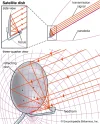
As we know, an offset satellite dish antenna is a small oval subsection from a much larger parabolic antenna design. It is oval in shape with a minor axis (left to right W) that is narrower than its major axis (top to bottom H). But the question is here: could this subsection be a circle not an ellipse (or oval)? Why not consider W equal to H while cutting? It is easy to extract a circular cut from the original front-fed reflector. It is clear from the photo below that it is possible to do this.
Please give me some explanation about this :\
 

Attachments

  • offset_dish.gif
    offset_dish.gif
    7.6 KB · Views: 23
  • Satellite-dishes-satellite-dish-antenna-paraboloid-portions.webp
    Satellite-dishes-satellite-dish-antenna-paraboloid-portions.webp
    251 KB · Views: 21
The satellite dish of a conventional offset dish is circular from the point of view of the LNB. It's only when the dish is viewed face on that it becomes oval.

An offset dish can have other shapes but it then requires an LNB which has a specially shaped feedhorn so that all the dish can be "seen". An example of this is the standard Sky mini dish which is wider than it's tall for purely aesthetic reasons.
 
To add:
The advantage of an elliptical offset dish (higher than wide) is that the LNB feedhorn can have a circular illumination angle, no matter the LNB skew angle.

There are, by the way, circular offset dishes. They don't have a flat dish face, for the paraboloid surface, of course. So sometimes they use a thicker dish rim at the top and at the bottom, so that the dish face at the rim is again flat.
The actual offset angle of such a circular dish is harder to determine than with a normal elliptical offset dish, which has a perfectly flat dish face.
Also checking if the dish might be warped, is very very hard (almost impossible), with such a dish.

An offset dish normally is not cut out of a prime focus dish, in the sense that first a PF dish is fabricated, and then the offset dish is cut out of it. So for production, a circular offset dish does not have a specific advantage, I would say.

Greetz,
A33
 
Quite simply, shine a flashlight diagonally against a wall, there you have the principle of an offset dish and why it is oval :)
 
It seems @ghasemi44 has not logged in to the forum anymore, since posting his/her question.

That is a pity....
So we might not get feedback, if his/her questions are answered satisfactorily.
 
To add:
The advantage of an elliptical offset dish (higher than wide) is that the LNB feedhorn can have a circular illumination angle, no matter the LNB skew angle.

There are, by the way, circular offset dishes. They don't have a flat dish face, for the paraboloid surface, of course. So sometimes they use a thicker dish rim at the top and at the bottom, so that the dish face at the rim is again flat.
The actual offset angle of such a circular dish is harder to determine than with a normal elliptical offset dish, which has a perfectly flat dish face.
Also checking if the dish might be warped, is very very hard (almost impossible), with such a dish.

An offset dish normally is not cut out of a prime focus dish, in the sense that first a PF dish is fabricated, and then the offset dish is cut out of it. So for production, a circular offset dish does not have a specific advantage, I would say.

Greetz,
A33

To add:
The advantage of an elliptical offset dish (higher than wide) is that the LNB feedhorn can have a circular illumination angle, no matter the LNB skew angle.

There are, by the way, circular offset dishes. They don't have a flat dish face, for the paraboloid surface, of course. So sometimes they use a thicker dish rim at the top and at the bottom, so that the dish face at the rim is again flat.
The actual offset angle of such a circular dish is harder to determine than with a normal elliptical offset dish, which has a perfectly flat dish face.
Also checking if the dish might be warped, is very very hard (almost impossible), with such a dish.

An offset dish normally is not cut out of a prime focus dish, in the sense that first a PF dish is fabricated, and then the offset dish is cut out of it. So for production, a circular offset dish does not have a specific advantage, I would say.

Greetz,
A33
How can the beamwidth of this type of dish be calculated?
 
I propose to continue @unk266 's question here, at his simultaneous new topic:


Greetz,
A33
 
Back
Top