Ka with Prodelin/Viasat 1.2m Band B

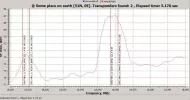
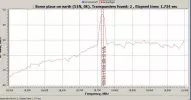
@John, here you go, 19.2E vertical with Gilat feed gaffer taped to 1.5m PF. Diplexer and polariser removed with unknown match between LNB and feed. 2-3dB improvement but different dish, under illuminated.
ITN Newsnet & the carrier on 18794 have disappeared.
BADR-7's beacon only 14dB c/n in 1kHz with this configuration.
19.2E_V_Ka.webp
 
Last edited:
@John, here you go, 19.2E vertical with Gilat feed gaffer taped to 1.5m PF. Diplexer and polariser removed with unknown match between LNB and feed. 2-3dB improvement but different dish, under illuminated.
ITN Newsnet & the carrier on 18794 have disappeared.
BADR-7's beacon only 14dB c/n in 1kHz with this configuration.
View attachment 106675


Those two frequencies shown on the plot G are from the Hor polarity of the sat. For Vert reference at about 99.9% of the time you will see Newsnet @ 18.557 V & the other data/comms carrier at 18.561V. -- .... or have i misunderstood your post (quite possible) lol.
 
Those two frequencies shown on the plot G are from the Hor polarity of the sat. For Vert reference at about 99.9% of the time you will see Newsnet @ 18.557 V & the other data/comms carrier at 18.561V. -- .... or have i misunderstood your post (quite possible) lol.

:-doh

I am still confused though, I though I knew the difference between V & H but obviously not. Well, at least I have reasonable X polar rejection! It's raining here now so a re-try will have to wait.

:-doh
 
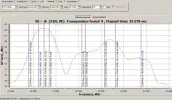
Ok, so this is the right way round. It's about 2dB up on circular on the 1.2m Prod. Blindscan now sees 18507 & 18511 but not locked.

Edit: I checked the LO and it is on 18249.826MHz but it wanders a few kHz. That means that the carrier (or beacon) is on 18794.64MHz
 

Attachments

  • 19.2E_V-really-_Ka.webp
    19.2E_V-really-_Ka.webp
    93.2 KB · Views: 16
Last edited:
Ok, so this is the right way round. It's about 2dB up on circular on the 1.2m Prod. Blindscan now sees 18507 & 18511 but not locked.


Yes, that looks right Graham. Newsnet & the data next to it are usually always the strongest. Other frequencies below and above are usually lower strength.
Edit: The above statement refers to my location in North Notts of course but have to say your latest plot looks like what i would see up here.
 
I found another version of the ODU that covers band D. I removed the LNB from the ODU and modified it so that the feed fits directly. There is a mis-match between the LNB waveguide and the feed but it doesn't seem too bad. It wasn't possible to try it easily on the Prodelin so I put it on the 1.5m PF. That is under-illuminated when using the standard feed but still adequate. Here is a scan from 16E H:

16E_H_scan.webp

I also tried it with a standard scalar feed and it improved by about 1.5dB compared to the above. It shouldn't have come as a surprise but the position of the feed is critical to within a mm or so. The PF scalar feed is shown attached to the LNB here:

Gilat_D+PF_Feed_DSC1573a.webp

The attached .pdf shows the modifications I made to the LNB.
 

Attachments

Last edited:
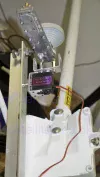
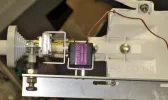
Here are a couple of pics of the Gilat, with polarisation control, mounted on the Prodelin. The mount is adjustable to be able to peak focus.

servo_DSC1625s_copy.webp servo_DSC1628s_copy.webp
 
Thanks st1 & CH. Inspired by John & qwer's ideas.

@John I moved the LO around on the band B Gilat and the limitation is as I thought, it's the RF filter. There's nothing to be gained by moving the LO down unless you wanted shift the IF range at the expense of coverage. The LO will stay locked over a range of 17.2-19.6GHz (after doubler) but that's way outside the spec of the PLL chip. The LNBs are usable over a range of 18.5-20.6GHz with a bit of droop at both ends.
 
Last edited:
Back
Top