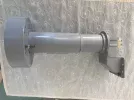
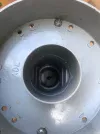
Just Sharing This My Channel Master 1.8 project.

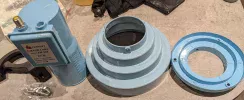
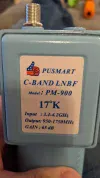
no dielectric plate included...not sure what the shallow ring is...? also, holes on the plastic cap - can i cover them up to stop water ingress?

pics attached.
 

Attachments

  • PXL_20220216_180451798.webp
    PXL_20220216_180451798.webp
    119.9 KB · Views: 40
  • PXL_20220216_193127200.MP.webp
    PXL_20220216_193127200.MP.webp
    98.3 KB · Views: 32
  • PXL_20220217_201424197.webp
    PXL_20220217_201424197.webp
    51.5 KB · Views: 25
  • PXL_20220217_201428470.webp
    PXL_20220217_201428470.webp
    52.2 KB · Views: 24
  • PXL_20220217_201501260.webp
    PXL_20220217_201501260.webp
    25.3 KB · Views: 21
  • PXL_20220217_201508924.webp
    PXL_20220217_201508924.webp
    60.5 KB · Views: 29
no dielectric plate included...not sure what the shallow ring is...? also, holes on the plastic cap - can i cover them up to stop water ingress?

pics attached.
Yes and also insects
 
so i'll need to make up a dielectric plate to get circular TP's on 40.5w

how do you know which is circular and linear from the TP list on lyngsat ? where is it stated?
 
so i'll need to make up a dielectric plate to get circular TP's on 40.5w

how do you know which is circular and linear from the TP list on lyngsat ? where is it stated?
Next to the frequency , L or R.

Best try tonight though, tomorrow your dish could be in another postcode.
 
ahh thanks - that makes sense now.
 
no dielectric plate included...not sure what the shallow ring is...? also, holes on the plastic cap - can i cover them up to stop water ingress?

pics attached.


The larger hooded scalar ring is used with an offset focus dish. The flatter scalar ring is used with a prime focus dish.

There are no retaining grooves inside your C-Band LNBF to slide a dielectric plate into. For circular polarity frequencies you will need to secure a dielectric plate in place with something like blu-tack or tape.
Cut up a bit of teflon or a plastic bread board for a dielectric plate or buy one from SSS.

Alternatively, ditch the dielectric plate and buy a polo pipe, they give better signal levels on circular polarity compared to a dielectric plate.
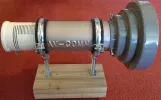
'ere is a picture of a polo pipe mock up, the LNBF is shoved into the polo pipe at one end and the hooded scalar fits on t'other end.

.
AV-COMM Feed & Zinwell LNB.jpg
 
Last edited:
thanks @moonbase - yes, i realised that (re the grooves) what are the effective properties of this polo pipe (whats that short for?) - what does the pipe look like inside?

i found this video which has the grooves....

i gather that you lose 3db approx of signal using a dielectric plate...
 
Next to the frequency , L or R.

Best try tonight though, tomorrow your dish could be in another postcode.

... Bring it on
....................................................................................................................................................................................................................................................................................................................................................................
Storm position.jpg..reduced..webp
 
you need to paint your dish to match your iron mongery.
:)
 
i gather that you lose 3db approx of signal using a dielectric plate...


You definitely gain signal on circular polarity signals by using a polo pipe compared to using a dielectric plate.
I have tested both and found the polo pipe consistently gives the stronger signal.

There is also a pin pipe which does the same thing, ie converts circular polarity to linear polarity
Lastly, there is the rib tickler. The rib tickler is made by Prodelin and is a very high quality piece of kit. It is quite a heavy unit and needs a square frame clamp.

A polo pipe has internal steps on opposite sides of the pipe.
A pin pipe has internal pins on opposite sides of the pipe.
A rib tickler is externally a square shaped waveguide with sequential ridges on opposite sides internally.

Polo pipes can be imported from Australia
Pin pipes can be imported from Brazil
Rib ticklers can be imported from the USA, sometimes listed on eBay.

Alternatively, they sometimes get sold second hand, or the polo and pin pipes can be fabricated rather than imported.
There are plenty topics on the forum discussing these pipes and ticklers, some with pictures of the internals.
 
Last edited:
And at the end of the day there's also the ultimate solution ... lottery win with finding a piece of good old ADL RP1/RP2 CP-400 feedhorn. :)
Which in fact is a polo type with internal steps but with a servo motor.

IMG_5770.webpIMG_5771.webp
 
... Bring it on
....................................................................................................................................................................................................................................................................................................................................................................
View attachment 141106
Whose is this or this version.

Best regards
 
Whose is this or this version.

Best regards

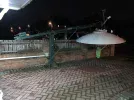
Mine - lowered and chained down to weather the pending storm gusts approaching.
 
And at the end of the day there's also the ultimate solution ... lottery win with finding a piece of good old ADL RP1/RP2 CP-400 feedhorn. :)
Which in fact is a polo type with internal steps but with a servo motor.

View attachment 141117View attachment 141118


@John

The picture showing the internal setup is interesting. The steps on opposite sides of the pipe look very similar to those in the AV-COMM polo pipe.
If you have measured them, how do the dimensions of the ADL stepped pipe compare with the AV-COMM polo pipe?
 
great ,
That's great, man.
not bothered by a little bit of wind in connection with the signal.
You give me an idea
 
Mine - lowered and chained down to weather the pending storm gusts approaching.
My poor dish is getting a right battering at the moment - still in alignment but wobbles enough to pixelate the image.
 
@John

The picture showing the internal setup is interesting. The steps on opposite sides of the pipe look very similar to those in the AV-COMM polo pipe.
If you have measured them, how do the dimensions of the ADL stepped pipe compare with the AV-COMM polo pipe?

Iv'e got the remains of one of those described feeds somewhere MB - from memory the ADL steps look a bit deeper.
I'll have a rummage later and check it out
 
great ,
That's great, man.
not bothered by a little bit of wind in connection with the signal.
You give me an idea

Iv'e had a 2.2 mtr Precision PF dish and a 'Jumbo' HH motor completely trashed many years ago that were mounted on that same King post arrangement by similar strength gale force winds - the King post will not go anywhere as there is a cubic metre of concrete under those fixings and it's also tied into the foundations to the wall at the side. My previous one was just tied down in the same position but used a rope instead of a chain - the gale was strong enought to get under the dish , snap the rope and threw the assembly back up to vertical at very high speed and knackered the reflector and 'Jumbo' motor. Changed to a heavy duty chain now to anchor it down and it does not move at at all.
High winds and large dishes do not go together well and can be very dangerous.
 
John,
not bothered by a little wind in connection with the signal.
I mean by this, that the dish does not go back and forth but is tight, and has a full signal.
 
"a little wind!" :D
 
Back
Top