36E (Eutelsat 36B)

Is or was there an official Channel Master polorising plate available for the 1.2 / 1.8 mtr CM feed to purchase ?

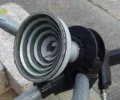
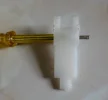
Yes - my original Channel Master feed was supplied with one when i bought it from CPC many years ago .... and was the only arrangement - ( i tried a few ) - that would lock that 36 E transponder
feed plate.webp plate.webp
 
Is "fish fork" the shape of the plate in the IRTE PF scalar feed?
I have attached a picture below of the Swedish Microwave XD12 polariser, is the plate similar to the IRTE fish fork?

The part pictured below is currently inserted between the Precision C120 waveguide and the Invacom LNB

.
View attachment 140486
Looks similar, but from memory the IRTE was thinner and better constructed.
 
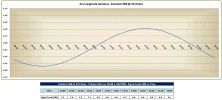
The below chart and table might be useful to any UK located dx'ers wishing to try to lock any of the circularly polarised signals from Eutelsat 36B?

There is a very minor azimuth motion on this satellite, it traverses between 35.83 East and 35.94 East giving a longtidue variance of 0.11 degrees
This minor azimuth motion seems to parallel the signal levels I recorded today for the Trikolor mux on 12149 L, SR27500.

If the correlation between longitude variance and signal level is correct there might be a best time of day to try to lock this frequency, currently at 10:30 and 20:30?
The azimuth motion is not fixed, it changes marginally day after day and it is also eccentric.

Location: Surrey, UK
Weather: Blanket cloud

.
36°0E_20220122_Longitude Variance.jpg
 
Last edited:
Before then, I have a couple of circular polarity LNBF's that I am going to try out on 36.0 East.
They have different designs to the dielectric plate in them and both are different to the design of the plate in the Swedish Microwave XD12 polariser.
Perhaps the different plate design might give me a boost?

It is a balancing act with these fringe circular polarity signals.
You get some signal level increase by converting circular to linear polarity. However, you then lose signal level due to the impact of the plate in the feed partly blocking the signal.
Hi - @moonbase

Did you try anything with different plate design ? ..... With my tinkering with C band plates just fractionally altering the position that the plate sits in the feed / throat can also be critical.
 
Hi - @moonbase

Did you try anything with different plate design ? ..... With my tinkering with C band plates just fractionally altering the position that the plate sits in the feed / throat can also be critical.


Hi - @nelson_b

Currently, there is an Invacom Quad C120 LNB on the dish with the Swedish Microwave XD12 polariser inserted between the LNB and the C120 waveguide.
However, I have two more LNBF's to try, both were manufactured as circular LNBF's with inbuilt but different plate designs. I will be testing both of these in the next few days.

I have attached below a chart that presents a revision of the satellite motion of Eutelsat 36B. The chart below now factors in the elevation motion as well as the azimuth motion.
It is a balancing act, the satellite can be accurately tracked and the dish adjusted accordingly to squeeze the very last bit of squirt from it.

The high and low points of the chart where the plot intersects the vertical axis represent 10:33 and 20:33 respectively with 10:33 being the lower point of the two. The intervals of the plot are hours.

.
36°0E_20220123_AzEl_Motion.jpg
 
Hi - @nelson_b

Currently, there is an Invacom Quad C120 LNB on the dish with the Swedish Microwave XD12 polariser inserted between the LNB and the C120 waveguide.
However, I have two more LNBF's to try, both were manufactured as circular LNBF's with inbuilt but different plate designs. I will be testing both of these in the next few days.

I have attached below a chart that presents a revision of the satellite motion of Eutelsat 36B. The chart below now factors in the elevation motion as well as the azimuth motion.
It is a balancing act, the satellite can be accurately tracked and the dish adjusted accordingly to squeeze the very last bit of squirt from it.

The high and low points of the chart where the plot intersects the vertical axis represent 10:33 and 20:33 respectively with 10:33 being the lower point of the two. The intervals of the plot are hours.

.
View attachment 140510

Interesting to see the motion chart ...... many weak signals seem time of day dependent for various reasons.....

I, m tempted to have another go here on this sat with these circulars - l.o.l. ... I have the Invacom Quad C120 LNB and sub reflector and its matched feed on the 2.4 c.m. again now but it has a sealed cap that i don,t really want to remove ...
sub feed.webp
i may try a plate in the rear of the feed where it bolts to the l.n.b -rather like your Swedish Microwave polariser has . ... my previous attempts at these circulars have been with a standard c.m. feed and plate inserted from the front
feed plate.webp
I tried a manufactured circular l.n.b.f , in the past ... but it fell about 1.0 db short of lock .
 
I tried two alternative options for circular polarity using two LNB's with different dielectric plate designs.
The outcome was no increase in signal levels compared to the setup with the Swedish Microwave XD12 polariser inline.

All three dielectric plate options gave similar signal levels.
I think the only way I could possibly improve signal levels would be to get hold of a Ku-Band polariser that has internal pins or steps of some type.

That's it from me for Eutelsat 36B for now, I will probably be back on the sniff at some point.
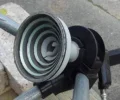
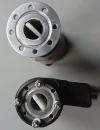
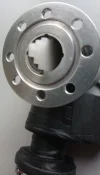
I have attached a few pics below of the two alternative LNB's I tried recently.

.
Circular Polarity C120 LNB's p1.jpg Circular Polarity C120 LNB's p2.jpg Circular Polarity C120 LNB's p3.jpg
 
I tried two alternative options for circular polarity using two LNB's with different dielectric plate designs.
The outcome was no increase in signal levels compared to the setup with the Swedish Microwave XD12 polariser inline.

All three dielectric plate options gave similar signal levels.
I think the only way I could possibly improve signal levels would be to get hold of a Ku-Band polariser that has internal pins or steps of some type.

That's it from me for Eutelsat 36B for now, I will probably be back on the sniff at some point.
I have attached a few pics below of the two alternative LNB's I tried recently.

.
View attachment 140604 View attachment 140605 View attachment 140606

O.K. - M.B.

Thanks for letting me know the outcome .. and the pictures of the different l.n.b,s and their different plate designs

You said - "I think the only way I could possibly improve signal levels would be to get hold of a Ku-Band polariser that has internal pins or steps of some type."

Does anyone make those type of polarisers for k/u i wonder ?

I .v not had the chance to try that which i mentioned in post 146 .... all i could hope for is a improvement in signal strength on that 1 transponder ... i,m sure i would not gain any new ones
I lose full line of sight from sats beyond 45 E with the 2.4 dish - so no point in me trying for the circular t.p,s at 56 E. at this time.

Cheers.
 
You said - "I think the only way I could possibly improve signal levels would be to get hold of a Ku-Band polariser that has internal pins or steps of some type."

Does anyone make those type of polarisers for k/u i wonder ?


I am fairly sure I have seen pictures of these though they might not have been mass produced.
There have been a few papers published covering the topic including designs and theoretical considerations.

However, I have yet to get my hands on one.
 
I have attached a few pictures and listed a small table below from the frequencies I managed to lock from the Sub Saharan beam of Eutelsat 36B.
To date, I have locked three frequencies but there might be another two that I can lock if the signal levels improve slightly over the course of a day or two.

Locked to date are:
11474H, SR27500 (DSTV mux)
12054H, SR27500 (DSTV mux)
12245H, SR27500 (DSTV mux) - this is a strong signal, the bin lid kids round 'ere are getting locks on this one.

.
36.0E_SubSaharaBeam_20230128_11747H_SR27500_p1.jpg 36.0E_SubSaharaBeam_20230127_12054H_SR27500_p1.jpg 36.0E_SubSaharaBeam_20230127_12245H_SR27500_p2.jpg
 
Locked to date are:
11474H, SR27500 (DSTV mux)
12054H, SR27500 (DSTV mux)
12245H, SR27500 (DSTV mux) - this is a strong signal, the bin lid kids round 'ere are getting locks on this one...


Correction to the 1st frequency in the list.

Locked to date are:
11747H, SR27500 (DSTV mux)
12054H, SR27500 (DSTV mux)
12245H, SR27500 (DSTV mux)
 
I have received many more on 1.8m in the Netherlands, but all encrypted.
About all DVB-S transponders on Sub Sahara Beam of Eutelsat 36B.
12054 H is far stronger than the rest and I could even receive it with 1.2m dish.
 
Sub Saharan beam of Eutelsat 36B: (With a 90 cm motorized antenna).

11,727 V (DVB-S2 8PSK) | 11,747 H | 11,766 V | 11,785 H | 11,804 V | 11,823 H | 11,862 H | 11,881 V (the weakest frequency) | 11,900 H | 11,938 H | 11,958 V | 11,977 H | 11,996 V No signal | 12,015 H Okapi radio FTA | 12,034 V | 12,054 H | 12073 V

20230130_235923_ALT-DVB @ BDA [ TBS 5927 USB DVB-S2 Tuner ] - Satellite.png 20230131_000025_ALT-DVB @ BDA [ TBS 5927 USB DVB-S2 Tuner ] - Satellite.png 20230131_000058_ALT-DVB @ BDA [ TBS 5927 USB DVB-S2 Tuner ] - Satellite.png 20230131_000142_ALT-DVB @ BDA [ TBS 5927 USB DVB-S2 Tuner ] - Satellite.png 20230131_000447_ALT-DVB @ BDA [ TBS 5927 USB DVB-S2 Tuner ] - Satellite.png 20230131_000635_ALT-DVB @ BDA [ TBS 5927 USB DVB-S2 Tuner ] - Satellite.png 20230131_000820_ALT-DVB @ BDA [ TBS 5927 USB DVB-S2 Tuner ] - Satellite.png 20230131_001020_ALT-DVB @ BDA [ TBS 5927 USB DVB-S2 Tuner ] - Satellite.png 20230131_001147_ALT-DVB @ BDA [ TBS 5927 USB DVB-S2 Tuner ] - Satellite.png20230131_001309_ALT-DVB @ BDA [ TBS 5927 USB DVB-S2 Tuner ] - Satellite.png
 
I have attached a few pictures and listed a small table below from the frequencies I managed to lock from the Sub Saharan beam of Eutelsat 36B.
To date, I have locked three frequencies but there might be another two that I can lock if the signal levels improve slightly over the course of a day or two.

Locked to date are:
11474H, SR27500 (DSTV mux)
12054H, SR27500 (DSTV mux)
12245H, SR27500 (DSTV mux) - this is a strong signal, the bin lid kids round 'ere are getting locks on this one.

.
View attachment 147152 View attachment 147153 View attachment 147154

hello but are they scrambled or not?
 
Picking up 12245H on the sub saharan beam today in SE UK on my Gibertini 1.1!

Sadly all encrypted :(

6.0db with low BER.
 
Picking up 12245H on the sub saharan beam today in SE UK on my Gibertini 1.1!

Sadly all encrypted :(

6.0db with low BER.
I have picked that one up several times with my 100cm Gibertini alway encrypted :eek:
 
Back
Top