
You are using an out of date browser. It may not display this or other websites correctly.
You should upgrade or use an alternative browser.
You should upgrade or use an alternative browser.
Eutelsat Hot Bird 13F & 13G
- Thread starter solly
- Start date

- My Satellite Setup
- TM 5402HD
Sky+ UK.
- My Location
- Scottish Borders
The testing takes however long it takes. The operator (Eute in this case) might take a few days. They might take a few months. It varies. Why are you so impatient? SHe will come into service eventually.as per past experience , anyone please confirm that how long testing will continues on current position

Fisty McB
Member
- My Satellite Setup
- See my signature...
- My Location
- County Tyrone, N. Ireland
You will only find out for certain one the satellite in question is at its planned orbital slot and go fully into service. On-orbit testing at another orbital position along with (any) operator published footprint maps will give a good guide, but they rarely provide 100% accurate info for its planned service or "mission". Until then, no one on this forum unless they are an Eutelsat employee that is involved in these tests & operations (and the chance of that is almost zero unless they're looking to get sacked) can tell you what the final signal levels from this bird will be at a given location.
There is otherwise pretty much no point continuing to pester people here as to what will eventually happen, as they are very unlikely to know beyond any other layperson in this hobby/interest/pastime.
This may be blunt, but that's the way it is. New satellites going up to the Clarke Belt to replace old birds often provide differing footprints that can be significantly different from the ones before them, and this is always a "hazard" for the fringes of footprints or sidelobes on older satellites that may not be replicated on newer satellites, especially as newer satellite footprints have been getting progressively better at ensuring a tight roll-off of reception away from the core areas to be served.
Once Hot Bird 13F is in orbit and radiating DVB-S/S2 signals, then such questions can start being answered.
There is otherwise pretty much no point continuing to pester people here as to what will eventually happen, as they are very unlikely to know beyond any other layperson in this hobby/interest/pastime.
This may be blunt, but that's the way it is. New satellites going up to the Clarke Belt to replace old birds often provide differing footprints that can be significantly different from the ones before them, and this is always a "hazard" for the fringes of footprints or sidelobes on older satellites that may not be replicated on newer satellites, especially as newer satellite footprints have been getting progressively better at ensuring a tight roll-off of reception away from the core areas to be served.
Once Hot Bird 13F is in orbit and radiating DVB-S/S2 signals, then such questions can start being answered.

Paolo71
Member
- My Satellite Setup
- Gibertini 100cm, STAB HH120, Inverto BU 0.2dB, Laminas 120, Moteck SG2100A, Inverto Premium 0.2dB.
TBS 5925, Edision OsMio 4K plus, AZbox Premium HD+, pc AMD FX8350 ram 32Gb. IQMonitor Pro, EBS Pro, Crazyscan, DvbDream, VLC and PotPlayer.
- My Location
- Monterotondo (Rome), Italy
In the '90's there were TV SAT 2, TDF 1 and 2 with up to 62dbW !! Anyway today's satellites are powerful enough, either with wide beam or super wide beam. The minimum antenna size should be 70/80cm, better 120cm, just to prevent weak signals during heavy storms or strong rains. With 40/50cm antennas you CAN'T be sure with 24 hours-a-day signals.I have question from expert's
I haven't seen any satellite which offer more than 53 dbw signal
Do super beam offer even higher signal quality because all satellites maximum offer this strength
So there is no need of any super beam in modern era as electric satellite's signal performance is way efficient compared to conventional satellite's.
So I am much hopeful that there will be only one map for hotbird new satellite's with better coverage and signal in Europe and for rest of area okay signal
So I am much hopeful that there will be only one map for hotbird new satellite's with better coverage and signal in Europe and for rest of area okay signal
- My Satellite Setup
- TM 5402HD
Sky+ UK.
- My Location
- Scottish Borders
What a load af tosh!With 40/50cm antennas you CAN'T be sure with 24 hours-a-day signals.
Well adjusted 45/60cm dishes are absolutely fine for Sky UK/Freesat here in the UK. Yes you might lose reception in an extreme downpour but seeing as thats only going to happen once or twice a year for a few minutes. And wet snow in the winter sitting on the lnb arm might take signals out but thats only going to happen every couple of years, and a larger dish isnt going to helpb as the attenuation is extreme in wet snow..
Yes you need bigger dishes in tropical areas where there is heavy rainfall every day to compensate for the attenuation but thats part of living in such areas...
- My Satellite Setup
- TM 5402HD
Sky+ UK.
- My Location
- Scottish Borders
Losing access to frequencies or entire satellites is just part of the tv game as satellites go through their renewal cycle. YOU dont give the satellite operator millions of Euros in revenue every year therefore your wishes are completely irrelevant to them.we are at the edge of coverage and our only interest is coverage map and clarification of confusion whether we will continue to receive this satellite with important packages or we will loose this bird forever
What about strong winds? That is a factor too.What a load af tosh!
Well adjusted 45/60cm dishes are absolutely fine for Sky UK/Freesat here in the UK. Yes you might lose reception in an extreme downpour but seeing as thats only going to happen once or twice a year for a few minutes. And wet snow in the winter sitting on the lnb arm might take signals out but thats only going to happen every couple of years, and a larger dish isnt going to helpb as the attenuation is extreme in wet snow..
Yes you need bigger dishes in tropical areas where there is heavy rainfall every day to compensate for the attenuation but thats part of living in such areas...
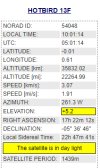

At this moment n2yo.com stopped tracking ute.13f

 www.n2yo.com
I guess they r re-locating the bird
www.n2yo.com
I guess they r re-locating the bird
Real time satellite tracking for: HOTBIRD 13F
Track satellite(s) HOTBIRD 13F and see where are they located now. Check when there will be the next pass over your location
www.n2yo.com
Last edited:
At this moment n2yo.com stopped tracking ute.13f
I guess they r re-locating the birdReal time satellite tracking for: HOTBIRD 13F
Track satellite(s) HOTBIRD 13F and see where are they located now. Check when there will be the next pass over your location
yes
real time tracking stopped , no data for this satellite on any tracking website for real time tracking
NORAD ID 54048
Must be close to final orbital slo
Let's see
May be some work going on due to which tracking is lost by all websites