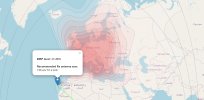
Eutelsat Hot Bird 13G

Well nobody knows for sure yet but most likely it will be the same coverage.


coverage maps are only tentative and even different TP,s has different coverage

e.g. on new 13g satellite couple of TP,s have very strong coverage in middle east including TP which ha adult content and rest other TP,s are ver weak in middle east

so it all depend on Eutelsat and broadcaster
 
Once again, Hot Birds are made for cover Europe and marginally outside Europe ! Living in the borders of the footprints needs to use bigger dishes, more than 200/240 cm.
 
A quick check on my Vu+ Duo2 receiver of the transmissions that have moved to HB13G would seem to suggest where I am (County Tyrone, Northern Ireland) that the SNR of the respective transmissions have dropped approx 1db on 13G compared to what they were on 13C.

If that shows to be consistently the case & is the same when HB13F comes into service, then given the transmission parameters that most Hot Bird transponders broadcast with - requiring reasonably high SNRs - then that's a significant fall in the rain fade margin to the point that a Sky (UK) Zone 2 satellite dish probably isn't large enough now to give an acceptable rain fade margin locally except maybe on most of the DVB-S transponders. Essentially that makes Hot Bird reception here needing an 80cm dish at a minimum for reception in all but the typically heaviest of local rainfalls.

I might need to tweak my Zone 2 dish I have for "temporary"** reception of 13 East, but I don't think it's been knocked out of alignment that would cause a 1db fall on its own.


** I say temporary, it's been up now over 18 months! I really need to get the Wavefrontier T90 I have sitting in a spare bedroom out & installed to finish off the dish farm in my back garden & take the two Zone 2 temporary dishes down!
 
13C is still at 13 east
Wrong info Hotbird 13C is still moving east :)


EUTE HOT BIRD 13C (HB 9)


NORAD ID:33459
LOCAL TIME:10:13:02
UTC:09:13:02
LATITUDE:-0.03
LONGITUDE:9.46
ALTITUDE [km]:35788.63
ALTITUDE [mi]:22238.02
SPEED [km/s]:3.07
SPEED [mi/s]:1.91
AZIMUTH:167.8 S
ELEVATION:+30.4
RIGHT ASCENSION:03h 07m 33s
DECLINATION:-08° 31' 30''
Local Sidereal Time:02h 26m 25s
The satellite is in day light​
SATELLITE PERIOD:1439m
​
pixel.gif
 
A quick check on my Vu+ Duo2 receiver of the transmissions that have moved to HB13G would seem to suggest where I am (County Tyrone, Northern Ireland) that the SNR of the respective transmissions have dropped approx 1db on 13G compared to what they were on 13C.

If that shows to be consistently the case & is the same when HB13F comes into service, then given the transmission parameters that most Hot Bird transponders broadcast with - requiring reasonably high SNRs - then that's a significant fall in the rain fade margin to the point that a Sky (UK) Zone 2 satellite dish probably isn't large enough now to give an acceptable rain fade margin locally except maybe on most of the DVB-S transponders. Essentially that makes Hot Bird reception here needing an 80cm dish at a minimum for reception in all but the typically heaviest of local rainfalls.

I might need to tweak my Zone 2 dish I have for "temporary"** reception of 13 East, but I don't think it's been knocked out of alignment that would cause a 1db fall on its own.


** I say temporary, it's been up now over 18 months! I really need to get the Wavefrontier T90 I have sitting in a spare bedroom out & installed to finish off the dish farm in my back garden & take the two Zone 2 temporary dishes down!
At my place in the southern parts of Sweden almost all signals from 13G are stonger than those from 13C. Some transponders are much stronger and some a little bit. No one is weaker. However I have noticed the strength varies over the day.
11766 V is around 88-89 % (on the VU+ Duo 4K SE) in the morning but in the evening it's 95-96 %. Same thing every day. These variations goes for some other transpoders too. If it's caused by the LNB, the cable or the satellite I don't know. (On the VU+ Duo2 it's 97 % in the morning and 99 % in the evening).

Really strong transponders are 10873 V, 10992 V, 11034 V, 11137 H, 11373 H, 11585 V, 11662 V, 12111 V, 12558 V which all are 99 % 24/7 on the 4K SE. A bit weak (87-90 %) are 11013 H, 11747 H and 12692 H. Might be better with an adjustment of the skew.

However I will make no adjustments of the dish (110 cm Triax) until 13F too is operational and both 13G and 13F has "setteled in" at their new home at 13 degrees E.
 
coverage maps are only tentative and even different TP,s has different coverage

e.g. on new 13g satellite couple of TP,s have very strong coverage in middle east including TP which ha adult content

so it all depend on Eutelsat and broadcaster
The Middle East has still got the most important stuff in that case :-rofl2
 
I see the Satbeams website has published a footprint for HB13G - looking at it, it would appear that compared to the old HB13C it replaced, it's "core" footprint is skewered a bit more to the north-east to provider a little stronger coverage towards Poland and the southern Baltic sea area at the expense towards the north-west - the EIRP level at my location for HB13G is given as 50dbW compared to 51dbW for HB13C, which would tally with a 1db reduction in SNR I've been experiencing. Looking at the 52/51/50/48 dbW contours they don't extend as far north & west across the UK & Ireland as the old HB13C used to. This does make some commercial sense on Eutelsat's behalf though - reinforce reception across Poland as the position is a Polish "hotspot" at the equivalent expense in an area where there are very few channels aimed at a DTH British or Irish audience.

A quick look elsewhere on the Satbeams HB13G footprint suggests power reductions for reception of HB13G compared to HB13C in the Azores, Canary Isles, Iceland, Istanbul, Moscow with a slight reduction in power levels covering most of the Arab peninsula, Iran & Pakistan (except for around Yemen & Oman).
If there is only one beam, why are people saying some transponders are stronger while others are weaker than before? It sounds to me like are different beams used.
 
Well true, the Hotbird 13G beam is becoming official, very similar (or the same) to the map they put up a few days ago. Apparently for the western islands (Tenerife, La Palma, La Gomera and El Hierro) a 1.30m dish is needed. I don't understand anything. Eutelsat very bad job done.

Screenshot 2023-06-11 at 19-14-20 SatBeams - Satellite Coverage Maps - Sat Footprint Intelsat ...png
 
If there is only one beam, why are people saying some transponders are stronger while others are weaker than before? It sounds to me like are different beams used.
There are always some difference between transponders. This goes for all satellites. When you are in the centre of the coverage zone you won"t notice this. At the fringes you most definitely will.
 
Well true, the Hotbird 13G beam is becoming official, very similar (or the same) to the map they put up a few days ago. Apparently for the western islands (Tenerife, La Palma, La Gomera and El Hierro) a 1.30m dish is needed. I don't understand anything. Eutelsat very bad job done.

View attachment 150345
As I understand it the beam has shifted a bit to the northeast to give a better coverage of Poland. That is probably because Eutelsat has customers as Canal+ Polska, TVN and Polsat Box there.
I don't think there are any Eutelsat customers (by that I mean companies aimed at this region) in Spain/the Canary Islands. They use Astra and Hispasat instead.
 
I can watch RAI Storia clearly. There seems to be an option of English subtitles.. "Questa pagina 778" : like subtitles available at this page on teletext. No luck with that. Do you know some trick ?

I heard better before this RAI radio.
But on the other hand VOA 1 is still in good reception.
 
I can watch RAI Storia clearly. There seems to be an option of English subtitles.. "Questa pagina 778" : like subtitles available at this page on teletext. No luck with that. Do you know some trick ?

I heard better before this RAI radio.
But on the other hand VOA 1 is still in good reception.
My guess is not many programs on RAI Storia are subtitled in English. The same goes for RAI 1-3. Many programs are subtitled (sottotitolati) in Italian but just a few in English. Good thing is many programs are broadcast with original sound (mostly English but French and German too). However when broadcast with original sound transmissions are encrypted.

If you can get RAI Storia you should be able to get the radios too. Otherwise you can get them over the Internet
 
the arte tv 5 europe will be replace to eutelsat 13f
they already are on Hotbird tv5 europe is in SD
Arte ,French version has multilingual versions.

and on astra1 Arte is in HD,but only German and French available
TV5-Europe AND tv5 FBS both HD also on Astra 1

TV5 Europe has been in SD on hotbird for 6 months more or less.
 
Back
Top