18ft C-band dish vs 6–8ft Ku dish for weak Ku-band satellites?

SEOShamsher

Member
My Satellite Setup
Past setup:
• 8-ft dish covering 68.5°E, 75.0°E (Ku), 78.5°E, 83.5°E, 90.0°E, 93.5°E (Ku), 100°E, 105.5°E, 115.0°E
• 6-ft dish at 49.0°E
• Receivers: COSHIP CDVB2000B, Dish TV Zinga

Current status:
Sold all equipment — want to start again from scratch.
My Location
Ludhiana, Punjab, India
Hi everyone,


Quick question for the experts here.


For very weak / out-of-footprint Ku-band satellites, which setup actually performs better in real-world conditions?


  • 6 ft or 8 ft fiber Ku-band dish
    vs
  • 18 ft C-band dish using a Ku LNBF

In terms of:


  • Raw signal strength (SNR)
  • Ability to lock borderline Ku transponders
  • Stability on weak feeds

Will the 18 ft C-band dish outperform the smaller dedicated 6 ft or 8 ft fiber Ku-band dishes?
Or will it be equal, or even worse due to focal point and efficiency differences?


Looking for real experiences.
 
Hi everyone,


Quick question for the experts here.


For very weak / out-of-footprint Ku-band satellites, which setup actually performs better in real-world conditions?


  • 6 ft or 8 ft fiber Ku-band dish
    vs
  • 18 ft C-band dish using a Ku LNBF

In terms of:


  • Raw signal strength (SNR)
  • Ability to lock borderline Ku transponders
  • Stability on weak feeds

Will the 18 ft C-band dish outperform the smaller dedicated 6 ft or 8 ft fiber Ku-band dishes?
Or will it be equal, or even worse due to focal point and efficiency differences?


Looking for real experiences.
Try it and come back with the results.
 
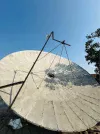
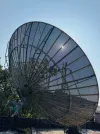
Someone is offering me an 18 ft C-band dish at a very good price


I’m trying to decide whether I should buy it or not, especially for Ku-band satellite reception.


The reason I’m considering this is that old 8, 9, 12, 14, or 16 ft fiberglass dishes are very rare to find now.
Try it and come back with the results.
 
Impossible to say for sure, too many factors. Can be worse ... but if the right person get his hand on the C-bander, it can be excellent.
Precondition is the shape & the surface of the 18-footer is not compromised, the mesh holes are not bigger than 1/2 inch, the focal distance is set 100% accurately and the right feedhorn & LNB are used.
I've tried Ku on my 10-foot (310 cm) Micromesh Orbitron dish and reached more gain compared to my 7.75-foot (240 cm) solid Prodelin.
 
Have a look, I'll set the focal point, yes will use the right focal point and feedhorn definitely. Been doing dish tracking from 2002 to 2015
 

Attachments

  • 469832019_1624982058088706_1361823690199678651_n.webp
    469832019_1624982058088706_1361823690199678651_n.webp
    105.8 KB · Views: 46
  • 469551413_1648222205728504_7748433787129563100_n.webp
    469551413_1648222205728504_7748433787129563100_n.webp
    105.5 KB · Views: 48
Someone is offering me an 18 ft C-band dish at a very good price


I’m trying to decide whether I should buy it or not, especially for Ku-band satellite reception.


The reason I’m considering this is that old 8, 9, 12, 14, or 16 ft fiberglass dishes are very rare to find now.
If it is a good price then why not ? you can always sell on later.

As before

Try it and come back with the results.
 
Impossible to say for sure, too many factors. Can be worse ... but if the right person get his hand on the C-bander, it can be excellent.
Precondition is the shape & the surface of the 18-footer is not compromised, the mesh holes are not bigger than 1/2 inch, the focal distance is set 100% accurately and the right feedhorn & LNB are used.
I've tried Ku on my 10-foot (310 cm) Micromesh Orbitron dish and reached more gain compared to my 7.75-foot (240 cm) solid Prodelin.
Mesh can be upgraded to a later type for not a lot of money.
 
...the mesh holes are not bigger than 1/2 inch,
Ups, please forgive me, I am not "an imperial" guy ... should be not bigger than 1.2 mm, no idea how much that in inches would be.
 
Impossible to say for sure, too many factors. Can be worse ... but if the right person get his hand on the C-bander, it can be excellent.
Precondition is the shape & the surface of the 18-footer is not compromised, the mesh holes are not bigger than 1/2 inch, the focal distance is set 100% accurately and the right feedhorn & LNB are used.
I've tried Ku on my 10-foot (310 cm) Micromesh Orbitron dish and reached more gain compared to my 7.75-foot (240 cm) solid Prodelin.
7.75-foot (240 cm) solid Prodelin. is it fiber ku band dish?
 
All Prodelin dishes are SMC compound, so yes. Solid and fibre with Ku band receive capability.
I guess then I should proceed and buy an 18-foot C-band dish.

Another question I've is whether a large dish is better for multi multi-satellite setup. I used to cover 68 degrees E to 105 degrees E satellites on an 8ft C-band mesh dish 10 years ago. That's 37 Degree Span. All C-band satellites.

But now ChatGPT and Gemini are saying that a large dish, 12 or 18ft, makes a multi-LNBf setup to cover multiple satellites difficult. However I'm I can now cover a larger span compared to an 8 ft Dish.


Here's what it exactly says
Big Dish Multi-LNB: Space vs. Physics
  • The Win: Bigger dishes (12–18ft) give you a massive focal plane. You’ve got tons of physical room to mount LNBs side-by-side without them touching. Plus, the high gain means even an "off-center" signal is often stronger than a centered signal on a small dish.
  • The Trap: As dishes get bigger, their beamwidth gets narrower. They become "laser-focused." A tiny move off-center on an 18ft dish causes a brutal signal drop (coma aberration) compared to a "sloppy" 8ft dish.
  • The Arc Limit: Even on an 18ft beast, physics usually kills the signal after about 15–20° off-center.
  • The Verdict for 1°E–105°E:
    That’s a 104° span. No single parabolic dish can handle this range. You may receive satellites near the middle, but the edge satellites (1°E and 105°E) will be effectively blind because the angles are too steep for the dish to properly reflect the signals into the LNB.

    A practical solution is to divide the arc into two parts and use two separate dishes:

    • 18-ft dish covering 1°E to 52°E, with 13°E as the center satellite
    • 8-ft dish covering 68°E to 105°E with 76 °E as center satellite
 
You should try motorising it, since Ku band will be receivable across a larger arc.
 
You should try motorising it, since Ku band will be receivable across a larger arc.
That's long term plan, but for the moment, I want to set up multiple LNBf.

So increasing dish size is not equal to a larger span of satellites i can cover?
 
Much easier done on an offset antenna or even better on a Simulsat.
Prime focus with multifeed is just an improvisation...
 
So increasing dish size is not equal to a larger span of satellites i can cover?

Increasing dish size of a paraboloid dish has two relevant effects, AFAIK:
1. more signal, also for the off-axis mounted LNBs.
2. bigger 'focal clouds' for the off-axis mounted LNBs, so more difficult for LNB-antennas to pick up the signal.

I am not sure if, or where, the second effect overrules the first effect. I would be optimistic, and try, if I were you!


BTW Don't believe AI answers for such satellite reception questions.
I've asked about focal length calculation of offset dishes using depth at the center as input, about multifeed skew calculation, about calculating pulse counts for the whole arc in actuator setups using a few pulse counts as inputs, and most of the answers were really wrong and/or at least very incomplete. Part was "hallucination", part was bad source material, I guess. :(:(
Though it was fun to have a dialog with AI, and confronting it :rolleyes: with obvious facts such as John Legon not being the first to have a formula for calculating focal length of offset antennas (using depth at the deepest point), as some French people were much earlier...


Greetz,
A33
 
That's long term plan, but for the moment, I want to set up multiple LNBf.

So increasing dish size is not equal to a larger span of satellites i can cover?
In simple terms the increase in size means more signal, but in one direction only.


Best plan for motorising now.
 
Never knew this beast exists.
Much easier done on an offset antenna or even better on a Simulsat.
Prime focus with multifeed is just an improvisation...
 
Good stuff here. I have a 12' dish with an orthomode transducer and twin Norsat c band lnb's. That said.
Setting the feed throat to aim at the exact center of the dish as well as getting the throat equidistant from the dish rim is super important.
Being offset in either instance has you focused at a non-optimum point in the paraboloid.
Compensating by aiming the dish to get the best signal has not resulted in the best signal possible when carefully setup.
I have a buttonhook feed mount. So moving the feed assembly is easy and allows adjustments to be made.
That said. Getting the best, strongest signal does take a bit of time and a lot of patience.

Another thing is a dish exposed to weather sags over time. Just when you think you have the strongest signal and the dish is aimed the best.
Grabbing the dish rim and lifting (usually) suddenly gives a few. Possibly more. Signal.
Crossed strings that intersect very closely. In my case 4 strings were used to make a pie shape. Looked very good. Not bad for a single fiberglass dish from the 80's.
End the end I added 3 (soon 4) perimeter guy wires that are mounted at the rim and to the scalar. So that after all of the initial positioning settings are made and I get the best signal. I have 3 stainless steel porch railing mini turnbuckles to further max signal. And it's worked very well.

I don't believe that stacking lnbf's side by side to cover multiple satellites on a fixed position dish is the best idea. The compromise is you really will suffer in signal strength. Because you will never "illuminate" the entire parabola. I mean. It can work. Just that weaker satellites will stay weak.
If at all possible resist instant gratification temptation and just get a polar mount and dish mover, actuator.

As far as ku band goes. I currently have a Geosatpro ku lnbf "sidecarred" next to my c band feed. And it works well. Although I don't really use ku band that much.
The ku feed is for an offset dish. Removing the cover shows the conical scalar that you see on most any of them.
A ku lnbf like the Invacom line with flat scalar for a prime focus dish makes sense.
As the Geosatpro lnbf is designed for a ~1.2m dish. That's just about the illumination of my 12' dish that it covers.
I tried milling off the first rib of its scalar with minimal, if any, signal increase.
And I verified its illumination by using metal strips on the dish surface until signal decreased. I ended up with right at a meter or so.
As the buttonhook feed mounting plate obscures the center of my dish. An offset angle was needed to grab a signal. Did that by first hand holding it and moving it and the dish E & W until I reached a happy medium. And the offset angle versus the same c band satellite is around 5 degrees.
So. It can work. Just not optimal. I can get signal lock and good picture as low as 4 dB versus 11.5 dB for c band.

Ask if you need to know any more findings.
 
That’s really helpful, thanks. I’ve been trying to get a deeper understanding of this and your explanation cleared it up. Sounds like the key is using a Ku LNB/feed designed for prime-focus dishes with a wider scalar and proper feedhorn, otherwise most of the big dish just isn’t being used.
 
Back
Top