- My Satellite Setup
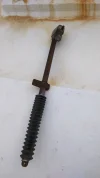
- Some SAT-related hardware.
- My Location
- N-E from Riga


Supposedly, my dish has been correctly aligned.
I did think about that too, but it is possible that polar-mount is turned little bit east, then LNB skew may be proper. But, yes, it is better to double check.I can see no indication of skewing of the Inverto LNB.

From your pictures, I can see no indication of skewing of the Inverto LNB.
I understand the following from your posts above:
- the dish is aimed at 28.2E
- you are located in Athens, Greece
- You did the swap of LNBs from Invacom to Inverto yourself
In Athens, you need about 2 degrees skew to the left (as seen when standing in front of the dish as in the second picture).
It makes the LNB look as if it was rotated slightly counterclockwise.
This does not sound like a lot, but just a single degree can make a noticable difference.
And it *is* visible when looking at the LNB/dish head-on.
When you installed the Inverto, did you just make the LNB vertical, or did you use a meter to maximise C/N ratio of the signal while adjusting skew?
I may be wrong, but it looks as if you could (sub-)optimise the reception by adjusting skew properly.
Note: This is very difficult to do unless you are right next to the LNB, and have either a sat-meter, or a PC with a Satcard or sat-usb-box + necessary software, so that you can fiddle with skew until you get maximum C/N ratio.
Edit:
And you also need to adjust the azimuth and elevation to match several channels (ie. both 28.5E and 28.2E).
When you have as big a dish as you do, then the beam width of the reflector means that you need to adjust you aim carefully to get the channels you want. Ideally, you need to aim either at 28.5E for SD, or 28.2E for HD, or a compromise 28.35E to get a useful balance...
this can all be done without modifying anything.
But it takes time, and patience, but *is* required for getting reception right...
I used simple Universal LNB, something like IBU, it has integrated feedhorn. I was playing with this dish last summer and then put it away in the garage. So, it is not installed ATM.
How can you be so sure about that?
And, of course, this professional installer did not check antenna's geometry. He did not check LNB's position and aiming. What he did- he got maximum possible signal by adjusting LNB's scew and it's position closer/further to the dish, antenna's azimuth and elevation. But if he was doing red highlighted, final result could be better.
Now, now, gentlemen.
Before we start modifying OPs dish, there's one thing that I noticed:
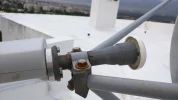
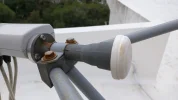
From your pictures, I can see no indication of skewing of the Inverto LNB.
I understand the following from your posts above:
- the dish is aimed at 28.2E
- you are located in Athens, Greece
- You did the swap of LNBs from Invacom to Inverto yourself
In Athens, you need about 2 degrees skew to the left (as seen when standing in front of the dish as in the second picture).
It makes the LNB look as if it was rotated slightly counterclockwise.
This does not sound like a lot, but just a single degree can make a noticable difference.
And it *is* visible when looking at the LNB/dish head-on.
When you installed the Inverto, did you just make the LNB vertical, or did you use a meter to maximise C/N ratio of the signal while adjusting skew?
I may be wrong, but it looks as if you could (sub-)optimise the reception by adjusting skew properly.
Note: This is very difficult to do unless you are right next to the LNB, and have either a sat-meter, or a PC with a Satcard or sat-usb-box + necessary software, so that you can fiddle with skew until you get maximum C/N ratio.
Edit:
And you also need to adjust the azimuth and elevation to match several channels (ie. both 28.5E and 28.2E).
When you have as big a dish as you do, then the beam width of the reflector means that you need to adjust you aim carefully to get the channels you want. Ideally, you need to aim either at 28.5E for SD, or 28.2E for HD, or a compromise 28.35E to get a useful balance...
this can all be done without modifying anything.
But it takes time, and patience, but *is* required for getting reception right...
Re dish condition: It's just dirt. Reflector is plastic and does not rust or corrode.
You can wash the reflector with water and soap and a sponge, if you are not happy about the visual appearence.
The reflector will not operate better or worse for a little bit of dirt.
You can paint it any colour you like with car paint, but it will have no effect on reflectivity.
The active reflective material is a metal mesh embedded in the plastic, you can't see it.
The only area that looks like it could do with attention is the mount.
But that requires taking the dish apart and sand-blasting/galvanising.
Major operation, and no reception while you do it

View attachment 92071 View attachment 92072
He did adjust dish geometry but with the current feedhorn I don't think LNBs position closer/further from the dish can be done...the feedhorn has a guide that does not allow that. He used his meter to obtain max signal.
Edit: I have attached photos showing the guide of the feedhorn.
That looks like the correct feed and clamp arrangement. Is there a lip in the feed that changes diameter between it and the lnb? The feed may be optimised for a lower part of the band than the desired English ones.
I'm not sure if there's a lip in the feed.
"The feed may be optimised for a lower part of the band than the desired English ones"
That's exactly why the installer insists I have to change the feed. He says back when this dish was sold the frequencies did not go that high, so we need a new feed.
For that he suggests a 50 degree 0800-1290.
Thank you Channel Hopper
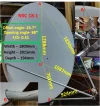
Ask me!So I am wondering whether you could help me in order to find the focal point in mm?
I have such a dish and know all the data about it. Will post info later today.Ask me!