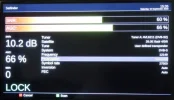
1 dbw is equivalent to how many signal percentage?

you could try and work something out from capture below but it wont get you anywhere, (there is no answer to your question) as mentioned in post 2 different receivers will give different reading on same setup, try tweaking or bigger dish is needed
IMG_2547.webp
 
Code:
https://en.wikipedia.org/wiki/Decibel_watt

Sorry that this has become too complicated but that someone who told you about the dBW has his dB's crossed.

dBW levels can not be directly converted to a "S" reading or "Q" reading percentage on a receiver, not without some complicated maths.

Using dBW as a starting point you have nothing to start with at the receiver, as most receivers have what is called an RSSI voltage output, (Received Signal Strength Indication) this is DC voltage that is used to provide the "S" measurement.

And most receiver sensitivity is measured in dBuV

So your friends measurement of 9 dBW would convert to +39 dBm, (146 dBuV) your measurement of 8.5 dBW (145 dBuV) would convert to +38.5 dBm, a difference of .5 dB, or 114 dBuV.

However at the signal strength of 9 dBW the receivers input would melt, so something has been crossed to the wrong starting point.

The dBW indications in the satellite footprints are based on the transmitted RF power of that transponder and the antenna gain at the satellite, once this is known you can calculate the received signal strength at the receiver if you know the gain of your dish,(in dB ) the gain of the LNB,(in dB )the dB loss of the coax and anything else inline to the receiver and finally the gain of the receivers satellite tuner. (in dB )

Once all this is known and calculated to a final product (in dB ) you can convert it to the DC voltage (XX dBuV equals YY DC voltage for the ZZ RSSI) that the receiver uses to give you XYZ percentage on the "S" meter for that receiver at that signal level.

Once this is known you can say that a drop in X dBW will give you a Y% drop on the "S" meter.

All this is calculated inside the receiver by software and all receivers are different in the tuners sensitivity.
 
Code:
https://en.wikipedia.org/wiki/Decibel_watt

Sorry that this has become too complicated but that someone who told you about the dBW has his dB's crossed.

dBW levels can not be directly converted to a "S" reading or "Q" reading percentage on a receiver, not without some complicated maths.

Using dBW as a starting point you have nothing to start with at the receiver, as most receivers have what is called an RSSI voltage output, (Received Signal Strength Indication) this is DC voltage that is used to provide the "S" measurement.

And most receiver sensitivity is measured in dBuV

So your friends measurement of 9 dBW would convert to +39 dBm, (146 dBuV) your measurement of 8.5 dBW (145 dBuV) would convert to +38.5 dBm, a difference of .5 dB, or 114 dBuV.

However at the signal strength of 9 dBW the receivers input would melt, so something has been crossed to the wrong starting point.

The dBW indications in the satellite footprints are based on the transmitted RF power of that transponder and the antenna gain at the satellite, once this is known you can calculate the received signal strength at the receiver if you know the gain of your dish,(in d:cool: the gain of the LNB,(in d:cool: the dB loss of the coax and anything else inline to the receiver and finally the gain of the receivers satellite tuner. (in d:cool:

Once all this is known and calculated to a final product (in d:cool: you can convert it to the DC voltage (XX dBuV equals YY DC voltage for the ZZ RSSI) that the receiver uses to give you XYZ percentage on the "S" meter for that receiver at that signal level.

Once this is known you can say that a drop in X dBW will give you a Y% drop on the "S" meter.

All this is calculated inside the receiver by software and all receivers are different in the tuners sensitivity.
Hi Terryl, can you edit the post by adding spaces to remove the blue smilies?
 
For ever 3 inches of increased or decreased antenna diameter you can add or subtract about 3 dB.
That is just plain wrong. To add 3dB you have to increase the dish size by the square root of 2, i.e. 1.4x. For example, 100cm dish, gain = 40.2 dB. Multiply 100cm by 1.4 gives 140 cm dish. Gain of a 140 cm dish is 43.1 dB, i.e. 3dB more than the 100 cm dish, if you ignore the rounding errors.


Examples. Gain at 11700:
60cm dish = 35.8 dB
70cm dish = 37.1 dB
80cm dish = 38.3 dB
90cm dish = 39.3 dB
100cm dish = 40.2 dB
110cm dish = 41.0 dB
120cm dish = 41.8 dB
130cm dish = 42.5 dB
140cm dish = 43.1 dB
150cm dish = 43.7 dB
 
I said ABOUT, and I work in inches not CM.
 
Ay, we Brits prefer inches to metric stuff, too.

But you chaps over there really must get your Gallons rationalised!
 
I said ABOUT, and I work in inches not CM.
3 inches is 7.5cm. So 3 inches doesn't even get you 1 dB of extra gain.

The Americans are a confused bunch. About the only nation still using inches, and even then they can't make their minds up.

Anyway what do you prefer as your weapon of choice? A .45 or a 9mm?
 
Last edited:
I'm devastating with a 9mm, regional champ 3 years running in the action course, (quite a few years ago) a .45 is too bulky.
 
OK BOYS! Holster the guns and discuss the differences politely over a beer , be it Spanish , English or American.

You both have lots to offer the forum , from what I have observed and it would be a major loss if either " threw the toys from the pram , and left "

My own personal opinion and in no way a reflection of that of the forum owner or staff.

P.S. I like the twin shot derringer made by Remington , virtually invisible in the pocket , but with the second shot if required!
 
OK BOYS! Holster the guns and discuss the differences politely over a beer
My point was they don't mind metric when measuring the the bore of their gun barrels.
 
My point was they don't mind metric when measuring the the bore of their gun barrels.
Fair enough. Must admit I don´t know too much about guns , but I loved my air rifles when I was younger.
Best I had were the BSA´s ( British Small Arms ) which all measured their bore in inches. .177 , .22 and .25 . Never heard them referred to as 4.5mm , 5.5 mm and 6.35 mm respectively , although now apparently they do !
 
Back
Top