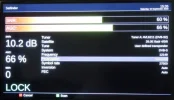
Code:
https://en.wikipedia.org/wiki/Decibel_watt
Sorry that this has become too complicated but that someone who told you about the dBW has his dB's crossed.
dBW levels can not be directly converted to a "S" reading or "Q" reading percentage on a receiver, not without some complicated maths.
Using dBW as a starting point you have nothing to start with at the receiver, as most receivers have what is called an RSSI voltage output, (
Received
Signal
Strength
Indication) this is DC voltage that is used to provide the "S" measurement.
And most receiver sensitivity is measured in dBuV
So your friends measurement of 9 dBW would convert to +39 dBm, (146 dBuV) your measurement of 8.5 dBW (145 dBuV) would convert to +38.5 dBm, a difference of .5 dB, or 114 dBuV.
However at the signal strength of 9 dBW the receivers input would melt, so something has been crossed to the wrong starting point.
The dBW indications in the satellite footprints are based on the transmitted RF power of that transponder and the antenna gain at the satellite, once this is known you can calculate the received signal strength at the receiver if you know the gain of your dish,(in d

the gain of the LNB,(in d
the dB loss of the coax and anything else inline to the receiver and finally the gain of the receivers satellite tuner. (in d
Once all this is known and calculated to a final product (in d
you can convert it to the DC voltage (XX dBuV equals YY DC voltage for the ZZ RSSI) that the receiver uses to give you XYZ percentage on the "S" meter for that receiver at that signal level.
Once this is known you can say that a drop in X dBW will give you a Y% drop on the "S" meter.
All this is calculated inside the receiver by software and all receivers are different in the tuners sensitivity.