Traditional vs Modified Elevation/Declination Angles

Tivù said:
Actually, 0.5 referred to the Motor bracket only, in continuation of the previous Posts.

I mentioned 0.05, not 0.5, as a realistic error for a Pole (given that most hobbyists use only a basic spirit level). Certainly half a degree error in the pole would make tracking difficult.

Sorry I misread your post.
 
dovercat said:
Sorry I misread your post.

No problem at all - This is turning into quite an interesting discussion so thankyou for starting it :)

A fairly eclectic selection of approaches to installation - and they all work (kind of!) .
 
Tivù said:
it can also be a bit of a sod to keep it there whilst tightening up the clamps?
That's a "feature" of intermediate sized dishes; big enough to be unruly but not big enough to warrant a self supporting adjustment mechanism.
 
I like it: "Unruly" :D

Excellent description.

And if you are familiar with the Triax TD110 (and, I guess, other mid-sized Triaxes), the Elevation slider itself is unruly to a high degree. But that's yet another practical problem, sadly.
 
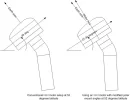
So going back to the point Dovercat was traying to make. If you read the stickies and DiSEqc motor guides, they all tell you set the motor angle parallel to the Earths axis to take the declination offset off your dish.

But what is being suggested is that the declination offset angles for a polar mount dish setup can be used for H-H motor dish set up. And the motors axis is tilted slightly south of the polar axis, and there would be less declination offset on the dish.
I've seen the description on the Geo-orbit website, but I don't see why they should only apply to Modified Polar mounts.
 

Attachments

  • HHaxissetting.webp
    HHaxissetting.webp
    27.5 KB · Views: 142
futumsch said:
So going back to the point Dovercat was traying to make. If you read the stickies and DiSEqc motor guides, they all tell you set the motor angle parallel to the Earths axis to take the declination offset off your dish.

But what is being suggested is that the declination offset angles for a polar mount dish setup can be used for H-H motor dish set up. And the motors axis is tilted slightly south of the polar axis, and there would be less declination offset on the dish.
I've seen the description on the Geo-orbit website, but I don't see why they should only apply to Modified Polar mounts.

That is where an analyser taken up the ladder comes in handy. I only use the elevation marks as a rough guide, set the dish to 'look' right on the end of the motor, and then do a number of fine adjustments of all three (inc the North/South ) until the tracking is as good as I can get it. The written instructions are always a guide only, but do serve a useful purpose for those installing for the first time.
 
futumsch said:
I've seen the description on the Geo-orbit website, but I don't see why they should only apply to Modified Polar mounts.
Dude, I don't see what you are getting at here. There's no difference between a diseqc motor, a 1224, or an actuator setup; they are all polar mounts. A polar mount just means only one actuator/motor is used to follow the arc as opposed to using one actuator for azimuth and one for elevation.
 
Dude, I don't see what you are getting at here.
Dude!? how did you know my middle name was Lebowski?

Anyway, cheers Heuvos, I can see that they are all polar mounts, its when web sites like __http://www.geo-orbit.org/sizepgs/decchartp.html show one set of declination offset angles for traditional polar mounts, and another set of declination offset angles for Modified Polar Mounts, made me think that there was something special about Modified polar mount dec offset angles didn't apply to the traditional mount.
There was something Channel Hooper said earlier
In modern systems the dish design is what gives the modified angle,
that also made me think this was true.
Maybe I'm overcomplicating things for myself, but I DO appreciate your knowledge on this subject. Thats worth recognition.
 
Originally posted by Channel Hopper
The written instructions are always a guide only, but do serve a useful purpose for those installing for the first time.
Yeah cheers CH, they certainly helped me set up my dish, but i can see this thread could be a bit confusing for first timers. Or even people like me making 1 and 1 equal 3. I like to know the theory behind what i am doing but i guess we're all learning a little bit every day.
 
futumsch said:
There was something Channel Hooper said earlier "In modern systems the dish design is what gives the modified angle," that also made me think this was true.
Forget the dish, it's got nothing to do with how a polar mount tracks the arc. Think of the dish as an arrow attached to the polar mount, all it does is point in one direction. It is completely static in relation to the polar mount.

The thing that is built in to the dish is the elevation adjustment... but that's just to point it in the first place... once it's bolted up though it's completely static.
 
Huevos said:
The thing that is built in to the dish is the elevation adjustment....

In a polarmount system that would be the declination adjustment......
:)
 
Channel Hopper said:
In a polarmount system that would be the declination adjustment......
:)
You're still missing the point. Declination is just how much the dish points downwards in relation to the polar axis. But that does not compensate for the southern most satellite requiring more declination due to its shorter range. The only way to compensate for this is to tilt the motor axis forward in relation to the earth's axis. If you don't do this you will be out at either end of the arc by nearly 0.75º at mid latitudes.
 
WoW ...
Some discussion you guys are having ..
There's certainly nothing us mere mortals can add to the mix..
I do know that setting up without monitoring equipment ...and just using the various scales etched on dish elevation and motor brackets is a not going to get you anywhere.
I'm definately of the old school persuasion ..
Make sure your pole is plumb..
Use the guides ..scales ...and a compass to get a close approximation of how the installation should be set up ..
Once South has been ascertained accurately ...use a meter to tweak and re-tweak elevation and declination until beacon sats at or close to the arcs apex and extreme East and West.
Nothing beats using live signals from actual sats for setting up imo.
As has been mentioned already ..the bigger the dish ...the more accuracy is needed.
..and of course a good mental image of what you are trying to acheive is vital....
I admire you all for your in depth persuit of the inaccuracies of these mechanical systems ...but you could just scare a potential newbie thinking of putting up a motorised system ...half to death before they've even unpacked the dish...
rgds 2 all

;)
 
Huevos said:
You're still missing the point. Declination is just how much the dish points downwards in relation to the polar axis. But that does not compensate for the southern most satellite requiring more declination due to its shorter range.


Actually, the correct reason for the compensation is down to something you explained earlier, that of the observer being on the surface of the earth, rather than at the core. The 'shorter range' of the satellite nearest to 'south' bears no relation geometrically to the procedure necessary to fully track the Clarke arc.
 
Vipersan said:
Nothing beats using live signals from actual sats for setting up imo.

Knowing which ones are geostationary is useful though. ;)
 
Channel Hopper said:
Knowing which ones are geostationary is useful though. ;)


Point taken CH..
rgds
 
Channel Hopper said:
Actually, the correct reason for the compensation is down to something you explained earlier, that of the observer being on the surface of the earth, rather than at the core. The 'shorter range' of the satellite nearest to 'south' bears no relation geometrically to the procedure necessary to fully track the Clarke arc.
They are just two sides of the same coin, the shorter range means you have to look downwards more and it is caused because the planet's surface is offset in the orbit... But that is not point of the original post. The question was "Why does the Moteck sg2100 instruction manual use the traditional polar mount setup angles, latitude = eleveation?". The answer I think is to keep things simple. Diseqc motors are for small dishes that have wide beamwidth and that are too small to receive much from the ends of the arc. So rather than including a complex equation to get the right elevation angle they just use simple arithmetic that any six-year-old could understand and ignore the tracking error that simple arithmetic causes.
 
Huevos said:
They are just two sides of the same coin, the shorter range means you have to look downwards more and it is caused because the planet's surface is offset in the orbit...

Now that is plainly incorrect. The downwards appearance is simply down to the observer not being at the equator, if they were, the motor elevation would be set to 90 degrees (minus whatever angle to compensate for the offset dish) and the declination would be set to zero.
 
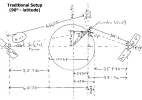
Dovercat, I've made a diagram of a traditionally set up polar mount (situated in London) so you (and anyone else) can easily see what we are talking about. The satellite on the right of the drawing is the due south satellite and the satellite on the left is the due north satellite (which obviously is below the horizon). All the figures are in degrees or kilometres (so anyone who is interested can check/correct them). If you look at the southern satellite you will see that the angle between the orbital plane and pointing up towards London is 7.37º. This is the declination angle for that latitude. In a traditional setup the motor is set at 0º (i.e. motor axis is parallel to the Earth's polar axis) and the declination is dealt with at the dish, so the declination between the dish and the motor axis is set at 7.37º. Ok, so now we have perfect alignment on the southern satellite.

Now lets look at the northern satellite. The dish is still fixed to the motor shaft (motor axis) with 7.37º declination as this is a static fastening. If we send the motor round 180º it will point due north but still be pointing downwards with 7.37º declination. Oh dear, now we have a problem because according to the figures we require 6.11º declination for that satellite. How is this corrected? Simple, tilt the motor axis forward towards the south by 0.63º (0.63º less motor elevation) and set the declination between the dish and motor to 6.74º.

Now lets look at how that works:
Southern satellite, 6.74º + 0.63º = 7.37º. Perfect alignment.
Northern satellite, 6.74º - 0.63º = 6.11º. Also perfect alignment.

Ok, so with the "modified" setup we have perfect tracking right across the arc, but is there any problem with this system? Well yes there is, the maths is a lot more complicated than "90º - latitude"...
 

Attachments

  • polar_mount_setup_x.webp
    polar_mount_setup_x.webp
    42.6 KB · Views: 146
Of course modified angles are the correct way even for small dishes, even sites like Satlex.de uses standard angles and most other sites until you grab a real satellite tv handbook where the correct angles are for modified mount or use Arrows sitemaster programs _http://www.arrowe.com/ which shows correct values for your site.
 
Back
Top